Results by title
151 books match the query 'Liberalism' and 7 start with i
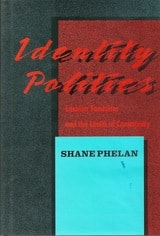
Identity Politics
Lesbian Feminism and the Limits of CommunityShane Phelan
Temple University Press, 1991
"Lesbian feminism began and has fueled itself with the rejection of liberalism.... In this rejection, lesbian feminists were not alone. They were joined by the New Left, by many blacks in the civil rights movement, by male academic theorists.... What all these groups shared was an intense awareness of the ways in which liberalism fails to account for the social reality of the world, through a reliance upon law and legal structure to define membership, through individualism, through its basis in a particular conception of rationality."
In tracing how lesbian feminism came to be defined in uneasy relationships with the Women’s Movement and gay rights groups, Shane Phelan explores the tension between liberal ideals of individual rights and tolerance and communitarian ideals of solidarity. The debate over lesbian sado-masochism—an expression of individual choice or pornographic, anti-feminist behavior?—is considered as a test case.
Phelan addresses the problems faced by "the woman-identified woman" in a liberal society that presumes heterosexuality as the biological, psychological, and moral standard. Often silenced by laws defining their sexual behavior as criminal and censured by a medical establishment that persists in defining homosexuality as perversion, lesbians, like blacks and other groups, have fought to have the same rights as others in their communities and even in their own homes. Lesbian feminists have also sought to define themselves as a community that would be distinctly different, a community that would disavow the traditional American obsession with individual advancement in the world as it is.
In this controversial study of political philosophy and the women’s movement, Phelan argues that "the failure to date to produce a satisfying theory and program for lesbian action is reflective of the failure of modern political thinking to produce a compelling, nonsuspect alternative to liberalism."
In the series Women in the Political Economy, edited by Ronnie J. Steinberg.

Ideologies in the Age of Extremes
Liberalism, Conservatism, Communism, Fascism 1914-1991Willie Thompson
Pluto Press, 2010
This is a history of political ideologies during the period famously described by Eric Hobsbawn as ‘The Age of Extremes’ - from the First World War to the collapse of the Soviet Union.
Ideologies in the Age of Extremes introduces the key ideologies of the age; liberalism, conservatism, communism and fascism. Willie Thompson identifies the political influence of mass movements as a key feature. He uses a powerful approach that considers the different ideologies in relation to each other. This allows him to shows that they often emerged from a common root or merged into a common future, stealing each other’s clothes and reinventing themselves as the stark opposite of a competing ideology.
This sophisticated yet accessible analysis will be of great interest to students of 20th century history and political theory.
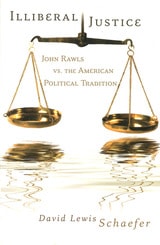
Illiberal Justice
John Rawls vs. the American Political TraditionDavid Lewis Schaefer
University of Missouri Press, 2007
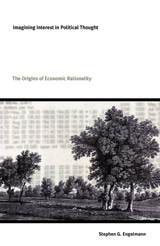
Imagining Interest in Political Thought
Origins of Economic RationalityStephen G. Engelmann
Duke University Press, 2003
Tracing the development of monistic interest from its origins in Reformation political theory and theology through late-twentieth-century neoliberalism, Engelmann reconceptualizes the history of liberalism as consisting of phases in the history of monistic interest or economic government. He describes how monistic interest, as formulated by Bentham, is made up of the individual’s imagined expectations, which are constructed by the very regime that maximizes them. He asserts that this construction of interests is not the work of a self-serving manipulative state. Rather, the state, which is itself subject to strict economic regulation, is only one cluster of myriad "public" and "private" agencies that produce and coordinate expectations. In place of a liberal vision in which government appears only as a protector of the free pursuit of interest, Engelmann posits that the free pursuit of interest is itself a mode of government, one that deploys individual imagination and choice as its agents.
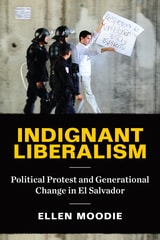
Indignant Liberalism
Political Protest and Generational Change in El SalvadorEllen Moodie
University of Texas Press, 2026
Documenting the rise and disillusionment of El Salvador’s postwar activists in the face of populist authoritarian politics.
The conclusion of El Salvador’s long civil war, in 1992, was supposed to bring about equality and political freedom. Leftist insurgents laid down arms, and the government formally embraced liberal ideals. Yet today, El Salvador is ruled by an authoritarian president who was reelected via unconstitutional means. What went wrong?
Anthropologist and journalist Ellen Moodie embedded with indignados—young middle-class protestors, demanding that the government live up to its liberal commitments—to better understand the course of political change since the civil war. Yet the “post-postwar” generation is only the latest demographic disappointed with liberalism in practice. Moodie examines a nineteenth-century “racial liberalism” that saw descendants of colonists “civilizing” Indigenous people while dispossessing them of lands and mobilizing them for labor. Today, the failure to make good on the promises of postwar liberalism has inspired robust support for strongman Nayib Bukele. Moodie argues that El Salvador’s case, though inflected by local concerns, is not unique. Rather, it is another stark demonstration of how liberalism’s imaginary social contract gives rise to populist authoritarianism.
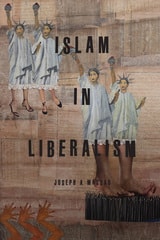
Islam in Liberalism
Joseph A. Massad
University of Chicago Press, 2014
Joseph Massad’s Islam in Liberalism explores what Islam has become in today’s world, with full attention to the multiplication of its meanings and interpretations. He seeks to understand how anxieties about tyranny, intolerance, misogyny, and homophobia, seen in the politics of the Middle East, are projected onto Islam itself. Massad shows that through this projection Europe emerges as democratic and tolerant, feminist, and pro-LGBT rights—or, in short, Islam-free. Massad documents the Christian and liberal idea that we should missionize democracy, women’s rights, sexual rights, tolerance, equality, and even therapies to cure Muslims of their un-European, un-Christian, and illiberal ways. Along the way he sheds light on a variety of controversial topics, including the meanings of democracy—and the ideological assumption that Islam is not compatible with it while Christianity is—women in Islam, sexuality and sexual freedom, and the idea of Abrahamic religions valorizing an interfaith agenda. Islam in Liberalism is an unflinching critique of Western assumptions and of the liberalism that Europe and Euro-America blindly present as a type of salvation to an assumingly unenlightened Islam.
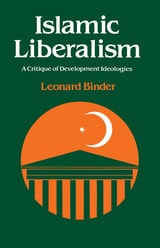
Islamic Liberalism
A Critique of Development IdeologiesLeonard Binder
University of Chicago Press, 1988
The Islamic political community presents special problems to the development of an indigenous liberalism. That community is conceived of as divinely ordained, and its notions of the good are to be derived from scriptural revelation, not arrived at through rational discourse. Liberal politics would seem to stand little chance of surviving in such an atmosphere, let alone thriving.
Binder responds to the challenge of Edward Said's critique of Orientalism, of a range of neo-Marxian development theorists, of Sayyid Qutb's fundamentalist vision, of Samir Amin's vision of Egypt's role in the Arab awakening, of Tariq al-Bishri's new populism, of Zaki Najib Mahmud's pragmatism, and the structuralism of Arkoun and Laroui. The deconstruction of these varied texts produces a number of persuasive hermeneutical conclusions that are sequentially woven together in a critical argument that refocuses our attention on the central question of political freedom and democracy. In the course of constructing this argument, Binder reopens the dialogue between Western modernity and Islamic authenticity and reveals the surprising extent to which there is a convergent interest in liberal, democratic, civil society. Finally, in a concluding chapter, he addresses the prospects for liberalism in the three major bourgeois states of Islam—Egypt, Turkey, and Iran.