Results by title
716 books match the query 'Literary Figures' and 24 start with i

I Contain Multitudes
A New Life of Walt WhitmanEric G. Wilson
University of Chicago Press, 2027
Lively and entertaining, this is the first comprehensive biography of Walt Whitman in more than twenty-five years, drawing on significant new discoveries and scholarship.
Walt Whitman is not only one of the most influential and popular poets in American history but also a symbol of American character and independence, as important to our nation’s identity as Abraham Lincoln, Harriet Beecher Stowe, or Louis Armstrong. While his poetry and exuberant style still inspire writers today, our understanding of his life is due for an update. It has been over a quarter of a century since the last full-length biography of Whitman, and in that time several works by Whitman have been rediscovered—including a novel and a men’s health manual—that put Whitman in a new light. In I Contain Multitudes, Eric G. Wilson draws on these discoveries to give us a fresh life of Whitman, one that reveals him to be more playful, flexible, and pragmatic than we had known.
Whitman emerges here as an artist adept in almost every literary genre. Across these varied writings, he fashioned a comedic vision based on the multifariousness of the cosmos. In his life as well, he created a wide range of personae. Like an experienced actor, Whitman had many roles and selves at the ready: the urban dandy, the Broadway bohemian, the humble Civil War nurse. Wilson’s portrait casts well-studied Whitman traits in a new light: his radical egalitarianism, he shows, was suffused with humor—to be a good citizen meant not taking yourself too seriously—and his famous powers of empathy resulted in darkly funny challenges to oppressive hierarchies.
Wilson tells Whitman’s life in dozens of brief, vivid segments, an innovative approach that reflects Whitman’s own existential and literary brio. Presenting the multitudinous Whitman with both stylistic gusto and scholarly rigor, I Contain Multitudes reads as much like a novel as the authoritative biography it is.
Iain M. Banks
Paul Kincaid
University of Illinois Press, 2017

Illegal
Reflections of an Undocumented ImmigrantJose Angel N.
University of Illinois Press, 2014
Arriving in the 1990s with a ninth grade education, N. traveled to Chicago where he found access to ESL and GED classes. He eventually attended college and graduate school and became a professional translator.
Despite having a well-paying job, N. was isolated by a lack of legal documentation. Travel concerns made promotions impossible. The simple act of purchasing his girlfriend a beer at a Cubs baseball game caused embarrassment and shame when N. couldn't produce a valid ID. A frustrating contradiction, N. lived in a luxury high-rise condo but couldn't fully live the American dream. He did, however, find solace in the one gift America gave him–-his education. Ultimately, N.'s is the story of the triumph of education over adversity. In Illegal, he debunks the stereotype that undocumented immigrants are freeloaders without access to education or opportunity for advancement. With bravery and honesty, N. details the constraints, deceptions, and humiliations that characterize alien life "amid the shadows."
Illumination And Night Glare
The Unfinished Autobiography Of Carson MccullersCarson Mccullers
University of Wisconsin Press, 2001
Looking back over her life from a precocious childhood in Georgia to her painful decline from a series of crippling strokes, McCullers offers poignant and unabashed remembrances of her early writing success, her family attachments, a troubled marriage to a failed writer, and friendships with literary and film luminaries (Gypsy Rose Lee, Richard Wright, Isak Dinesen, John Huston, Marilyn Monroe), and the intense relationships of the important women in her life.

In Byron's Footsteps
Tessa de Loo
Haus Publishing, 2010
In Fielding’s Wake
Jeremy Black
St. Augustine's Press, 2022
Fielding's epic comic novel, Tom Jones, is unforgettable for many reasons, but the author must be credited with an aptitude for documenting contemporary cultural history and his contribution to a new species of writing. Black's treatment of Fielding draws to the fore a man who was of his time but not confined to it. "Philosophy in practice encompassed his stance as a man of action as well as a reflective writer of genius." Fielding is shown to provide across the breadth of his work extensive and invaluable commentary on issues as diverse as law and order, marriage, women, and the interplay of urban and rural life. Black, an historian, is here a student of storytelling and recovers Fielding's rich descriptions of the human heart and call to defy the vices with which circumstances might taunt it.
Black has done a service along many fronts at once: the science of the novel and genre, the history of a people and the figure of a memorable writer.
In a Closet Hidden
The Life and Work of Mary E. Wilkins FreemanLeah Blatt Glasser
University of Massachusetts Press, 1996
The first literary biography of a much-neglected American writer, this book explores the multiple tensions at the core of Mary E. Wilkins Freeman's life and work. A prolific short story writer and novelist, Freeman (1852–1930) developed a reputation as a local colorist who depicted the peculiarities of her native New England. Yet as Leah Blatt Glasser shows, Freeman was one of the first American authors to write extensively about the relationships women form outside of marriage and motherhood, the role of work in women's lives, the complexity of women's sexuality, and the interior lives of women who rebel rather than conform to patriarchal strictures.
In a Closet Hidden traces Freeman's evolution as a writer, showing how her own inner conflicts repeatedly found expression in her art. As Glasser demonstrates, Freeman's work examined the competing claims of creativity and convention, self-fulfillment and self-sacrifice, spinsterhood and marriage, lesbianism and heterosexuality.
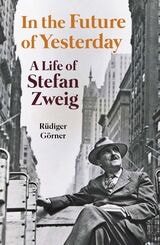
In the Future of Yesterday
A Life of Stefan ZweigRüdiger Görner
Haus Publishing, 2025
In the Future of Yesterday delves into Stefan Zweig’s considerable contribution to world literature, rooted in the Austro-Jewish tradition. His privileged social background saw him embrace European culture and cosmopolitanism. A world traveler from the outset, he liked to uproot himself, but whether he stayed in London, New York, or, eventually, in Brazil, his literary baggage continued to contain the flair of fin de siècle Vienna.
This biography re-examines Zweig’s influential time in England and offers new insights into his final years in the United States and Brazil. It discusses some of his prolific literary output in relation to his life and explores his political views on Europe, Zionism, and the world order in greater depth than previous appraisals of Zweig’s life.
The book also considers the many contradictions in Zweig’s views and attitudes, which included an initial, and surprising, leniency towards fascism. Most importantly, though, In the Future of Yesterday presents Zweig as a towering figure of a form of writing that was bursting with life and that was written in the knowledge that there can only be a future if we remain conscious of the past. In that sense, Zweig is a writer for our time.
In the Mirror
New and Selected Poems of Wong Phui NamWong Phui Nam
National University of Singapore Press, 2025
The poetry of Wong Phui Nam is foundational to Malaysian literature in English. While his early work is often cited in this regard, this edited collection of his poetry and critical essays makes it clear that his lifelong trajectory as a poet and critic is of deep interest. In the Mirror by Wong Phui Nam is a critical exploration of Malaysia's fractured post-colonial identity and literary landscapes.
Like many of his English-speaking peers at the University of Malaya, by the 1960s, Wong became disillusioned with the stark contradictions of writing in a colonial language while striving to build or maintain a national literary tradition. In 1969, when Malaysia's national cultural policy firmly emphasized the primacy of the Bahasa Malaysian language over English, Wong proclaimed, "I no longer wanted to write, at least not in a language I was told was a colonial leftover."
Over the years, however, he returned to poetry in English, often publishing privately. He came to believe that English was the language “most capable of representing our predicament,” given the spiritual and cultural vacuums left by colonialism's great ruptures in the region, and the ongoing neocolonial structure of the state and economy. His work challenges the reader to confront the realities of cultural displacement and the complexities of a multi-ethnic society grappling with its past and future.
This collection includes both recent works as well as some of his earlier achievements, starting with How the Hills are Distant, and also includes a foreword linking Wong's work with contemporary literary work in the region. An afterword by Wong's contemporary, Singaporean literary pioneer Edwin Thumboo, completes the volume.
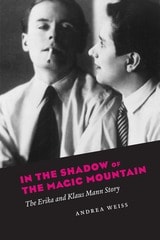
In the Shadow of the Magic Mountain
The Erika and Klaus Mann StoryAndrea Weiss
University of Chicago Press, 2008
Thomas Mann’s two eldest children, Erika and Klaus, were unconventional, rebellious, and fiercely devoted to each other. Empowered by their close bond, they espoused vehemently anti-Nazi views in a Europe swept up in fascism and were openly, even defiantly, gay in an age of secrecy and repression. Although their father’s fame has unfairly overshadowed their legacy, Erika and Klaus were serious authors, performance artists before the medium existed, and political visionaries whose searing essays and lectures are still relevant today. And, as Andrea Weiss reveals in this dual biography, their story offers a fascinating view of the literary and intellectual life, political turmoil, and shifting sexual mores of their times.
In the Shadow of the Magic Mountain begins with an account of the make-believe world the Manns created together as children—an early sign of their talents as well as the intensity of their relationship. Weiss documents the lifelong artistic collaboration that followed, showing how, as the Nazis took power, Erika and Klaus infused their work with a shared sense of political commitment. Their views earned them exile, and after escaping Germany they eventually moved to the United States, where both served as members of the U.S. armed forces. Abroad, they enjoyed a wide circle of famous friends, including Andre Gide, Christopher Isherwood, Jean Cocteau, and W. H. Auden, whom Erika married in 1935. But the demands of life in exile, Klaus’s heroin addiction, and Erika’s new allegiance to their father strained their mutual devotion, and in 1949 Klaus committed suicide.
Beautiful never-before-seen photographs illustrate Weiss’s riveting tale of two brave nonconformists whose dramatic lives open up new perspectives on the history of the twentieth century.

In the Sierra Madre
Jeff Biggers
University of Illinois Press, 2006
A stunning history of legendary treasure seekers and enigmatic natives in Mexico's Copper Canyon
Based on his one-year sojourn in Copper Canyon among the Raramuri/Tarahumara, award-winning journalist Jeff Biggers offers a rare look into the ways of the most resilient indigenous culture in the Americas, the exploits of Mexican mountaineers, and the fascinating parade of argonauts and accidental travelers who have journeyed into the Sierra Madre over centuries. From African explorers, Bohemian friars, Confederate and Irish war deserters, French poets, Boer and Russian commandos, Apache and Mennonite communities, bewildered archaeologists, addled writers, and legendary characters including Antonin Artaud, Henry Flipper, B. Traven, Sergei Eisenstein, George Patton, Geronimo, and Pancho Villa, Biggers uncovers the remarkable treasures of the Sierra Madre.
In the Solitude of My Soul
The Diary of Genevieve Breton, 1867-1871James Smith Allen
Southern Illinois University Press, 1994
Originally published to glowing reviews and literary prizes in France in 1985, this revealing diary not only recounts the moving and tragic relationship of its author, Geneviève Bréton, with the rising young nineteenth-century artist Henri Regnault, it also serves as a valuable historical document concerning the social, cultural, and political life of the French Second Empire.
The young Geneviève Bréton began her journal in 1867 as a consolation for the death of her eldest brother, Antoine. She met Regnault soon after on a trip to Rome. Throughout the next four years of their relationship, Bréton eloquently describes the personal, cultural, and political turbulence that affected her life. Writing against the backdrop of France’s fateful conflict with Prussia and the hardships and dangers of the siege of Paris and the Commune, Bréton, with innate candor and lyricism, creates a text that beautifully illuminates French art, literature, family life, society, and politics of the time. Her poignant account of her love for and engagement to Regnault reveals special insight into the life and mind of an extraordinary, though little known, literary talent. At Regnault’s death in 1871 during the Franco–Prussian War, the expression of her anguish is as much testimony to the political and cultural disorder of the time as it is to her own personal tragedy.
Following Bréton’s own instructions that she left before her death in 1918, this English version of the diary reincorporates material that was deleted from the French edition. Graced by rare photographs of the Bréton family as well as Regnault’s paintings, the book contains a touching foreword by the author’s granddaughter, Daphné Doublet-Vaudoyer. In its first English translation, it is a book for lovers of French life and culture, as well as students of French history; literature, and art.
Indian Summer
Musings on the Gift of LifeSam Pickering
University of Missouri Press, 2005
Returning to Nova Scotia every summer contributes to the illusion of smooth continuance, each summer not the first thread in a new fabric but another button on a cardigan, perhaps looser than buttons below but still familiar and comfortable. Every summer the songs of white-throated sparrows bounce from scrub like novelty tunes from the fifties. Early in the morning ravens grind woodenly. . . . No matter how slowly I jog, on the headland butterflies spring from my feet in clumps, first azures and orange crescents, then wood nymphs, and finally over the lowlands near the Beaver River outlet cabbage whites spiraling, dizzy with mating.
Indian Summer is the newest collection of personal essays by Sam Pickering. In typical Pickering fashion, he seeks to capture the gift of living. He brings to the page again his family, students, and a wealth of country characters who live in places that exist only in his imagination and who wander through the stories he tells.
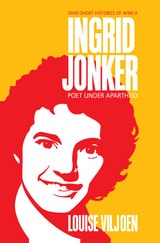
Ingrid Jonker
Poet under ApartheidLouise Viljoen
Ohio University Press, 2012
Nelson Mandela brought the poetry of Ingrid Jonker to the attention of South Africa and the wider world when he read her poem “Die kind” (The Child) at the opening of South Africa’s first democratic parliament on May 24, 1994. Though Jonker was already a significant figure in South African literary circles, Mandela’s reference contributed to a revival of interest in Jonker and her work that continues to this day.
Viljoen’s biography illuminates the brief and dramatic life of Jonker, who created a literary oeuvre—as searing in its intensity as it is brief—before taking her own life at the age of thirty-one. Jonker wrote against a background of escalating apartheid laws, violent repression of black political activists, and the banning of the African National Congress and the Pan Africanist Congress. Viljoen tells the story of Ingrid Jonker in the political and cultural context of her time, provides sensitive insights into her poetry, and considers the reasons for the enduring fascination with her life and death.
Her writings, her association with bohemian literary circles, and her identification with the oppressed brought her into conflict with her father, a politician in the white ruling party, and with other authority figures from her Afrikaner background. Her life and work demonstrate the difficulty and importance of artistic endeavor in a place of terrible conflict.
Intimate Strangers
The Letters of Margaret Laurence and Gabrielle RoyMargaret Laurence
University of Manitoba Press, 2004
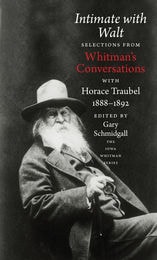
Intimate With Walt
Whitmans Conversataions With Horace TraubelGary Schmidgall
University of Iowa Press, 2001
In Intimate with Walt Gary Schmidgall has condensed Traubel's nearly 5,000 pages into one manageable volume featuring the many self-revealing, humorous, nostalgic, and often curmudgeonly words of the Good Gray Poet. The book is divided into five sections, each consisting of several chapters: the first, presenting Walt on himself, his family, and his daily life and visitors at the only home he ever owned; the second, on his artistic credos, the literary life, and a large array of comments on the writing, publication of, and critical reaction to Leaves of Grass; the third, focusing on his friends, admirers, idols, and lovers; the fourth and longest, presenting his no-holds-barred views on a variety of topics, including the American scene, race, religion, music, and even alcohol; and finally, a gathering of passages revealing Whitman's struggles with his infirmities, his poignant final days, and Traubel's observations on Whitman's deathbed scene and burial rites.

Irving Wallace
A Writer's ProfileJohn Leverence
University of Wisconsin Press, 1974
This profile of the man and the writer is an introduction to the personality behind The Chapman Report and The Fan Club. Through correspondence, diaries, manuscript annotations, interviews and other private sources, the profile reveals the man who began as a sports stringer for a Wisconsin newspaper and is now one of the world's most popular novelists.
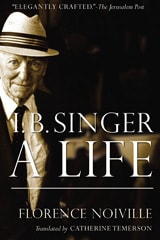
Isaac B. Singer
A LifeFlorence Noiville
Northwestern University Press, 2008
In this vivid biography, Florence Noiville offers a glimpse into the world of this much-loved but persistently elusive writer: Isaac Bashevis Singer. Singer (1904–91) is generally recognized as the most popular Yiddish writer of the twentieth century. His widely translated body of work, for which he received the Nobel Prize in Literature in 1978, is beloved around the world. But although Singer was a very public and outgoing figure, much about his personal life remains unknown.
Singer was greatly influenced by his early years in Poland, with his rabbi father and rationalist, secular mother. His interest in themes of faith and dilemma stem directly from this set of conflicts; he bounced back and forth between revering and fighting orthodoxy. This was not the only paradox in his life, however: this man, who wrote many successful children’s books, had abandoned his first wife and only son in Poland as the Nazis began to sweep across Europe. His novels and stories are recognized for their mystical, folkloric tone and his public image was that of a grandfather or uncle; but he was wracked with self-doubt, a womanizer, and, as Noiville writes, a “modern virtuoso of anguish, inhibition, and fiasco.”
Noiville speaks to these and other paradoxes surrounding her subject, drawing on letters, personal stories, Singer’s own autobiographies, and interviews with friends, family, and publishing contemporaries. She travels as he did, from Poland to New York to Florida, tracing his journey from penniless immigrant to Nobel laureate. By pursuing Singer’s public and private past, she rebuilds his story and the story of the world he wrote from: a Yiddish world, a Poland removed from history by Nazi Germany.

Isaac Bashevis Singer - American Writers 86
University of Minnesota Pamphlets on American WritersBen Siegel
University of Minnesota Press, 1969
Isaac Bashevis Singer - American Writers 86 was first published in 1969. Minnesota Archive Editions uses digital technology to make long-unavailable books once again accessible, and are published unaltered from the original University of Minnesota Press editions.

Isaac Bashevis Singer
A LifeJanet Hadda
University of Wisconsin Press, 2003
Isaac Bashevis Singer brought the vibrant milieu of pre-Holocaust Polish Jewry to the English-speaking world through his subtle psychological insight, deep sympathy for the eccentricities of Jewish folk custom, and unerring feel for the heroism of everyday life. His novels, including The Family Moskat and Enemies: A Love Story, and his short stories, such as "Yentl" and "Gimpel the Fool," prove him a consummate storyteller and probably the greatest Yiddish writer of the twentieth century.

Isak Dinesen
The Life And Imagination Of A SeducerOlga Anastasia Pelensky
Ohio University Press, 1991
Born into a Victorian Danish family, Karen Christentze Dinesen married her second cousin, a high-spirited and philandering baron, and moved to Kenya where she ran a coffee plantation, painted, and wrote. She later returned to Denmark, lived through the German occupation during World War II, and became a pivotal figure in Heretica, a major literary movement that flourished in Denmark after the war. By the time of her death, Dinesen was an international figure. Truman Capote would later call Out of Africa one of the most beautiful books of the century.
Despite the popularity of her writing, little is known about her life. For this provocative biography, Pelensky has uncovered hundreds of papers in libraries and private collections, and discovered new interview sources in Africa, Denmark, and England to help put the pieces of Dinesen’s life together. Her father’s outspoken sympathy for the plight of the American Indians, his suicide and the effects of his personal anguish as a failed adventurer are illuminated as major forces on Dinesen’s imagination. The Danish history of romance and masquerade and the tradition of pantomime in Denmark are also explored as themes that recur in Dinesen’s work.
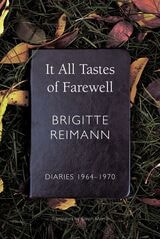
It All Tastes of Farewell
Diaries, 1964–1970Brigitte Reimann
Seagull Books, 2016
It All Tastes of Farewell is a frank account of one woman’s life and loves in 1960s East Germany. As a writer, Brigitte Reimann could not help but tell a compelling story, and that is born out here in her diaries, which are gripping as any novel. She recorded only what mattered: telling details, emotional truths, and political realities. Never written for publication and first published in full in German only after the fall of the Berlin Wall, these diaries offer a unique record of what it felt like to live in a country that no longer exists, was represented for years largely through Cold War propaganda, and is still portrayed in fairy-tale Stasi dramas. Here we get a sense of lived experience as if Doris Lessing or Edna O’Brien had been allowed in with their notebooks. This volume continues where her earlier book of diaries, I Have No Regrets, left off, in 1964. It sees Reimann grow wistful and at times bitter, as her love life, her professional life, and her health all suffer. Yet throughout she retains a lively appetite for new experiences and a dedication to writing. Finally, she finds security in a surprising new love, and although she died soon after this volume ends, the novel she was writing was to become a much-read cult hit after her death.
A remarkable document from a time and place that we still struggle to see clearly, It All Tastes of Farewell is unforgettable, a last gift from an essential writer.
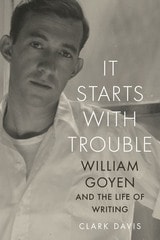
It Starts with Trouble
William Goyen and the Life of WritingBy Clark Davis
University of Texas Press, 2015
William Goyen was a writer of startling originality and deep artistic commitment whose work attracted an international audience and the praise of such luminaries as Northrop Frye, Truman Capote, Gaston Bachelard, and Joyce Carol Oates. His subject was the land and language of his native East Texas; his desire, to preserve the narrative music through which he came to know his world. Goyen sought to transform the cherished details of his lost boyhood landscape into lasting, mythic forms. Cut off from his native soil and considering himself an “orphan,” Goyen brought modernist alienation and experimentation to Texas materials. The result was a body of work both sophisticated and handmade—and a voice at once inimitable and unmistakable.
It Starts with Trouble is the first complete account of Goyen’s life and work. It uncovers the sources of his personal and artistic development, from his early years in Trinity, Texas, through his adolescence and college experience in Houston; his Navy service during World War II; and the subsequent growth of his writing career, which saw the publication of five novels, including The House of Breath, nonfiction works such as A Book of Jesus, several short story collections and plays, and a book of poetry. It explores Goyen’s relationships with such legendary figures as Frieda Lawrence, Katherine Anne Porter, Stephen Spender, Anaïs Nin, and Carson McCullers. No other twentieth-century writer attempted so intimate a connection with his readers, and no other writer of his era worked so passionately to recover the spiritual in an age of disabling irony. Goyen’s life and work are a testament to the redemptive power of storytelling and the absolute necessity of narrative art.
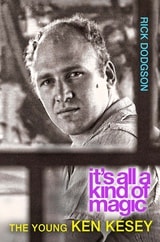
It’s All a Kind of Magic
The Young Ken KeseyRick Dodgson
University of Wisconsin Press, 2013
“Rick Dodgson has pored over Kesey’s published and unpublished writings, interviews, and historical records to write a colorful biography of this charismatic American character. The resulting portrayal challenges assumptions about Kesey’s place in the counterculture.”—Journal of American History
“Dodgson’s painstaking research unearths hidden gems of Kesey’s life that marked him as a fascinating figure.”—H-Net