Results by title
328 books match the query 'Literature and society' and 11 start with i

Imagining the Penitentiary
Fiction and the Architecture of Mind in Eighteenth-Century EnglandJohn Bender
University of Chicago Press, 1987

In Common Cause
The “Conservative” Frances Trollope and the “Radical” Frances WrightSusan S. Kissel
University of Wisconsin Press, 1993
In Search of the Paper Tiger
A Sociological Perspective of Myth, Formula, and the Mystery Genre in the Entertainment Print Mass MediumGary Hoppenstand
University of Wisconsin Press, 1987

In the Company of Radical Women Writers
Rosemary Hennessy
University of Minnesota Press, 2023
Recovering the bold voices and audacious lives of women who confronted capitalist society’s failures and injustices in the 1930s—a decade unnervingly similar to our own
In the Company of Radical Women Writers rediscovers the political commitments and passionate advocacy of seven writers—Black, Jewish, and white—who as young women turned to communism around the Great Depression and, over decades of national crisis, spoke to issues of labor, land, and love in ways that provide urgent, thought-provoking guidance for today. Rosemary Hennessy spotlights the courageous lives of women who confronted similar challenges to those we still face: exhausting and unfair labor practices, unrelenting racial injustice, and environmental devastation.
As Hennessy brilliantly shows, the documentary journalism and creative and biographical writings of Marvel Cooke, Louise Thompson Patterson, Claudia Jones, Alice Childress, Josephine Herbst, Meridel Le Sueur, and Muriel Rukeyser recognized that life is sustained across a web of dependencies that we each have a duty to maintain. Their work brought into sharp focus the value and dignity of Black women’s domestic work, confronted the destructive myths of land exploitation and white supremacy, and explored ways of knowing attuned to a life-giving erotic energy that spans bodies and relations. In doing so, they also expanded the scope of American communism.
By tracing the attention these seven women pay to “life-making” as the relations supporting survival and wellbeing—from Harlem to the American South and Midwest—In the Company of Radical Women Writers reveals their groundbreaking reconceptions of the political and provides bracing inspiration in the ongoing fight for justice.
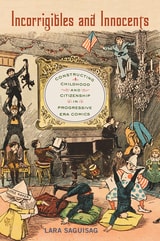
Incorrigibles and Innocents
Constructing Childhood and Citizenship in Progressive Era ComicsSaguisag, Lara
Rutgers University Press, 2019
Histories and criticism of comics note that comic strips published in the Progressive Era were dynamic spaces in which anxieties about race, ethnicity, class, and gender were expressed, perpetuated, and alleviated. The proliferation of comic strip children—white and nonwhite, middle-class and lower class, male and female—suggests that childhood was a subject that fascinated and preoccupied Americans at the turn of the century. Many of these strips, including R.F. Outcault’s Hogan’s Alley and Buster Brown, Rudolph Dirks’s The Katzenjammer Kids and Winsor McCay’s Little Nemo in Slumberland were headlined by child characters. Yet no major study has explored the significance of these verbal-visual representations of childhood. Incorrigibles and Innocents addresses this gap in scholarship, examining the ways childhood was depicted and theorized in late nineteenth- and early twentieth-century comic strips. Drawing from and building on histories and theories of childhood, comics, and Progressive Era conceptualizations of citizenship and nationhood, Lara Saguisag demonstrates that child characters in comic strips expressed and complicated contemporary notions of who had a right to claim membership in a modernizing, expanding nation.

Indian Nation
Native American Literature and Nineteenth-Century NationalismsCheryl Walker
Duke University Press, 1997
Walker examines the rhetoric and writings of nineteenth-century Native Americans, including William Apess, Black Hawk, George Copway, John Rollin Ridge, and Sarah Winnemucca. Demonstrating with unique detail how these authors worked to transform venerable myths and icons of American identity, Indian Nation chronicles Native American participation in the forming of an American nationalism in both published texts and speeches that were delivered throughout the United States. Pottawattomie Chief Simon Pokagon’s "The Red Man’s Rebuke," an important document of Indian oratory, is published here in its entirety for the first time since 1893.
By looking at this writing through the lens of the best theoretical work on nationality, postcoloniality, and the subaltern, Walker creates a new and encompassing picture of the relationship between Native Americans and whites. She shows that, contrary to previous studies, America in the nineteenth century was intercultural in significant ways.
Industry and the Creative Mind
The Eccentric Writer in American Literature and Entertainment, 1790-1860Sandra Tomc
University of Michigan Press, 2012
Industry and the Creative Mind takes a radically new look at the figure of the eccentric, alienated writer in American literature and entertainment from 1790 to 1860. Traditional scholarship takes for granted that the eccentric writer, modeled by such Romantic beings as Lord Byron and brought to life for American audiences by the gloomy person of Edgar Allan Poe, was a figure of rebellion against the excesses of modern commercial culture and industrial life. By contrast, Industry and the Creative Mind argues that in the United States myths of writerly moodiness, alienation, and irresponsibility predated the development of a commercial arts and entertainment industry and instead of forming a site of rebellion from this industry formed a bedrock for its development. Looking at the careers of a number of early American writers---Joseph Dennie, Nathaniel Parker Willis, Edgar Allan Poe, Fanny Fern, as well as a host of now forgotten souls who peopled the twilight worlds of hack fiction and industrial literature---this book traces the way in which early nineteenth-century American arts and entertainment systems incorporated writerly eccentricity in their "logical" economic workings, placing the mad, rebellious writer at the center of the industry's productivity and success.
Intimate Commerce
Exchange, Gender, and Subjectivity in Greek TragedyBy Victoria Wohl
University of Texas Press, 1997
Exchanges of women between men occur regularly in Greek tragedy—and almost always with catastrophic results. Instead of cementing bonds between men, such exchanges rend them. They allow women, who should be silent objects, to become monstrous subjects, while men often end up as lifeless corpses. But why do the tragedies always represent the transferal of women as disastrous?
Victoria Wohl offers an illuminating analysis of the exchange of women in Sophocles' Trachiniae, Aeschylus' Agamemnon, and Euripides' Alcestis. She shows how the attempts of women in these plays to become active subjects rather than passive objects of exchange inevitably fail. While these failures seem to validate male hegemony, the women's actions, however futile, blur the distinction between male subject and female object, calling into question the very nature of the tragic self. What the tragedies thus present, Wohl asserts, is not only an affirmation of Athens' reigning ideologies (including its gender hierarchy) but also the possibility of resistance to them and the imagination of alternatives.
Intimate Communities
Representation and Social Transformation in Women's College Fiction, 1895–1910Sherrie A. Inness
University of Wisconsin Press, 1995
While other scholars have argued that the Progressive Era was the “golden age” for women’s single-sex education, pointing to the many positive depictions of the women’s college student, Inness suggests that these representations actually helped to perpetuate the status quo and did little to advance women’s social rights.
Inventing High and Low
Literature, Mass Culture, and Uneven Modernity in SpainStephanie Sieburth
Duke University Press, 1994
Choosing two historical moments of sweeping material and cultural change in Spanish history, Sieburth reads two novels from the 1880s (by Benito Pérez Galdós) and two from the 1970s (by Juan Goytisolo and Carmen Martín Gaite) as fictional theories about the impact of modernity on culture and politics. Her analysis reveals that the high/low division in the cultural sphere reinforces other kinds of separations—between social classes or between men and women—dear to the elite but endangered by progress. This tension, she shows, is particularly evident in Spain, where modernization has been a contradictory and uneven process, rarely accompanied by political freedom, and where consumerism and mass culture coexist uneasily with older ways of life.
Weaving together a wide spectrum of diverse material, her work will be of interest to readers concerned with Spanish history and literature, literary theory, popular culture, and the relations between politics, economics, gender, and the novel.

Isherwood in Transit
James J. Berg
University of Minnesota Press, 2020
New perspectives on Christopher Isherwood as a searching and transnational writer
“Perhaps I had traveled too much, left my heart in too many places,” muses the narrator of Christopher Isherwood’s novel Prater Violet (1945), which he wrote in his adopted home of Los Angeles after years of dislocation and desperation. In Isherwood in Transit, James J.Berg and Chris Freeman bring together diverse Isherwood scholars to understand the challenges this writer faced as a consequence of his travel.
Based on a conference at the Huntington Library, where Isherwood’s recently opened papers are held, Isherwood in Transit considers the writer not as an English, continental, or American writer but as a transnational one, whose identity, politics, and beliefs were constantly transformed by global connections and engagements arising from journeys to Germany, Japan, China, and Argentina; his migration to the United States; and his conversion to Vedanta Hinduism in the 1940s.
Approaching Isherwood’s rootlessness and restlessness from various perspectives, these essays show that long after he made a new home in California and became an American citizen, Christopher Isherwood remained unsettled, although his wanderings became spiritual and personal rather than geographic.
Contributors: Barrie Jean Borich, DePaul U; Jamie Carr, Niagara U; Robert L. Caserio, Penn State U, University Park; Lisa Colletta, American U of Rome; Lois Cucullu, U of Minnesota; Jaime Harker, U of Mississippi; Carola M. Kaplan, California State U, Pomona; Calvin W. Keogh, Central European U, Budapest; Victor Marsh; Wendy Moffat, Dickinson College; Xenobe Purvis; Bidhan Roy, California State U, Los Angeles; Katharine Stevenson, U of Texas at Austin; Edmund White.