175 books match the query 'Marriage' and 8 start with i
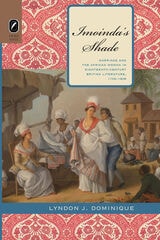
cover of Imoinda’s Shade: Marriage and the African Woman in Eighteenth-Century British Literature, 1759–1808

Imoinda’s Shade

Marriage and the African Woman in Eighteenth-Century British Literature, 1759–1808

Lyndon J. Dominique

The Ohio State University Press, 2012

As the eighteenth century is entirely bereft of narratives written by African women, one might assume that these women had little to no impact on British literature and the national psyche of the period. Yet these kinds of assumptions are belied by the influence of one prominent African woman featured in the period’s literary texts.
 
Imoinda’s Shade examines the ways in which British writers utilize the most popular African female figure in eighteenth-century fiction and drama to foreground the African woman’s concerns and interests as well as those of a British nation grappling with the problems of slavery and abolition. Imoinda, the fictional phenomenon initially conceived by Aphra Behn and subsequently popularized by Thomas Southerne, has an influence that extends well beyond the Oroonoko novella and drama that established her as a formidable presence during the late Restoration period. This influence is palpably discerned in the characterizations of African women drawn up in novels and dramas written by late-eighteenth-century British writers. Through its examinations of the textual instances from 1759–1808 when Imoinda and her involvement in the Oroonoko marriage plot are being transformed and embellished for politicized ends, Imoinda’s Shade demonstrates how this period’s fictional African women were deliberately constructed by progressive eighteenth-century writers to popularize issues of rape, gynecological rebellion, and miscegenation. Moreover, it shows how these specific African female concerns influence British antislavery, abolitionist, and post-slavery discourse in heretofore unheralded, unusual, and sometimes radical ways.
[more]
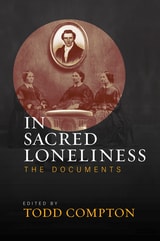
cover of In Sacred Loneliness: The Documents

In Sacred Loneliness

The Documents

Todd Compton

Signature Books, 2022

Plural marriage in the Nauvoo era of LDS Church history has long been a fascinating subject. To understand it fully requires one to look at it from the perspective of the man who introduced it, but just as crucial is a dive into the lives of the women he married, all who have their stories to tell. In his 1997 award-winning study, In Sacred Loneliness: The Plural Wives of Joseph Smith, Todd Compton focused on the thirty-three women who he could demonstrate that Smith married, providing life stories of many who were well-known and others who have been largely forgotten. In his new work, In Sacred Loneliness: The Documents, Compton returns to his subject and provides the raw materials that helped him create his original study, writings composed by the women themselves. 

This volume includes many autobiographical writings, diaries, and letters, with Compton providing annotations and introductory material that illuminates these crucial primary sources. This allows readers to take their understanding of this unique group of women to a new level and to drive home that fact that their lives go far beyond the Nauvoo experiment that forever links them to Mormonism’s founding prophet. 
[more]
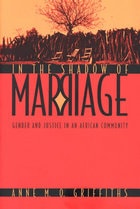
cover of In the Shadow of Marriage: Gender and Justice in an African Community

In the Shadow of Marriage

Gender and Justice in an African Community

Anne M. O. Griffiths

University of Chicago Press, 1997

Anne Griffiths originally went to Botswana to establish a university course in family law. But independent fieldwork in Botswana convinced her of the central role of the traditional customary legal system that stands alongside the colonial common law of courts and magistrates she was examining in her course. In the first comparative work on these two systems, Griffiths shows how the structure of both legal institutions is based on power and gender relations that heavily favor males.

Griffiths's analysis is based on careful observation of how people actually experience the law as well as the more standard tools of statutes and cases familiar to Western legal scholars. She explains how women's access to law is determined by social relations over which they have little control. In this powerful feminist critique of law and anthropology, Griffiths shows how law and custom are inseparable for Kwena women. Both colonial common law and customary law pose comparable and constant challenges to Kwena women's attempts to improve their positions in society.
[more]
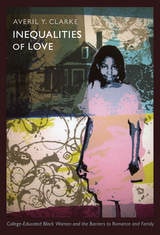
cover of Inequalities of Love: College-Educated Black Women and the Barriers to Romance and Family

Inequalities of Love

College-Educated Black Women and the Barriers to Romance and Family

Averil Y. Clarke

Duke University Press, 2011
Inequalities of Love uses the personal narratives of college-educated black women to describe the difficulties they face when trying to date, marry, and have children. While conventional wisdom suggests that all women, regardless of race, must sacrifice romance and family for advanced educations and professional careers, Averil Y. Clarke’s research reveals that educated black women’s disadvantages in romance and starting a family are consequences of a system of racial inequality and discrimination. The author analyzes the accounts of black women who repeatedly return to incompatible partners as they lose hope of finding “Mr. Right” and reject unwed parenting because it seems to affirm a negative stereotype of black women’s sexuality that is inconsistent with their personal and professional identities. She uses national survey data to compare college-educated black women’s experiences of romance, reproduction, and family to those of less-educated black women and those of white and Hispanic women with degrees. She reports that degreed black women’s lives include less marriage and sex, and more unwanted pregnancy, abortion, and unwed childbearing than college-educated white and Hispanic women. Black women’s romantic limitations matter because they constitute deprivation and constraint in romance and because they illuminate important links between race, class, and gender inequality in the United States. Clarke’s discussion of the inequities that black women experience in romance highlights the connections between individuals’ sexual and reproductive decisions, their performance of professional or elite class identities, and the avoidance of racial stigma.
[more]
cover of Intimate Connections: Love and Marriage in Pakistan’s High Mountains

Intimate Connections

Love and Marriage in Pakistan’s High Mountains

Anna-Maria Walter

Rutgers University Press, 2022

Intimate Connections dissects ideas, feelings, and practices around love, marriage, and respectability in the remote high mountains of Gilgit-Baltistan in northern Pakistan. It offers insightful perspectives from the emotional lives of Shia women and their active engagement with their husbands. These gender relations are shaped by countless factors, including embodied values of modesty and honor, vernacular fairy tales and Bollywood movies, Islamic revivalism and development initiatives. In particular, the advent of media and communication technologies has left a mark on (pre)marital relations in both South Asia and the wider Muslim world. Juxtaposing different understandings of ‘love’ reveals rich and manifold worlds of courtship, elopements, family dynamics, and more or less affectionate matches that are nowadays often initiated through SMS. Deep ethnographic accounts trace the relationships between young couples to show how Muslim women in a globalized world dynamically frame and negotiate circumstances in their lives.
[more]
cover of Intimate Disconnections: Divorce and the Romance of Independence in Contemporary Japan

Intimate Disconnections

Divorce and the Romance of Independence in Contemporary Japan

Allison Alexy

University of Chicago Press, 2020

In many ways, divorce is a quintessentially personal decision—the choice to leave a marriage that causes harm or feels unfulfilling to the two people involved. But anyone who has gone through a divorce knows the additional public dimensions of breaking up, from intense shame and societal criticism to friends’ and relatives’ unsolicited advice. In Intimate Disconnections, Allison Alexy tells the fascinating story of the changing norms surrounding divorce in Japan in the early 2000s, when sudden demographic and social changes made it a newly visible and viable option. Not only will one of three Japanese marriages today end in divorce, but divorces are suddenly much more likely to be initiated by women who cite new standards for intimacy as their motivation. As people across Japan now consider divorcing their spouses, or work to avoid separation, they face complicated questions about the risks and possibilities marriage brings: How can couples be intimate without becoming suffocatingly close? How should they build loving relationships when older models are no longer feasible? What do you do, both legally and socially, when you just can’t take it anymore?
 
Relating the intensely personal stories from people experiencing different stages of divorce, Alexy provides a rich ethnography of Japan while also speaking more broadly to contemporary visions of love and marriage during an era in which neoliberal values are prompting wide-ranging transformations in homes across the globe.
[more]
cover of Intimate States: Gender, Sexuality, and Governance in Modern US History

Intimate States

Gender, Sexuality, and Governance in Modern US History

Edited by Margot Canaday, Nancy F. Cott, and Robert O. Self

University of Chicago Press, 2021

Fourteen essays examine the unexpected relationships between government power and intimate life in the last 150 years of United States history.
 
The last few decades have seen a surge of historical scholarship that analyzes state power and expands our understanding of governmental authority and the ways we experience it. At the same time, studies of the history of intimate life—marriage, sexuality, child-rearing, and family—also have blossomed. Yet these two literatures have not been considered together in a sustained way. This book, edited and introduced by three preeminent American historians, aims to close this gap, offering powerful analyses of the relationship between state power and intimate experience in the United States from the Civil War to the present.

The fourteen essays that make up Intimate States argue that “intimate governance”—the binding of private daily experience to the apparatus of the state—should be central to our understanding of modern American history. Our personal experiences have been controlled and arranged by the state in ways we often don’t even see, the authors and editors argue; correspondingly, contemporary government has been profoundly shaped by its approaches and responses to the contours of intimate life, and its power has become so deeply embedded into daily social life that it is largely indistinguishable from society itself. Intimate States makes a persuasive case that the state is always with us, even in our most seemingly private moments.
[more]
cover of Islamic Divorce in the Twenty-First Century: A Global Perspective

Islamic Divorce in the Twenty-First Century

A Global Perspective

Erin E. Stiles

Rutgers University Press, 2022

Islamic Divorce in the 21st Century shows the wide range of Muslim experiences in marital disputes and in seeking Islamic divorces. For Muslims, having the ability to divorce in accordance with Islamic law is of paramount importance. However, Muslim experiences of divorce practice differ tremendously. The chapters in this volume discuss Islamic divorce from West Africa to Southeast Asia, and each story explores aspects of the everyday realities of disputing and divorcing Muslim couples face in the twenty-first century. The book’s cross-cultural and comparative look at Islamic divorce indicates that Muslim divorces are impacted by global religious discourses on Islamic authority, authenticity, and gender; by global patterns of and approaches to secularity; and by global economic inequalities and attendant patterns of urbanization and migration. Studying divorce as a mode of Islamic law in practice shows us that the Islamic legal tradition is flexible, malleable, and context-dependent.
[more]