268 books match the query 'Mass media' and 11 start with i

cover of Image Science: Iconology, Visual Culture, and Media Aesthetics

Image Science

Iconology, Visual Culture, and Media Aesthetics

W. J. T. Mitchell

University of Chicago Press, 2015

Almost thirty years ago, W. J. T. Mitchell’s Iconology helped launch the interdisciplinary study of visual media, now a central feature of the humanities. Along with his subsequent Picture Theory and What Do Pictures Want?, Mitchell’s now-classic work introduced such ideas as the pictorial turn, the image/picture distinction, the metapicture, and the biopicture. These key concepts imply an approach to images as true objects of investigation—an “image science.”

Continuing with this influential line of thought, Image Science gathers Mitchell’s most recent essays on media aesthetics, visual culture, and artistic symbolism. The chapters delve into such topics as the physics and biology of images, digital photography and realism, architecture and new media, and the occupation of space in contemporary popular uprisings. The book looks both backward at the emergence of iconology as a field and forward toward what might be possible if image science can indeed approach pictures the same way that empirical sciences approach natural phenomena.

Essential for those involved with any aspect of visual media, Image Science is a brilliant call for a method of studying images that overcomes the “two-culture split” between the natural and human sciences.

[more]
cover of Images of a Free Press

Images of a Free Press

Lee C. Bollinger

University of Chicago Press, 1991

Rich in historical detail, Images of a Free Press is an elegant, powerful guide to the evolution of our modern conception of freedom of the press, which finds expression in laws that protect print journalism and regulate broadcast media. Bollinger argues that this distinction remains meaningful but he advocates a more sophisticated approach to issues of privacy, access, and technology. Providing concrete guidelines for improving media laws, Images of a Free Press is a vital First Amendment primer for lawyers, media professionals, and critics, and all concerned citizens.

"Images of a Free Press is the natural sequel to Lee Bollinger's first book, The Tolerant Society, and is destined to become a standard in first amendment scholarship."—Rodney A. Smolla, Constitutional Commentary

"Revisiting themes he first explored some fifteen years ago, Bollinger now adds further to our understanding of the complex relationship among the First Amendment, the Supreme Court, the public, the press and the democratic process. This is a work of insight, sensitivity, and power. Bollinger has a profound knowledge of and a deep affection for his subject, and it shows."—Geoffrey R. Stone, Michigan Law Review

"This thoughtful, understated book remains a call to come join the town meeting and hammer out some new rules of order. Scholars and citizens alike could do well to read Bollinger's book and accept his challenge."—Yale Law Review

"For a number of years, Lee Bollinger has argued that the First Amendment has been applied differently to the print media than it has been to the broadcast media. In his new book, Images of a Free Press, Bollinger provides a concise, persuasive account of why this is so—and why it ought to be so."—Columbia Law Review

[more]
cover of Imagining the Global: Transnational Media and Popular Culture Beyond East and West

Imagining the Global

Transnational Media and Popular Culture Beyond East and West

Fabienne Darling-Wolf

University of Michigan Press, 2014
Based on a series of case studies of globally distributed media and their reception in different parts of the world, Imagining the Global reflects on what contemporary global culture can teach us about transnational cultural dynamics in the 21st century. A focused multisited cultural analysis that reflects on the symbiotic relationship between the local, the national, and the global, it also explores how individuals’ consumption of global media shapes their imagination of both faraway places and their own local lives. Chosen for their continuing influence, historical relationships, and different geopolitical positions, the case sites of France, Japan, and the United States provide opportunities to move beyond common dichotomies between East and West, or United States and “the rest.” From a theoretical point of view, Imagining the Global endeavors to answer the question of how one locale can help us understand another locale. Drawing from a wealth of primary sources—several years of fieldwork; extensive participant observation; more than 80 formal interviews with some 160 media consumers (and occasionally producers) in France, Japan, and the United States; and analyses of media in different languages—author Fabienne Darling-Wolf considers how global culture intersects with other significant identity factors, including gender, race, class, and geography. Imagining the Global investigates who gets to participate in and who gets excluded from global media representation, as well as how and why the distinction matters.
[more]
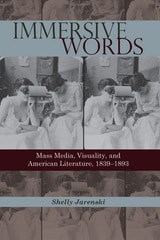
cover of Immersive Words: Mass Media, Visuality, and American Literature, 1839–1893

Immersive Words

Mass Media, Visuality, and American Literature, 1839–1893

Shelly Jarenski

University of Alabama Press, 2015

In Immersive Words, Michelle Jarenski demonstrates that the contemporary challenge that visual images and virtual environments in cinema and photography, on the web, and in video games pose to reading and writing are not uniquely contemporary developments but equally exercised the imaginations, anxieties, and works of nineteenth-century authors.
 
The middle of the nineteenth century witnessed the emergence of numerous visual technologies and techniques: the daguerreotype, immersive exhibition spaces such as cycloramas and panoramas, mechanized tourism, and large-scale exhibitions and spectacles such as the World’s Fair. In closely argued chapters devoted to these four visual forms, Jarenski demonstrates that the popularity of these novelties catalyzed a shift by authors of the period beyond narratives that merely described images to ones that invoked aesthetic experiences.
 
Jarenski describes how Herman Melville adapts the aesthetic of the daguerreotype through his use of dramatic point-of-view and unexpected shifts that disorient readers. Frederick Douglass is shown to appropriate a panoramic aesthetic that severs spatial and temporal narratives from standard expectations. Jarenski traces how Nathaniel Hawthorne’s The Marble Faun found success as a travel guide to Rome, though intended as a work of serious fiction. Finally, Sarah Orne Jewett is shown to simulate the interactivity of the World Columbian Exposition to promote racialized and gendered forms of aesthetic communication. These techniques and strategies drawn from visual forms blur the just-so boundary critics and theorists have traditionally drawn between text and image.
 
In the mid-nineteenth century, the national identity of the United States remained fluid and hinged upon matters of gender, sexuality, and, crucially, race. Authors both reflected that evolving identity and contributed to its ongoing evolution. In demonstrating how the aesthetic and visual technologies of the nineteenth century changed the fundamental aesthetics of American literature, the importance of Immersive Words goes far beyond literary criticism.

[more]
cover of In the Event of Women

In the Event of Women

Tani Barlow

Duke University Press, 2021
In the Event of Women outlines the stakes of what Tani Barlow calls “the event of women.” Focusing on the era of the late nineteenth century through the mid-twentieth century's Cultural Revolution, Barlow shows that an event is a politically inspired action to install a newly discovered truth, in this case the mammal origins of human social evolution. Highbrow and lowbrow social theory circulating in Chinese urban print media placed humanity's origin story in relation to commercial capital's modern advertising industry and the conclusion that women's liberation involved selling, buying, and advertising industrial commodities. The political struggle over how the truth of women in China would be performed and understood, Barlow shows, means in part that an event of women was likely global because its truth is vested in biology and physiology. In so doing, she reveals the ways in which historical universals are effected in places where truth claims are not usually sought. This book reconsiders Alain Badiou's concept of the event; particularly the question of whose political moment marks newly discovered truths.
[more]
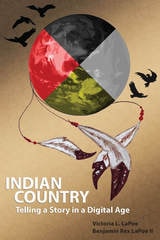
cover of Indian Country: Telling a Story in a Digital Age

Indian Country

Telling a Story in a Digital Age

Victoria L. LaPoe

Michigan State University Press, 2017

Storytelling has always been an important part of Native culture. Stories play a part in everyday Native life—they are often oral and rich in detail and language and serve as a form of recording history. Digital media now allow for the extension of this storytelling. This necessary text evaluates how digital media are changing the rich cultural act of storytelling within Native communities, with a specific focus on Native newsroom norms and routines. The authors argue that the non-Native press often leave consumers with a stereotypical view of American Indians, and aim to give a more authentic representation to Native journalism. With interviews from more than forty Native journalists around the country, this book is essential to understanding how digital media possibly advances the distribution of storytelling within the American Indian community.
 
[more]
cover of Indianizing Film: Decolonization, the Andes, and the Question of Technology

Indianizing Film

Decolonization, the Andes, and the Question of Technology

Schiwy, Freya

Rutgers University Press, 2009

Latin American indigenous media production has recently experienced a noticeable boom, specifically in Bolivia, Ecuador, and Colombia. Indianizing Film zooms in on a selection of award-winning and widely influential fiction and docudrama shorts, analyzing them in the wider context of indigenous media practices and debates over decolonizing knowledge. Within this framework, Freya Schiwy approaches questions of gender, power, and representation.

Schiwy argues that instead of solely creating entertainment through their work indigenous media activists are building communication networks that encourage interaction between diverse cultures. As a result, mainstream images are retooled, permitting communities to strengthen their cultures and express their own visions of development and modernization. Indianizing Film encourages readers to consider how indigenous media contributes to a wider understanding of decolonization and anticolonial study against the universal backdrop of the twenty-first century.

[more]
cover of Indirect Subjects: Nollywood's Local Address

Indirect Subjects

Nollywood's Local Address

Matthew H. Brown

Duke University Press, 2021

In Indirect Subjects, Matthew H. Brown analyzes the content of the prolific Nigerian film industry's mostly direct-to-video movies alongside local practices of production and circulation to show how screen media play spatial roles in global power relations. Scrutinizing the deep structural and aesthetic relationship between Nollywood, as the industry is known, and Nigerian state television, Brown tracks how several Nollywood films, in ways similar to both state television programs and colonial cinema productions, invite local spectators to experience liberal capitalism not only as a form of exploitation but as a set of expectations about the future. This mode of address, which Brown refers to as “periliberalism,” sustains global power imbalances by locating viewers within liberalism but distancing them from its processes and benefits. Locating the wellspring of this hypocrisy in the British Empire's practice of indirect rule, Brown contends that culture industries like Nollywood can sustain capitalism by isolating ordinary African people, whose labor and consumption fuel it, from its exclusive privileges.
[more]
cover of Informatics of Domination

Informatics of Domination

Zach Blas, Melody Jue, and Jennifer Rhee, editors

Duke University Press, 2025

Informatics of Domination is an experimental collection addressing formations of power that manifest through technical systems and white capitalist patriarchy in the twenty-first century. The volume takes its name from a chart in Donna J. Haraway’s canonical 1985 essay “A Manifesto for Cyborgs.” Haraway theorizes the informatics of domination as a feminist, diagrammatic concept for situating power and a world system from which the figure of the cyborg emerges. Informatics of Domination builds on Haraway’s chart as an open structure for thought, inviting fifty scholars, artists, and creative writers to unfold new perspectives. Their writings take on a variety of forms, such as essays on artificial intelligence, disability and protest, and transpacific imaginaries; conversations with an AI trained on Black oral history; a three-dimensional response to Mexico-US border tensions; hand-drawn images on queer autotheory; ecological fictions about gut microbiomes and wet markets; and more. Together, the writings take up the unfinished structure of the chart in order to proliferate critiques of white capitalist patriarchal power with the study of information systems, networks, and computation today. This volume includes an afterword by Haraway.

Contributors. Dalida María Benfield, Zach Blas, Ama Josephine Budge Johnstone, micha cárdenas, Amy Sara Carroll, Shu Lea Cheang, Jian Neo Chen, Heather Dewey-Hagborg, Ranjodh Singh Dhaliwal, Stephanie Dinkins, Ricardo Dominguez, Ashley Ferro-Murray, Matthew Fuller, Jacob Gaboury, Jennifer Gabrys, Alexander R. Galloway, Jennifer Mae Hamilton, Donna J. Haraway, Eva Hayward, Stefan Helmreich, Kathy High, Leon J. Hilton, Ho Rui An, Hi'ilei Julia Kawehipuaakahaopulani Hobart, Tung-Hui Hu, Caroline A. Jones, Melody Jue, Homay King, Larissa Lai, Lawrence Lek, Esther Leslie, Alexis Lothian, Isadora Neves Marques, Radha May (Elisa Giardina-Papa, Nupur Mathur, and Bathsheba Okwenje), Shaka McGlotten, Mahan Moalemi, madison moore, Astrida Neimanis, Bahar Noorizadeh, Luciana Parisi, Thao Phan, Ana Teixeira Pinto, Luiza Prado de O. Martins, Rita Raley, Patricia Reed, Jennifer Rhee, Bassem Saad, Ashkan Sepahvand, Justin Talplacido Shoulder, Lucy Suchman, Ollie Zhang

[more]
cover of Informing a Nation: The Newspaper Presidency of Thomas Jefferson

Informing a Nation

The Newspaper Presidency of Thomas Jefferson

Mel Laracey

University of Michigan Press, 2021

During his presidency, Thomas Jefferson both sponsored and wrote for his own newspaper, the National Intelligencer and Washington Advertiser. The newspaper spoke on behalf of his policies and those of his Republican, anti-federalist party, the Democratic-Republicans, the precursor to today’s Democrats. Author Mel Laracey focuses on the newspaper’s message during Jefferson’s first term, showing how the third president used media to promote his administration and its goals against their political rivals, the Federalists. Informing a Nation shows how Jefferson and his allies dealt with political challenges, reveals hitherto unexamined aspects of the early presidency, and raises broad questions of the relationship between the presidency and media today.
[more]
cover of Insufferable Tools: Feminism Against Big Tech

Insufferable Tools

Feminism Against Big Tech

Sarah Sharma

Duke University Press, 2026

In a world seemingly run by the whims and power plays of Musks and Zucks, Insufferable Tools cuts to the core of modern technology’s gendered politics. Sarah Sharma challenges the idea that the Big Tech broligarchs are neutral utilitarians who view technology as mere tools. She shows instead how these tech giants have turned the internet, and, increasingly, “real life” into a set of environments which they cultivate and manipulate to wield the real tools: us, the users. Sharma critiques a popular system of inclusion she calls “Big Tech Feminism” that attempts to incorporate and make useful people of color, queer people, and others who are seen as broken machines in the current gendered power structures. Deconstructing Big Tech’s patriarchal deployment of media theory to gain and maintain power, Sharma proposes a feminist techno-politics that can forge new futures free from the grip of the truly insufferable tools.
[more]