Results by title
308 books match the query 'Memory' and 9 start with i
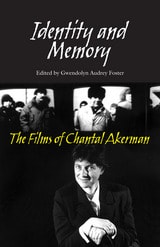
Identity And Memory
The Films of Chantal AkermanEdited by Gwendolyn Audrey Foster
Southern Illinois University Press, 2003
Considered to be one of the most influential auteurs in French cinema today, Chantal Akerman has had a profound impact on both feminist filmmaking discourse and avant-garde film. She has shown herself to be an uncompromising and dedicated practitioner of the cinematic arts in works such as I…You…He…She (Je tu il elle,1974); Jeanne Dielman, 23 quai du Commerce, 1080 Bruxelles (1975); Meetings with Anna (Les Rendez-vous d’Anna,1978); American Stories/Food, Family, and Philosophy (Histoires d’Amérique,1989); and From the East (D’Est,1993). Akerman has continued to create new and unexpected films that explore ideas about image, gaze, space, performance, and narration.
This collection of essays edited by Gwendolyn Audrey Foster assesses Akerman’s wide-ranging oeuvre, particularly her exploration of identity and memory, and considers her development as an artist and as a social force. Along with a detailed filmography and bibliography, both compiled by Foster, ten of the key figures in contemporary feminist moving-image discourse explore the themes with which Akerman is preoccupied: sexuality and lesbian identity, subjectivity, alterity, quotidian reality, the mother-daughter relationship, and Jewish diasporic identity.
The contributors include Maureen Turim, Sandy Flitterman-Lewis, Jennifer M. Barker, Ivone Margulies, Catherine Fowler, Janet Bergstrom, Ginette Vincendeau, Gwendolyn Audrey Foster, Judith Mayne, and Kristine Butler.
Originally published in the United Kingdom by Flicks Books, this marks the first United States edition of Identity and Memory: The Films of Chantal Akerman.
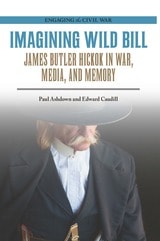
Imagining Wild Bill
James Butler Hickok in War, Media, and MemoryPaul Ashdown and Edward Caudill
Southern Illinois University Press, 2020
When it came to the Wild West, the nineteenth-century press rarely let truth get in the way of a good story. James Butler “Wild Bill” Hickok’s story was no exception. Mythologized and sensationalized, Hickok was turned into the deadliest gunfighter of all, a so-called moral killer, a national phenomenon even while he was alive.
Rather than attempt to tease truth from fiction, coauthors Paul Ashdown and Edward Caudill investigate the ways in which Hickok embodied the culture of glamorized violence Americans embraced after the Civil War and examine the process of how his story emerged, evolved, and turned into a viral multimedia sensation full of the excitement, danger, and romance of the West.
Journalists, the coauthors demonstrate, invented “Wild Bill” Hickok, glorifying him as a civilizer. They inflated his body count and constructed his legend in the midst of an emerging celebrity culture that grew up around penny newspapers. His death by treachery, at a relatively young age, made the story tragic, and dime-store novelists took over where the press left off. Reimagined as entertainment, Hickok’s legend continued to enthrall Americans in literature, on radio, on television, and in the movies, and it still draws tourists to notorious Deadwood, South Dakota.
American culture often embraces myths that later become accepted as popular history. By investigating the allure and power of Hickok’s myth, Ashdown and Caudill explain how American journalism and popular culture have shaped the way Civil War–era figures are remembered and reveal how Americans have embraced violence as entertainment.
Imprints, Voiceprints, and Footprints of Memory
Werner H. Kelber
SBL Press, 2013
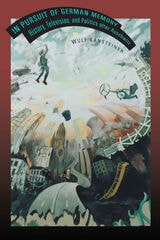
In Pursuit of German Memory
History, Television, and Politics after AuschwitzWulf Kansteiner
Ohio University Press, 2006
The collective memories of Nazism that developed in postwar Germany have helped define a new paradigm of memory politics. From Europe to South Africa and from Latin America to Iraq, scholars have studied the German case to learn how to overcome internal division and regain international recognition.
In Pursuit of German Memory: History, Television, and Politics after Auschwitz examines three arenas of German memory politics—professional historiography, national politics, and national public television—that have played key roles in the reinvention of the Nazi past in the last sixty years. Wulf Kansteiner shows that the interpretations of the past proposed by historians, politicians, and television producers reflect political and generational divisions and an extraordinary concern for Germany's image abroad. At the same time, each of these theaters of memory has developed its own dynamics and formats of historical reflection.
Kansteiner’s analysis of the German scene reveals a complex social geography of collective memory. In Pursuit of German Memory underscores the fact that German memories of Nazism, like many other collective memories, combine two seemingly contradictory qualities: They are highly mediated and part of a global exchange of images and story fragments but, at the same time, they can be reproduced only locally, in narrowly circumscribed networks of communication.
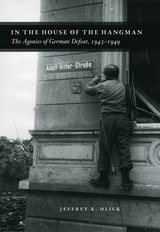
In the House of the Hangman
The Agonies of German Defeat, 1943-1949Jeffrey K. Olick
University of Chicago Press, 2005
In the House of the Hangman chronicles this delicate process, exploring key debates about the Nazi past and German future during the later years of World War II and its aftermath. What did British and American leaders think had given rise to National Socialism, and how did these beliefs shape their intentions for occupation? What rhetorical and symbolic tools did Germans develop for handling the insidious legacy of Nazism? Considering these and other questions, Jeffrey K. Olick explores the processes of accommodation and rejection that Allied plans for a new German state inspired among the German intelligentsia. He also examines heated struggles over the value of Germany's institutional and political heritage. Along the way, he demonstrates how the moral and political vocabulary for coming to terms with National Socialism in Germany has been of enduring significance—as a crucible not only of German identity but also of contemporary thinking about memory and social justice more generally.
Given the current war in Iraq, the issues contested during Germany's abjection and reinvention—how to treat a defeated enemy, how to place episodes within wider historical trajectories, how to distinguish varieties of victimhood—are as urgent today as they were sixty years ago, and In the House of the Hangman offers readers an invaluable historical perspective on these critical questions.
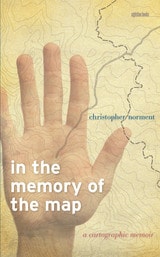
In the Memory of the Map
A Cartographic MemoirChristopher Norment
University of Iowa Press, 2012
Maps may have been the stuff of his dreams, but they sometimes drew him away from places where he should have remained firmly rooted. In the Memory of the Map explores the complex relationship among maps, memory, and experience—what might be called a “cartographical psychology” or “cartographical history.” Interweaving a personal narrative structured around a variety of maps, with stories about maps as told by scholars, poets, and fiction writers, this book provides a dazzlingly rich personal and intellectual account of what many of us take for granted.
A dialog between desire and the maps of his life, an exploration of the pleasures, utilitarian purposes, benefits, and character of maps, this rich and powerful personal narrative is the matrix in which Norment embeds an exploration of how maps function in all our lives. Page by page, readers will confront the aesthetics, mystery, function, power, and shortcomings of maps, causing them to reconsider the role that maps play in their lives.
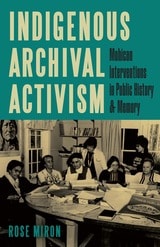
Indigenous Archival Activism
Mohican Interventions in Public History and MemoryRose Miron
University of Minnesota Press, 2024
Who has the right to represent Native history?
The past several decades have seen a massive shift in debates over who owns and has the right to tell Native American history and stories. For centuries, non-Native actors have collected, stolen, sequestered, and gained value from Native stories and documents, human remains, and sacred objects. However, thanks to the work of Native activists, Native history is now increasingly being repatriated back to the control of tribes and communities. Indigenous Archival Activism takes readers into the heart of these debates by tracing one tribe’s fifty-year fight to recover and rewrite their history.
Rose Miron tells the story of the Stockbridge-Munsee Mohican Nation and their Historical Committee, a group of mostly Mohican women who have been collecting and reorganizing historical materials since 1968. She shows how their work is exemplary of how tribal archives can be used strategically to shift how Native history is accessed, represented, written and, most importantly, controlled. Based on a more than decade-long reciprocal relationship with the Stockbridge-Munsee Mohican Nation, Miron’s research and writing is shaped primarily by materials found in the tribal archive and ongoing conversations and input from the Stockbridge-Munsee Historical Committee.
As a non-Mohican, Miron is careful to consider her own positionality and reflects on what it means for non-Native researchers and institutions to build reciprocal relationships with Indigenous nations in the context of academia and public history, offering a model both for tribes undertaking their own reclamation projects and for scholars looking to work with tribes in ethical ways.
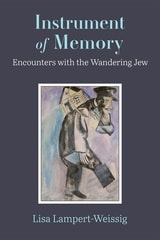
Instrument of Memory
Encounters with the Wandering JewLisa Lampert-Weissig
University of Michigan Press, 2024
It All Began in Nuremberg
Between History and MemoryRita Thalmann
University of Michigan Press, 2015