153 books match the query 'Metaphysics' and 7 start with i
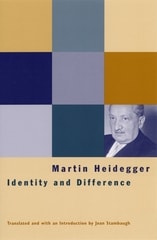
cover of Identity and Difference

Identity and Difference

Martin Heidegger

University of Chicago Press, 2002

Two essential works by Heidegger on the nature of identity 
Identity and Difference consists of English translations and the original German versions of two little-known lectures given in 1957 by Martin Heidegger, "The Principle of Identity" and "The Onto-theo-logical Constitution of Metaphysics." Both lectures discuss the difficult problem of the nature of identity in the history of metaphysics. 
 
This translation marks a significant improvement over earlier versions in English. In addition to her clear, accurate translation, Joan Stambaugh, who was a student of Heidegger's, offers a helpful introduction and a list of references.
[more]
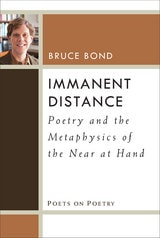
cover of Immanent Distance: Poetry and the Metaphysics of the Near at Hand

Immanent Distance

Poetry and the Metaphysics of the Near at Hand

Bruce Bond

University of Michigan Press, 2015
In these essays, Bruce Bond interrogates the commonly accepted notion that all poetry since modernism tends toward one of two traditions: that of a more architectural sensibility with its resistance to metaphysics, and that of a latter-day Romantic sensibility, which finds its authority in a metaphysics authenticated by the individual imagination. Poetry, whether self-consciously or not, has always thrived on the paradox of the distant in the immanent and the other in the self; as such, it is driven by both a metaphysical hunger and a resistance to metaphysical certainty. Hidden resources of being animate the language of the near, just as near things beckon from an elusive and inarticulate distance. Bond revalidates the role of poetry and, more broadly, of the poetic imagination as both models for and embodiments of a transfigurative process, an imperfectly mimetic yet ontological engendering of consciousness at the limits of a language that must—if cognizant of its psychological, ethical, and epistemological summons—honor that which lies beyond it.

[more]
cover of In Reasonable Hope: Philosophical Reflections on Ultimate Meaning

In Reasonable Hope

Philosophical Reflections on Ultimate Meaning

Patrick Masterson

Catholic University of America Press, 2021
In Reasonable Hope considers three foundational responses to this quest for some understanding of the existence, meaning, and value of everything. Other approaches can be considered as combinations or variations of these. Firstly, there is the approach which claims that it is our humanity, exercising its unique intelligent subjectivity, that is the source and measure of all possible meaning and value. Nothing can be thought of as existing, meaningful or of value apart from a thinking human subject. This is a broadly Humanist approach to ultimate meaning. Man is the measure of all things. Secondly, there is the approach of Scientism. This claims that an ultimate understanding of the world and ourselves must be sought, less anthropocentrically, in terms of the findings of basic empirical sciences such as physics and chemistry. We live in a world ever-increasingly dominated by the autonomous system of science and technology. Such Scientism implies an explicitly reductionist and materialist conception of the meaning and value of everything. Thirdly, there is the approach of Theism which maintains that, in the final analysis, the meaning and value of everything, insofar as this can be known, is to be explained in terms of a transcendent infinitely perfect personal being we call God. The first two approaches are carefully considered. However, it is the third to which most attention is devoted. Consideration is given to the traditional impersonal metaphysical approach to questions about the existence and nature of God. The alternative approaches of linguistic philosophy and phenomenology, which reject such metaphysical speculation are also discussed. These various approaches are judged to be complementary rather than strict alternatives. In the latter half of the book is devoted to a more personal and self-involving discussion of the relevance of an affirmation of the existence of God. It explores the implications of a rational commitment to live one's life in accordance with the requirements of values which transcend explanation in purely physical terms, such as truth, goodness, beauty, and especially love. It provides a personal and existential development of the rational hope that such values are ultimately more objectively real and dependable than the eventual universal material chaos predicted by empirical science. It argues that the existence of God as the infinite expression and source of these values is the necessary and sufficient condition of this rational hope in their enduring significance. Finally, there is an account of how the Christian Revelation illuminates and transforms our rational hope in the enduring significance of love of God and neighbor.
[more]
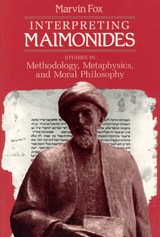
cover of Interpreting Maimonides: Studies in Methodology, Metaphysics, and Moral Philosophy

Interpreting Maimonides

Studies in Methodology, Metaphysics, and Moral Philosophy

Marvin Fox

University of Chicago Press, 1990
In this comprehensive study, Marvin Fox offers an approach to Moses Maimonides that illuminates the intersections of his philosophical, religious, and Jewish visions—ideas that have embattled readers of Maimonides since the twelfth century.
[more]
cover of Intersubjective Existence: A Critical Reflection on the Theory and the Practice of Selfhood

Intersubjective Existence

A Critical Reflection on the Theory and the Practice of Selfhood

Oliva Blanchette

Catholic University of America Press, 2021

Intersubjective Existence, as the author notes, aims, first, to develop a wisdom about human life that takes the form of a theory of selfhood and, second, to reflect on what is called for in the ethical practice of human existence. Secondly, the ethical implications of this theory of selfhood are explored, specifically looking at conscience, prudential reasoning, justice, friendship, the law, temperance, courage, and concluding with a brief treatment of religion. Olivia Blanchette charts the path of his inquiry through an analysis of reflective self-consciousness in selves communing with one another. They are constituted in their substance as a union of body and soul, with intelligence and free will that give rise to cultures in communion with other selves. These cultures are over and above what is given to each self in sense consciousness and in sense appetites and which each one contends with in the exercise of selfhood and the rights that go with that in keeping with justice. Concern for right reasoning and justice leads to an analysis of temperance and courage. The chief arguments take the form of phenomenological reflections on the building blocks of the perennial philosophy. Blanchette recasts Aristotelian-Thomistic metaphysics from the perspective of a phenomenology of the mutual recognition of agents and the historical consciousness to which it gives rise.
[more]
cover of Investigations In Philosophy Of Space: Continental Thought Series V. 11

Investigations In Philosophy Of Space

Continental Thought Series V. 11

Elisabeth Ströker

Ohio University Press, 1987

The central contribution of Ströker’s investigations is a careful and strict analysis of the relationship between experienced space, Euclidean space, and non-Euclidean spaces. Her study begins with the question of experienced space, inclusive of mood space, space of action and perception, of practical activities and bodily orientations, and ends with the controversies of the proponents of geometric and mathematical understanding of space. Within the context of experienced space, Ströker includes historical discussions of place, topology, depth, perspectivity, homogeneity, orientation, and the questions of empty and full spaces. Her investigation concludes that any strict analysis of space must be founded upon an unavoidable ontology.

Philosophical Investigations of Space addresses a number of methodological controversies. It tests the limitations of a variety of scientific, phenomenological, geometric, and logical methods in order to demonstrate limitations of both methodology and underlying assumption. In addition to the richness of her historical and systematic discussion, Ströker’s work is a model of thoroughly documented philosophical scholarship and conceptual precision.
[more]
cover of Is St. Thomas’s Aristotelian Philosophy of Nature Obsolete?

Is St. Thomas’s Aristotelian Philosophy of Nature Obsolete?

C. Robert Koons

St. Augustine's Press, 2022

“The Analytic Thomist,” Rob Koons, delivered the 2021 Aquinas Lecture at the University of Dallas. Here he engages the possibility of a bridge between philosophy and metaphysics proper. Koons boldly lays out his position: without Aristotelian metaphysics, there is no Aristotelian philosophy of nature, and there is no philosophy of nature in Aristotle without acknowledging his natural science. His lecture thus challenges Thomists and their respective approaches to hylomorphism and their all too frequent quickness to discard it. (Koons lays down the gauntlet. if one denies hylomorphism there can be no transubstantiation!) 
       A bonus addition to this volume in the Dallas lecture series is Koon's “Aristotle, god and the Quantum.”   
[more]