Results by title
53 books match the query 'Mignolo, Walter D.' and 5 start with i
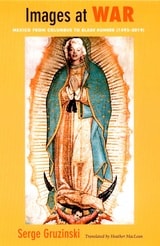
Images at War
Mexico From Columbus to Blade Runner (1492–2019)Serge Gruzinski
Duke University Press, 2001
Although the baroque image played a decisive role in many arenas, especially that of conquest and New World colonization, its powerful resonance in the sphere of religion is a focal point of Gruzinski’s study. In his analysis of how images conveyed meaning across linguistic barriers, he uncovers recurring themes of false images, less-than-perfect replicas, the uprooting of peoples and cultural memories, and the violence of iconoclastic destruction. He shows how various ethnic groups—Indians, blacks, Europeans—left their distinct marks on images of colonialism and religion, coopting them into expressions of identity or instruments of rebellion. As Gruzinski’s story unfolds, he tells of Aztec idols, the cult of the Virgin of Guadalupe, conquistadors, Franciscans, and neoclassical attempts to repress the baroque. In the final chapter he discusses the political and religious implications of contemporary imagery—such as that in Mexican soap operas—and speculates about the future of images in Latin America.
Originally written in French, this work makes available to an English audience a seminal study of Mexico and the role of the image in the New World.
Imperial Subjects
Race and Identity in Colonial Latin AmericaAndrew B. Fisher and Matthew D. O Hara, eds.
Duke University Press, 2009
Whether analyzing cases in which the Inquisition found that the individuals before it were “legally” Indians and thus exempt from prosecution, or considering late-eighteenth- and early-nineteenth-century petitions for declarations of whiteness that entitled the mixed-race recipients to the legal and social benefits enjoyed by whites, the book’s contributors approach the question of identity by examining interactions between imperial subjects and colonial institutions. Colonial mandates, rulings, and legislation worked in conjunction with the exercise and negotiation of power between individual officials and an array of social actors engaged in countless brief interactions. Identities emerged out of the interplay between internalized understandings of self and group association and externalized social norms and categories.
Contributors. Karen D. Caplan, R. Douglas Cope, Mariana L. R. Dantas, María Elena Díaz, Andrew B. Fisher, Jane Mangan, Jeremy Ravi Mumford, Matthew D. O’Hara, Cynthia Radding, Sergio Serulnikov, Irene Silverblatt, David Tavárez, Ann Twinam

In the Name of El Pueblo
Place, Community, and the Politics of History in YucatánPaul K. Eiss
Duke University Press, 2010
Indians and Leftists in the Making of Ecuador's Modern Indigenous Movements
Marc Becker
Duke University Press, 2008
Becker explains how rural laborers and urban activists worked together in Ecuador, merging ethnic and class-based struggles for social justice. Socialists were often the first to defend Indigenous languages, cultures, and social organizations. They introduced rural activists to new tactics, including demonstrations and strikes. Drawing on leftist influences, Indigenous peoples became adept at reacting to immediate, local forms of exploitation while at the same time addressing broader underlying structural inequities. Through an examination of strike activity in the 1930s, the establishment of a national-level Ecuadorian Federation of Indians in 1944, and agitation for agrarian reform in the 1960s, Becker shows that the history of Indigenous mobilizations in Ecuador is longer and deeper than many contemporary observers have recognized.

Indigenous and Popular Thinking in América
Rodolfo Kusch
Duke University Press, 2010
Indigenous and Popular Thinking in América is a record of Kusch's attempt to immerse himself in the indigenous ways of knowing and being. At first glance, his methodology resembles ethnography. He speaks with and observes indigenous people and mestizos in Peru, Bolivia, and Argentina. He questions them about their agricultural practices and economic decisions; he observes rituals; he asks women in the market the meaning of indigenous talismans; he interviews shamans; he describes the spatial arrangement and the contents of shrines, altars, and temples; and he reproduces diagrams of archaeological sites, which he then interprets at length. Yet he does not present a "them" to a putative "us." Instead, he offers an inroad to a way of thinking and being that does not follow the logic or fit into the categories of Western social science and philosophy. In his introduction, Walter D. Mignolo discusses Kusch's work and its relation to that of other twentieth-century intellectuals, Argentine history, and contemporary scholarship on the subaltern and decoloniality.