Results by title
138 books match the query 'Minority Studies' and 5 start with i
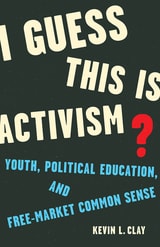
I Guess This Is Activism?
Youth, Political Education, and Free-Market Common SenseKevin L. Clay
University of Minnesota Press, 2026
How neoliberal capitalism and pedagogical deideologization constrain the radical possibilities of youth activism
In I Guess This Is Activism? Kevin L. Clay presents an eye-opening account of his experience with Youth Participatory Action Research (YPAR) as an Upward Bound educator. Grounded in Paulo Freire’s tradition of critical pedagogy, YPAR has been championed by community-based educators and scholars in the United States as an approach for supporting critical consciousness development and social change with working-class Black and Latino youth. Clay, however, questions whether YPAR can effectively prepare youths to subvert the systems reproducing their material conditions under neoliberal capitalism. Exposing the political and pedagogical limits of YPAR’s progressive education model, he reveals how omnipresent neoliberalism undermines youths’ radical potential when political education is not prioritized in youth activism.
I Guess This Is Activism? engages Black radical thinkers, including Ella Baker and Fred Hampton, to reveal the faulty assumptions implicit in YPAR’s program. Looking deeply into how he and his students navigated questions of community problems and social change at the twilight of the Obama presidency, Clay demonstrates how, in the absence of political education on the structures of race, class, and capitalism, youth activism is always eclipsed by the common sense of the free market.
As working-class Black and Latino youth inherit a society deeply shaped by neoliberal dogma, I Guess This Is Activism? delivers a much-needed reexamination of YPAR and visions for the future of youth activist education.
Retail e-book files for this title are screen-reader friendly with images accompanied by short alt text and/or extended descriptions.

Identity Complex
Making the Case for MultiplicityMichael Hames-García
University of Minnesota Press, 2011
In seemingly exhaustive arguments about identity as a category of analysis, we have made a critical error—one that Michael Hames-García sets out to correct in this revisionary look at the making and meaning of social identities. We have asked how separate identities—of race, class, ethnicity, gender, and sexuality—come to intersect. Instead, Hames-García proposes, we should begin by understanding such social identities as mutually constituting one another.
Grounded in both theoretical and political practices—in the lived realities of people’s experience—Identity Complex reinvigorates identity as a key concept and as a tool for the pursuit of social justice. Hames-García draws on a wide range of examples to show that social identities are central to how exploitation works, such as debates about the desirability of sexual minority identities in postcolonial contexts, questions about the reality of race, and the nature of the U.S. prison crisis.
Unless we understand precisely how identities take shape in relation to each other and within contexts of oppression, he contends, we will never be able to eradicate discrimination and social inequality. By analyzing the social interdependence of identities, Hames-García seeks to enable the creation of deep connections of solidarity across differences.
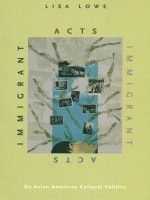
Immigrant Acts
On Asian American Cultural PoliticsLisa Lowe
Duke University Press, 1996
Lowe argues that a national memory haunts the conception of Asian American, persisting beyond the repeal of individual laws and sustained by U.S. wars in Asia, in which the Asian is seen as the perpetual immigrant, as the “foreigner-within.” In Immigrant Acts, she argues that rather than attesting to the absorption of cultural difference into the universality of the national political sphere, the Asian immigrant—at odds with the cultural, racial, and linguistic forms of the nation—displaces the temporality of assimilation. Distance from the American national culture constitutes Asian American culture as an alternative site that produces cultural forms materially and aesthetically in contradiction with the institutions of citizenship and national identity. Rather than a sign of a “failed” integration of Asians into the American cultural sphere, this critique preserves and opens up different possibilities for political practice and coalition across racial and national borders.
In this uniquely interdisciplinary study, Lowe examines the historical, political, cultural, and aesthetic meanings of immigration in relation to Asian Americans. Extending the range of Asian American critique, Immigrant Acts will interest readers concerned with race and ethnicity in the United States, American cultures, immigration, and transnationalism.

Impossible Purities
Blackness, Femininity, and Victorian CultureJennifer DeVere Brody
Duke University Press, 1998
Opening with a reading of Daniel Defoe’s “A True-Born Englishman,” which posits the mixed origins of English identity, Brody goes on to analyze mulattas typified by Rhoda Swartz in William Thackeray’s Vanity Fair, whose mixed-race status reveals the “unseemly origins of English imperial power.” Examining Victorian stage productions from blackface minstrel shows to performances of The Octoroon and Uncle Tom’s Cabin, she explains how such productions depended upon feminized, “black” figures in order to reproduce Englishmen as masculine white subjects. She also discusses H.G. Wells’s The Island of Dr. Moreau in the context of debates about the “new woman,” slavery, and fears of the monstrous degeneration of English gentleman. Impossible Purities concludes with a discussion of Bram Stoker’s novella, “The Lair of the White Worm,” which brings together the book’s concerns with changing racial representations on both sides of the Atlantic.
This book will be of interest to scholars in Victorian studies, literary theory, African American studies, and cultural criticism.

Island Possessed
Katherine Dunham
University of Chicago Press, 1994