Results by title
100 books match the query 'Missions' and 6 start with i
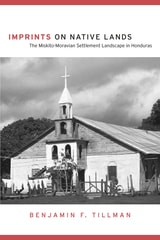
Imprints on Native Lands
The Miskito-Moravian Settlement Landscape in HondurasBenjamin F. Tillman
University of Arizona Press, 2011
More than one hundred fifty years ago, Moravian missionaries first landed along a so-called isolated stretch of Honduras’s Mosquito Coast bordering the western Caribbean Sea. The missionaries were sent, with the strong encouragement of German political leaders and in the context of German attempts at colonization, to “spread the word” of Protestantism in Central America. Upon their arrival, the missionaries employed a three-pronged approach consisting of proselytizing, medical treatment, and education to convert the majority of the indigenous population.
Much like the Spanish and English attempts before them, German colonizing efforts in the region never completely took hold. Still, as Benjamin Tillman shows, for the region’s indigenous inhabitants, the Miskito people, the arrival of the Moravian missionaries marked the beginning of an important cultural interface.
Imprints on Native Lands documents Moravian contributions to the Miskito settlement landscape in sixty four villages of eastern Honduras through field observations of material culture, interviews with village residents, and research in primary sources in the Moravian Church archives. Tillman employs the resulting data to map a hierarchy of Moravian centers, illustrating spatially varying degrees of Moravian influence on the Miskito settlement landscape.
Tillman reinforces Miskito claims to ancestral lands by identifying and mapping their created ethnic landscape, as well as supporting earlier efforts at land-use mapping in the region. This book has broad implications, providing a methodology that will be of help to those with an interest in geography, anthropology, or Latin American studies, and to anyone interested in documenting and strengthening indigenous land claims.
[more]
In Africa's Forest and Jungle
Six Years Among the YorubasRichard Henry Stone, edited by Betty Finklea Florey
University of Alabama Press, 2009
In Africa's Forest and Jungle is the memoir of Richard Henry Stone, a Civil War era Southern Baptist missionary, who served in what is now Nigeria during the late 1850s and again during the first years of the American Civil War. Stone published this work in 1899, when it became clear that age would prevent him from returning to Africa.
Stone served in Africa with his wife and successfully learned the Yoruba language. He was an intelligent, self-reflective, and reliable observer, making his works important sources of information on Yoruba society before the intervention of European colonialism. In Africa's Forest and Jungle is a rare account of West African culture, made all the more complete by the additional journal entries, letters, and photographs collected in this edition.
Stone served in Africa with his wife and successfully learned the Yoruba language. He was an intelligent, self-reflective, and reliable observer, making his works important sources of information on Yoruba society before the intervention of European colonialism. In Africa's Forest and Jungle is a rare account of West African culture, made all the more complete by the additional journal entries, letters, and photographs collected in this edition.
[more]
Indian Assimilation in the Franciscan Area of Nueva Vizcaya
William B. Griffen
University of Arizona Press, 1979
Examines the processes of disappearance during the late 16th and 17th centuries--through assimilation or extermination--of the native Indians encountered by Spaniards in present-day Chihuahua, Mexico.
[more]
Indigenous Landscapes and Spanish Missions
New Perspectives from Archaeology and EthnohistoryEdited by Lee M. Panich and Tsim D. Schneider
University of Arizona Press, 2014
Spanish missions in North America were once viewed as confining and stagnant communities, with native peoples on the margins of the colonial enterprise. Recent archaeological and ethnohistorical research challenges that notion. Indigenous Landscapes and Spanish Missions considers how native peoples actively incorporated the mission system into their own dynamic existence. The book, written by diverse scholars and edited by Lee M. Panich and Tsim D. Schneider, covers missions in the Spanish borderlands from California to Texas to Georgia.
Offering thoughtful arguments and innovative perspectives, the editors organized the book around three interrelated themes. The first section explores power, politics, and belief, recognizing that Spanish missions were established within indigenous landscapes with preexisting tensions, alliances, and belief systems. The second part, addressing missions from the perspective of indigenous inhabitants, focuses on their social, economic, and historical connections to the surrounding landscapes. The final section considers the varied connections between mission communities and the world beyond the mission walls, including examinations of how mission neophytes, missionaries, and colonial elites vied for land and natural resources.
Indigenous Landscapes and Spanish Missions offers a holistic view on the consequences of missionization and the active negotiation of missions by indigenous peoples, revealing cross-cutting perspectives into the complex and contested histories of the Spanish borderlands. This volume challenges readers to examine deeply the ways in which native peoples negotiated colonialism not just inside the missions themselves but also within broader indigenous landscapes. This book will be of interest to archaeologists, historians, tribal scholars, and anyone interested in indigenous encounters with colonial institutions.
[more]
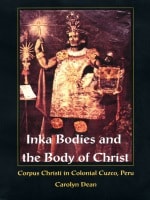
Inka Bodies and the Body of Christ
Corpus Christi in Colonial Cuzco, PeruCarolyn Dean
Duke University Press, 1999
In Inka Bodies and the Body of Christ Carolyn Dean investigates the multiple meanings of the Roman Catholic feast of Corpus Christi as it was performed in the Andean city of Cuzco after the Spanish conquest. By concentrating on the era’s paintings and its historical archives, Dean explores how the festival celebrated the victory of the Christian God over sin and death, the triumph of Christian orthodoxy over the imperial Inka patron (the Sun), and Spain’s conquest of Peruvian society.
As Dean clearly illustrates, the central rite of the festival—the taking of the Eucharist—symbolized both the acceptance of Christ and the power of the colonizers over the colonized. The most remarkable of Andean celebrants were those who appeared costumed as the vanquished Inka kings of Peru’s pagan past. Despite the subjugation of the indigenous population, Dean shows how these and other Andean nobles used the occasion of Corpus Christi as an opportunity to construct new identities through tinkuy, a native term used to describe the conjoining of opposites. By mediating the chasms between the Andean region and Europe, pagans and Christians, and the past and the present, these Andean elites negotiated a new sense of themselves. Dean moves beyond the colonial period to examine how these hybrid forms of Inka identity are still evident in the festive life of modern Cuzco.
Inka Bodies and the Body of Christ offers the first in-depth analysis of the culture and paintings of colonial Cuzco. This volume will be welcomed by historians of Peruvian culture, art, and politics. It will also interest those engaged in performance studies, religion, and postcolonial and Latin American studies.
[more]
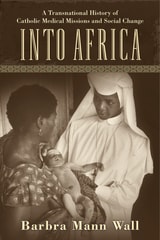
Into Africa
A Transnational History of Catholic Medical Missions and Social ChangeWall, Barbra Mann
Rutgers University Press, 2015
Winner of the 2016 Lavinia Dock Award from the American Association for the History of Nursing
Awarded first place in the 2016 American Journal of Nursing Book of the Year Award in the History and Public Policy category
The most dramatic growth of Christianity in the late twentieth century has occurred in Africa, where Catholic missions have played major roles. But these missions did more than simply convert Africans. Catholic sisters became heavily involved in the Church’s health services and eventually in relief and social justice efforts. In Into Africa, Barbra Mann Wall offers a transnational history that reveals how Catholic medical and nursing sisters established relationships between local and international groups, sparking an exchange of ideas that crossed national, religious, gender, and political boundaries.
Both a nurse and a historian, Wall explores this intersection of religion, medicine, gender, race, and politics in sub-Saharan Africa, focusing on the years following World War II, a period when European colonial rule was ending and Africans were building new governments, health care institutions, and education systems. She focuses specifically on hospitals, clinics, and schools of nursing in Ghana and Uganda run by the Medical Mission Sisters of Philadelphia; in Nigeria and Uganda by the Irish Medical Missionaries of Mary; in Tanzania by the Maryknoll Sisters of New York; and in Nigeria by a local Nigerian congregation. Wall shows how, although initially somewhat ethnocentric, the sisters gradually developed a deeper understanding of the diverse populations they served. In the process, their medical and nursing work intersected with critical social, political, and cultural debates that continue in Africa today: debates about the role of women in their local societies, the relationship of women to the nursing and medical professions and to the Catholic Church, the obligations countries have to provide care for their citizens, and the role of women in human rights.
A groundbreaking contribution to the study of globalization and medicine, Into Africa highlights the importance of transnational partnerships, using the stories of these nuns to enhance the understanding of medical mission work and global change.
[more]