Results by title
111 books match the query 'Museum Studies' and 4 start with i

Imagined Museums
Art and Modernity in Postcolonial MoroccoKatarzyna Pieprzak
University of Minnesota Press, 2010
Indian Enough
EssaysPaul Chaat Smith
University of Minnesota Press, 2027
An acerbic, candid reckoning with Indigenous identity, visibility, and the messy realities of cultural change
In Indian Enough, curator and critic Paul Chaat Smith probes the paradox of contemporary Indigeneity: enormous, hard-won cultural visibility in museum exhibits, land acknowledgments, mascot removals, and more alongside persistent erasure in everyday life. Rejecting the easy comforts of identity politics (he was, he admits, a fan of the Land O’Lakes Butter Maiden), Smith brings “honest confusion” to his inquiry, using sharp wit and wry humor to confront the gap between symbolism and lived reality.
Both memoir and cultural critique, Indian Enough follows Smith from a suburban childhood in Washington, D.C., filled with Kurt Vonnegut and Vine Deloria Jr., through teenage years steeped in Native politics leading to a thrilling and eventually disillusioning stint with the American Indian Movement, to his pivotal role in creating the inaugural exhibitions at the National Museum of the American Indian. His insider account of NMAI exposes how well-meaning efforts to redress Native erasure can simply swap one set of stereotypes for another, and his candor shows how institutions and activists—himself included—all grapple with the tension between good intentions and political realities.
Irreverent and searching, Indian Enough tackles culture writ large—the rise of punk and the fall of AIM, pop culture as a battleground, Indigenous slaveowners and other histories we’d rather forget, MAGA Indians, and what it means to win when the ground keeps shifting. Together these essays reveal a truth that’s hard to reconcile in an era of “progress”: representation is everywhere, certainty is not.
Retail e-book files for this title are screen-reader friendly with images accompanied by short alt text and/or extended descriptions.
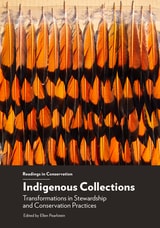
Indigenous Collections
Transformations in Stewardship and Conservation PracticesEllen Pearlstein
J. Paul Getty Trust, The, 0
A critical survey of the values, challenges, implications, history, and future of conserving Indigenous collections globally.
Once the exclusive realm of non-Indigenous curators and conservators, the care of Indigenous works in museums is now largely carried out either in collaboration with or by community members—a significant change from the colonial origins of museum collections and conservation practice.
This volume brings together over 100 readings—by Indigenous and non-Indigenous authors from around the world—that trace the development of the conservation of Indigenous collections. The writers provide a wide range of expertise, from archaeology and ethnography to law, and include community leaders, anthropologists, and art historians, as well as conservators and curators.
The book begins with an examination of the changes in terminology that reflect trust and respect, Indigenous care practices that predate the emergence of museums, and the impact of policy and legislation on Indigenous art and artifacts. Other readings explore the challenges associated with managing large, complex collections and the changes that resulted from addressing them: the development of specialized technical approaches, the incorporation of intangible heritage in conservation agendas, and a broadening view of what conservation means and how to practice it. Indigenous Collections concludes by looking at new approaches to museums—managed by or jointly with the people most closely connected to the holdings—and to the future, through innovations in conservation education.
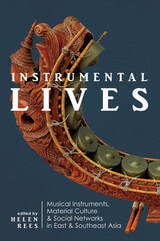
Instrumental Lives
Musical Instruments, Material Culture, and Social Networks in East and Southeast AsiaEdited by Helen Rees
University of Illinois Press, 2024
Original and expert, Instrumental Lives brings a new understanding of how musical instruments interact with their environments and societies. Contributors: Supeena Insee Adler, Marie-Pierre Lissoir, Terauchi Naoko, Jennifer C. Post, Helen Rees, Xiao Mei, Tyler Yamin, and Bell Yung