65 books match the query 'Oral tradition' and 4 start with i
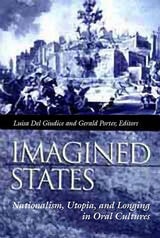
cover of Imagined States: Nationalism, Utopia, and Longing in Oral Cultures

Imagined States

Nationalism, Utopia, and Longing in Oral Cultures

edited by Luisa Del Giudice & Gerald Porter

Utah State University Press, 2003
An international ensemble of folklore scholars looks at varied ways in which national and ethnic groups have traditionally and creatively used imagined states of existence-some idealizations, some demonizations-in the construction of identities for themselves and for others. Drawing on oral traditions, especially as represented in traditional ballads, broadsides, and tale collections, the contributors consider fertile landscapes of the mind where utopias overflow with bliss and abundance, stereotyped national and ethnic caricatures define the lives of "others," nostalgia glorifies home and occupation, and idealized and mythological animals serve as cultural icons and guideposts to harmonious social life.
[more]
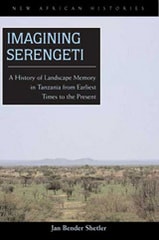
cover of Imagining Serengeti: A History of Landscape Memory in Tanzania from Earliest Times to the Present

Imagining Serengeti

A History of Landscape Memory in Tanzania from Earliest Times to the Present

Jan Bender Shetler

Ohio University Press, 2007

Many students come to African history with a host of stereotypes that are not always easy to dislodge. One of the most common is that of Africa as safari grounds—as the land of expansive, unpopulated game reserves untouched by civilization and preserved in their original pristine state by the tireless efforts of contemporary conservationists. With prose that is elegant in its simplicity and analysis that is forceful and compelling, Jan Bender Shetler brings the landscape memory of the Serengeti to life. She demonstrates how the social identities of western Serengeti peoples are embedded in specific spaces and in their collective memories of those spaces. Using a new methodology to analyze precolonial oral traditions, Shetler identifies core spatial images and reevaluates them in their historical context through the use of archaeological, linguistic, ethnographic, ecological, and archival evidence. Imagining Serengeti is a lively environmental history that will ensure that we never look at images of the African landscape in quite the same way.

[more]
cover of Impasse of the Angels: Scenes from a Moroccan Space of Memory

Impasse of the Angels

Scenes from a Moroccan Space of Memory

Stefania Pandolfo

University of Chicago Press, 1997

The image of the ethnographer in the field who observes his or her subjects from a distance while copiously taking notes has given way in recent years to a more critical and engaged form of anthropology. Composed as a polyphonic dialogue of texts, Stefania Pandolfo's Impasse of the Angels takes this engagement to its limit by presenting the relationship between observer and observed as one of interacting equals and mutually constituting interlocuters.

Impasse of the Angels explores what it means to be a subject in the historical and poetic imagination of a southern Moroccan society. Passionate and lyrical, ironic and tragic, the book listens to dissonant, often idiosyncratic voices—poetic texts, legends, social spaces, folktales, conversations—which elaborate in their own ways the fractures, wounds, and contradictions of the Maghribî postcolonial present. Moving from concrete details in a traditional ethnographic sense to a creative, experiential literary style, Impasse of the Angels is a tale of life and death compellingly addressing readers from anthropology, literature, philosophy, postcolonial criticism, and Middle Eastern studies.
[more]
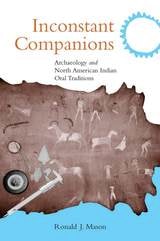
cover of Inconstant Companions: Archaeology and North American Indian Oral Traditions

Inconstant Companions

Archaeology and North American Indian Oral Traditions

Ronald J. Mason

University of Alabama Press, 2008

One of the most significant theoretical issues in contemporary American archaeology—the role of oral tradition in scientific research.
 
Ronald J. Mason explores the tension between aboriginal oral traditions and the practice of archaeology in North America. That exploration is necessarily interdisciplinary and set in a global context. Indeed, the issues at stake are universal in the current era of intellectual "decolonization" and multiculturalism.
 
Unless committed to writing, even the most esteemed utterances are inevitably forgotten with the passing of generations, however much the succeeding ones try to reproduce what they think they had heard. Writing shares with archaeo-logical remains a greater, if unequal, durability. Through copious examples across academic and ethnographic spectra and over millennia, Mason examines the disparate functions of traditional "ways of knowing" in contrast to the paradigm of science and critical historiography.
  

[more]