Results by title
116 books match the query 'Palestine' and 10 start with i
In Pursuit of Peace in Israel and Palestine
Gershon Baskin
Vanderbilt University Press, 2017
Despite the atmosphere of fear, Baskin found he could talk with both Jews and Palestinians, and that very few others were engaged in efforts at mutual understanding. At his initiative, the Ministry of Education and the office of right-wing prime minister Menachem Begin created the Institute for Education for Jewish-Arab Coexistence with Baskin himself as director. Eight years later he founded and codirected the only joint Israeli-Palestinian public policy think-and-do tank in the world, the Israel/Palestine Center for Research and Information. For decades he continued to cross borders, often with a kaffiyeh (Arab headdress) on his dashboard to protect his car in Palestinian neighborhoods. Airport passport control became Kafkaesque as Israeli agents routinely identified him as a security threat.
During the many cycles of peace negotiations, Baskin has served both as an outside agitator for peace and as an advisor on the inside of secret talks—for example, during the prime ministership of Yitzhak Rabin and during the initiative led by Secretary of State John Kerry. Baskin ends the book with his own proposal, which includes establishing a peace education program and cabinet-level Ministries of Peace in both countries, in order to foster a culture of peace.
Inextricably Bonded
Israeli Arab and Jewish Writers Re-Visioning CultureRachel Feldhay Brenner
University of Wisconsin Press, 2003
Despite the tragic reality of the continuing Israeli-Arab conflict and deep-rooted beliefs that the chasm between Israeli Jews and Israeli Arabs is unbridgeable, this book affirms the bonds between the two communities. Rachel Feldhay Brenner demonstrates that the literatures of both ethnic groups defy the ideologies that have obstructed dialogue between the two peoples.
Brenner argues that literary critics have ignored the variety and the dissent in the novels of both Arab and Jewish writers in Israel, giving them interpretations that embrace the politics of exclusion and conform with Zionist ideology. Brenner offers insightful new readings that compare fiction by Jewish writers Amos Oz, A.B. Yehoshua, David Grossman, and others with fiction written in Hebrew by such Arab-Israeli writers as Atallah Mansour, Emile Habiby, and Anton Shammas. This parallel analysis highlights the moral and psychological dilemmas faced by both the Jewish victors and the Arab vanquished, and Brenner suggests that the hope for release from the historical trauma lies—on both sides—in reaching an understanding with and of the adversary.
Drawing upon the theories of Walter Benjamin, Jacques Lacan, Sigmund Freud, Emanuel Levinas, and others, Inextricably Bonded is an innovative and illuminating examination of literary dissent from dominant ideology.
Inter/Nationalism
Decolonizing Native America and PalestineSteven Salaita
University of Minnesota Press, 2016
“The age of transnational humanities has arrived.” According to Steven Salaita, the seemingly disparate fields of Palestinian Studses and American Indian studies have more in common than one may think. In Inter/Nationalism, Salaita argues that American Indian and Indigenous studies must be more central to the scholarship and activism focusing on Palestine.
Salaita offers a fascinating inside account of the Boycott, Divestment, and Sanctions (BDS) movement—which, among other things, aims to end Israel’s occupation of Palestinian land. In doing so, he emphasizes BDS’s significant potential as an organizing entity as well as its importance in the creation of intellectual and political communities that put Natives and other colonized peoples such as Palestinians into conversation. His discussion includes readings of a wide range of Native poetry that invokes Palestine as a theme or symbol; the speeches of U.S. President Andrew Jackson and early Zionist thinker Ze’ev Jabotinsky; and the discourses of “shared values” between the United States and Israel.
Inter/Nationalism seeks to lay conceptual ground between American Indian and Indigenous studies and Palestinian studies through concepts of settler colonialism, indigeneity, and state violence. By establishing Palestine as an indigenous nation under colonial occupation, this book draws crucial connections between the scholarship and activism of Indigenous America and Palestine.
Invited to Witness
Solidarity Tourism across Occupied PalestineJennifer Lynn Kelly
Duke University Press, 2023

Israel and Palestine
Competing HistoriesGreg Philo and Mike Berry
Pluto Press, 2006
Following on from their acclaimed book Bad News from Israel, Greg Philo and Mike Berry present a concise guide to the Israel-Palestine conflict. This uniquely accessible book will appeal to anyone looking for an approachable introduction. Uniquely, the authors show how there are many different, competing histories. They offer an overview of the wide range of contending viewpoints, and indicate those which are based on the most considered historical research.
The book covers key events in chronological order, in each case examining the varied historical accounts and presenting the beliefs of key thinkers across the ideological spectrum, from Edward Said to Binyamin Netanyahu. Starting the with emergence of the Zionist movement in the nineteenth century, and the figures who shaped it, the authors go on to cover the founding of Israel and its subsequent history, up to and including the 'roadmap for peace', the construction of the wall, the death of Arafat and the withdrawal from Gaza.
Israel's Vicious Circle
Ten Years of Writings on Israel and PalestineUri Avnery
Pluto Press, 2008
Uri Avnery is one of the best-known peace activists in Israel and founder of the Gush Shalom peace movement. He has been involved in, and written about, all major events in Israel's history since its creation in 1948, and was the first Israeli to meet Yasser Arafat. This is a carefully selected collection of his articles from the last 10 years. Additionally, he has written a rigorous introduction that shows how peace can be achieved.
Avnery offers a unique perspective on the Middle-East conflict, drawing on his enormous experience of advocating Palestinian rights from within the system as a member of parliament and from outside as a peace activist. Written with passion and wit, his articles reveal and analyse the 'facts on the ground', always pointing out opportunities for reconciliation between the two sides and exposing those who exacerbate the conflict.
This book is a must-read for everyone who wants peace in the Middle East.
Israel, Jordan, and Palestine
The Two-State ImperativeAsher Susser
Brandeis University Press, 2011
Israel
A HistoryAnita Shapira
Brandeis University Press, 2014
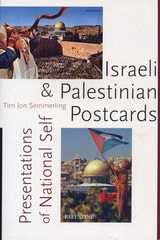
Israeli and Palestinian Postcards
Presentations of National SelfBy Tim Jon Semmerling
University of Texas Press, 2004
Searing images of suicide bombings and retaliatory strikes now define the Israeli-Palestinian conflict for many Westerners, but television and print media are not the only visual realms in which the conflict is playing out. Even tourist postcards and greeting cards have been pressed into service as vehicles through which Israelis and Palestinians present competing visions of national selfhood and conflicting claims to their common homeland.
In this book, Tim Jon Semmerling explores how Israelis and Palestinians have recently used postcards and greeting cards to present images of the national self, to build national awareness and reinforce nationalist ideologies, and to gain international acceptance. He discusses and displays the works of numerous postcard/greeting card manufacturers, artists, and photographers and identifies the symbolic choices in their postcards, how the choices are arranged into messages, what the messages convey and to whom, and who benefits and loses in these presentations of national self. Semmerling convincingly demonstrates that, far from being ephemeral, Israeli and Palestinian postcards constitute an important arena of struggle over visual signs and the power to produce reality.