59 books match the query 'Palestinian Arabs' and 5 start with i
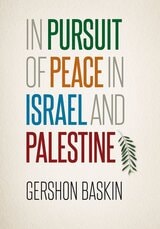
cover of In Pursuit of Peace in Israel and Palestine

In Pursuit of Peace in Israel and Palestine

Gershon Baskin

Vanderbilt University Press, 2017

Gershon Baskin's memoir of thirty-eight years of intensive pursuit of peace begins with a childhood on Long Island and a bar mitzvah trip to Israel with his family. Baskin joined Young Judaea back in the States, then later lived on a kibbutz in Israel, where he announced to his parents that he had decided to make aliya, emigrate to Israel. They persuaded him to return to study at NYU, after which he finally emigrated under the auspices of Interns for Peace. In Israel he spent a pivotal two years living with Arabs in the village of Kufr Qara.

Despite the atmosphere of fear, Baskin found he could talk with both Jews and Palestinians, and that very few others were engaged in efforts at mutual understanding. At his initiative, the Ministry of Education and the office of right-wing prime minister Menachem Begin created the Institute for Education for Jewish-Arab Coexistence with Baskin himself as director. Eight years later he founded and codirected the only joint Israeli-Palestinian public policy think-and-do tank in the world, the Israel/Palestine Center for Research and Information. For decades he continued to cross borders, often with a kaffiyeh (Arab headdress) on his dashboard to protect his car in Palestinian neighborhoods. Airport passport control became Kafkaesque as Israeli agents routinely identified him as a security threat.

During the many cycles of peace negotiations, Baskin has served both as an outside agitator for peace and as an advisor on the inside of secret talks—for example, during the prime ministership of Yitzhak Rabin and during the initiative led by Secretary of State John Kerry. Baskin ends the book with his own proposal, which includes establishing a peace education program and cabinet-level Ministries of Peace in both countries, in order to foster a culture of peace.
[more]
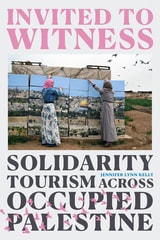
cover of Invited to Witness: Solidarity Tourism across Occupied Palestine

Invited to Witness

Solidarity Tourism across Occupied Palestine

Jennifer Lynn Kelly

Duke University Press, 2023
In Invited to Witness, Jennifer Lynn Kelly explores the significance of contemporary solidarity tourism across Occupied Palestine. Examining the relationships among race, colonialism, and movement-building in spaces where tourism and military occupation operate in tandem, Kelly argues that solidarity tourism in Palestine functions as both political strategy and emergent industry. She draws from fieldwork on solidarity tours in Palestine/Israel and interviews with guides, organizers, community members, and tourists, asking what happens when tourism is marketed as activism and when anticolonial work functions through tourism. Palestinian organizers, she demonstrates, have refashioned the conventions of tourism by extending invitations to tourists to witness Palestinian resistance and the effects of Israeli state practice on Palestinian land and lives. In so doing, Kelly shows how Palestinian guides and organizers wrest from Israeli control the capacity to invite and the permission to narrate both their oppression and their liberation.
[more]
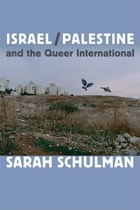
cover of Israel/Palestine and the Queer International

Israel/Palestine and the Queer International

Sarah Schulman

Duke University Press, 2012

In this chronicle of political awakening and queer solidarity, the activist and novelist Sarah Schulman describes her dawning consciousness of the Palestinian liberation struggle. Invited to Israel to give the keynote address at an LGBT studies conference at Tel Aviv University, Schulman declines, joining other artists and academics honoring the Palestinian call for an academic and cultural boycott of Israel. Anti-occupation activists in the United States, Canada, Israel, and Palestine come together to help organize an alternative solidarity visit for the American activist. Schulman takes us to an anarchist, vegan café in Tel Aviv, where she meets anti-occupation queer Israelis, and through border checkpoints into the West Bank, where queer Palestinian activists welcome her into their spaces for conversations that will change the course of her life. She describes the dusty roads through the West Bank, where Palestinians are cut off from water and subjected to endless restrictions while Israeli settler neighborhoods have full freedoms and resources.

As Schulman learns more, she questions the contradiction between Israel's investment in presenting itself as gay friendly—financially sponsoring gay film festivals and parades—and its denial of the rights of Palestinians. At the same time, she talks with straight Palestinian activists about their position in relation to homosexuality and gay rights in Palestine and internationally. Back in the United States, Schulman draws on her extensive activist experience to organize a speaking tour for some of the Palestinian queer leaders whom she had met and trusted. Dubbed "Al-Tour," it takes the activists to LGBT community centers, conferences, and universities throughout the United States. Its success solidifies her commitment to working to end Israel's occupation of Palestine, and it kindles her larger hope that a new "queer international" will emerge and join other movements demanding human rights across the globe.
[more]
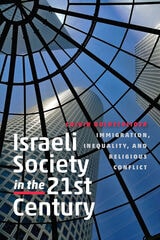
cover of Israeli Society in the Twenty-First Century: Immigration, Inequality, and Religious Conflict

Israeli Society in the Twenty-First Century

Immigration, Inequality, and Religious Conflict

Calvin Goldscheider

Brandeis University Press, 2015
This volume illuminates changes in Israeli society over the past generation. Goldscheider identifies three key social changes that have led to the transformation of Israeli society in the twenty-first century: the massive immigration of Jews from the former Soviet Union, the economic shift to a high-tech economy, and the growth of socioeconomic inequalities inside Israel. To deepen his analysis of these developments, Goldscheider focuses on ethnicity, religion, and gender, including the growth of ethnic pluralism in Israel, the strengthening of the Ultra-Orthodox community, the changing nature of religious Zionism and secularism, shifts in family patterns, and new issues and challenges between Palestinians and Arab Israelis given the stalemate in the peace process and the expansions of Jewish settlements. Combining demography and social structural analysis, the author draws on the most recent data available from the Israeli Central Bureau of Statistics and other sources to offer scholars and students an innovative guide to thinking about the Israel of the future. This book will be of interest to scholars and students of contemporary Israel, the Middle East, sociology, demography and economic development, as well as policy specialists in these fields. It will serve as a textbook for courses in Israeli history and in the modern Middle East.
[more]
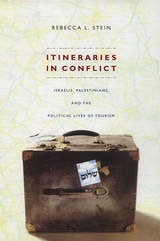
cover of Itineraries in Conflict: Israelis, Palestinians, and the Political Lives of Tourism

Itineraries in Conflict

Israelis, Palestinians, and the Political Lives of Tourism

Rebecca L. Stein

Duke University Press, 2008

In Itineraries in Conflict, Rebecca L. Stein argues that through tourist practices—acts of cultural consumption, routes and imaginary voyages to neighboring Arab countries, culinary desires—Israeli citizens are negotiating Israel’s changing place in the contemporary Middle East. Drawing on ethnographic and archival research conducted throughout the last decade, Stein analyzes the divergent meanings that Jewish and Palestinian citizens of Israel have attached to tourist cultures, and she considers their resonance with histories of travel in Israel, its Occupied Territories, and pre-1948 Palestine. Stein argues that tourism’s cultural performances, spaces, souvenirs, and maps have provided Israelis in varying social locations with a set of malleable tools to contend with the political changes of the last decade: the rise and fall of a Middle East Peace Process (the Oslo Process), globalization and neoliberal reform, and a second Palestinian uprising in 2000.

Combining vivid ethnographic detail, postcolonial theory, and readings of Israeli and Palestinian popular texts, Stein considers a broad range of Israeli leisure cultures of the Oslo period with a focus on the Jewish desires for Arab things, landscapes, and people that regional diplomacy catalyzed. Moving beyond conventional accounts, she situates tourism within a broader field of “discrepant mobility,” foregrounding the relationship between histories of mobility and immobility, leisure and exile, consumption and militarism. She contends that the study of Israeli tourism must open into broader interrogations of the Israeli occupation, the history of Palestinian dispossession, and Israel’s future in the Arab Middle East. Itineraries in Conflict is both a cultural history of the Oslo process and a call to fellow scholars to rethink the contours of the Arab-Israeli conflict by considering the politics of popular culture in everyday Israeli and Palestinian lives.

[more]