Results by title
104 books match the query 'Parenting' and 2 start with i
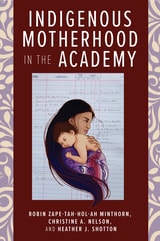
Indigenous Motherhood in the Academy
Robin Zape-tah-hol-ah Minthorn
Rutgers University Press, 2022
Indigenous Motherhood in the Academy highlights the experiences and narratives emerging from Indigenous mothers in the academy who are negotiating their roles in multiple contexts. The essays in this volume contribute to the broader higher education literature and the literature on Indigenous representation in the academy, filling a longtime gap that has excluded Indigenous women scholar voices. This book covers diverse topics such as the journey to motherhood, lessons through motherhood, acknowledging ancestors and grandparents in one’s mothering, how historical trauma and violence plague the past, and balancing mothering through the healing process. More specific to Indigenous motherhood in the academy is how culture and place impacts mothering (specifically, if Indigenous mothers are not in their traditional homelands as they raise their children), how academia impacts mothering, how mothering impacts scholarship, and how to negotiate loss and other complexities between motherhood and one’s role in the academy.
[more]
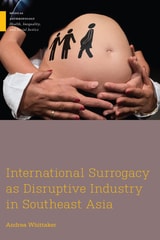
International Surrogacy as Disruptive Industry in Southeast Asia
Whittaker, Andrea
Rutgers University Press, 2019
During the last two decades, a new form of trade in commercial surrogacy grew across Asia. Starting in India, a “disruptive” model of surrogacy offered mass availability, rapid accessibility, and created new demands for surrogacy services from people who could not afford or access surrogacy elsewhere.
In International Surrogacy as Disruptive Industry in Southeast Asia, Andrea Whittaker traces the development of this industry and its movement across Southeast Asia following a sequence of governmental bans in India, Nepal, Thailand, and Cambodia. Through a case study of the industry in Thailand, the book offers a nuanced and sympathetic examination of the industry from the perspectives of the people involved in it: surrogates, intended parents, and facilitators. The industry offers intended parents the opportunity to form much desired families, but also creates vulnerabilities for all people involved. These vulnerabilities became evident in cases of trafficking, exploitation, and criminality that emerged in southeast Asia, leading to greater scrutiny on the industry as a whole. Yet the trade continues in new flexible hybrid forms, involving the circulation of reproductive gametes, embryos, surrogates, and ova donors across international borders to circumvent regulations. The book demonstrates the need for new forms of regulation to protect those involved in international surrogacy arrangements.
In International Surrogacy as Disruptive Industry in Southeast Asia, Andrea Whittaker traces the development of this industry and its movement across Southeast Asia following a sequence of governmental bans in India, Nepal, Thailand, and Cambodia. Through a case study of the industry in Thailand, the book offers a nuanced and sympathetic examination of the industry from the perspectives of the people involved in it: surrogates, intended parents, and facilitators. The industry offers intended parents the opportunity to form much desired families, but also creates vulnerabilities for all people involved. These vulnerabilities became evident in cases of trafficking, exploitation, and criminality that emerged in southeast Asia, leading to greater scrutiny on the industry as a whole. Yet the trade continues in new flexible hybrid forms, involving the circulation of reproductive gametes, embryos, surrogates, and ova donors across international borders to circumvent regulations. The book demonstrates the need for new forms of regulation to protect those involved in international surrogacy arrangements.
[more]