Results by title
413 books match the query 'Pictorial works' and 14 start with i

I Am Alaskan
Brian Adams
University of Alaska Press, 2013
In this full-color tribute, Adams entices us to reconsider our ideas of this unique and compelling land and its equally individual residents. He captures subjects on urban streets and in rural villages, revealing what daily life in Alaska is really like. The portraits focus on moments both ordinary and extraordinary, serious and playful, while capturing Alaskans at their most natural. Subjects range from Alaska Native villagers to rarely seen portraits of famous Alaskans, including Sarah Palin, Vic Fischer, and Lance Mackey. Through photographs, Adams also explores his own half-Iñupiat, half–American Alaska identity in the process, revealing how he came to define himself and the state in which he lives. Frame by frame, Adams powerfully and honestly shows what it means to be an Alaskan.
Illinois Insects and Spiders
Paintings by Peggy Macnamara
University of Chicago Press, 2005
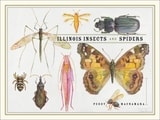
Marrying art and entomology, Illinois Insects and Spiders is a unique introduction to local biodiversity. Artist Peggy Macnamara celebrates the state's burgeoning insect and spider populations with twenty-seven color plates of beautiful renderings of numerous species, organized both taxonomically and thematically. The insects on each plate are depicted true to scale in relation to one another and are displayed approximately ten times larger than life size. Accompanying each plate are lively captions-written by Field Museum curators and collection managers-that identify the species and reveal their interesting behaviors and unique habitats.
Illinois Insects and Spiders encourages readers to explore the biodiversity at their feet-in the shiny beetles on the ground-and in the air-in the glint of a lightning bug in summer. More than a traditional field guide, Illinois Insects and Spiders is the rare book that combines lush artwork with the science of natural history, bringing both closer to the general reader.
Illuminating the Particular
Photographs of Milwaukee's Polish South SideChristel T. Maass
Wisconsin Historical Society Press, 2003
While Kwasniewski's camera captured the sights and sounds of Milwaukee at the turn of the century from the perspective of a single ethnic group in a single neighborhood, his photographs resonate far beyond Milwaukee's Polish South Side. They illuminate the particulars of American life during the early decades of the twentieth century. "What we see, reflected in the distant mirror," says John Gurda, "is ourselves."
Image and Reflection
A Pictorial History of the University of ArkansasEthel Simpson
University of Arkansas Press, 1990
Imagining Winnipeg
History Through the Photographs of L.B. FooteEsyllt W. Jones
University of Manitoba Press, 2012
Improbable Libraries
A Visual Journey to the World's Most Unusual LibrariesAlex Johnson
University of Chicago Press, 2015
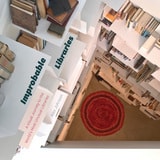
Public libraries are a cornerstone of modern civilization, yet like the books in them, libraries face an uncertain future in an increasingly digital world. Undaunted, librarians around the globe are thinking up astonishing ways of reaching those in reading need, whether by bike in Chicago, boat in Laos, or donkey in Colombia. Improbable Libraries showcases a wide range of unforgettable, never-before-seen images and interviews with librarians who are overcoming geographic, economic, and political difficulties to bring the written word to an eager audience. Alex Johnson charts the changing face of library architecture, as temporary pop-ups rub shoulders with monumental brick-and-mortar structures, and many libraries expand their mission to function as true community centers. To take just one example: the open-air Garden Library in Tel Aviv, located in a park near the city’s main bus station, supports asylum seekers and migrant workers with a stock of 3,500 volumes in sixteen different languages.
Beautifully illustrated with two hundred and fifty color photographs, Improbable Libraries offers a breathtaking tour of the places that bring us together and provide education, entertainment, culture, and so much more. From the rise of the egalitarian Little Free Library movement to the growth in luxury hotel libraries, the communal book revolution means you’ll never be far from the perfect next read.
In American Waters
The Sea in American PaintingDaniel Finamore
University of Arkansas Press, 2021
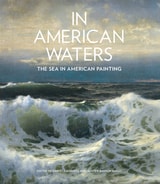
In American Waters is the catalog of an exhibition co-organized by Crystal Bridges Museum of American Art in Bentonville, Arkansas, and Peabody Essex Museum in Salem, Massachusetts.
The exhibition and this associated catalog invite visitors to discover the sea as an expansive way to reflect on American culture and environment, learn how coastal and maritime symbols moved inland across the United States, and question what it means to be “in American waters.” Work by Georgia O’Keeffe, Amy Sherald, Kay WalkingStick, Norman Rockwell, Hale Woodruff, Paul Cadmus, Thomas Hart Benton, Jacob Lawrence, Valerie Hegarty, Stuart Davis, and many others is included, along with essays from scholars, critics, and the curators.
In Nature's Name
An Anthology of Women's Writing and Illustration, 1780-1930Edited by Barbara T. Gates
University of Chicago Press, 2002
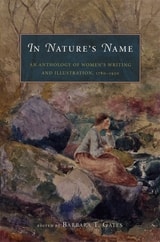
The works contained in this volume are as varied as the women who produced them. They include passionate essays on the protection of animals, vivid accounts of travel and adventure from the English seashore to the Indian Alps, poetry and fiction, and marvelous tales of nature for children. Special features of the book include a detailed chronology placing each selection in its historical and literary context; biographical sketches of each author's life and works; a comprehensive bibliography of primary and secondary literature; and over sixty illustrations.
An ideal introduction to women's powerful and diverse responses to the natural world, In Nature's Name will be treasured by anyone interested in natural history, women, or Victorian and Edwardian Britain.

In the Street
Chalk Drawings and Messages, New York City, 1938-1948Helen Levitt
Duke University Press, 1987
So wrote James Agee in 1939. He shared this fascination with children’s street drawings and messages with his friend Helen Levitt. Here now are over one hundred of her photographs, made in the years between 1938 and 1948. Most of these pictures have never before been published. They have been selected and arranged by the photographer and carefully reproduced.
Robert Coles has written especially for this book an essay on the imaginative live of children and of a time when “. . . children still had some visual independence, some keen-eyed interest in laying pictorial claim to the world around them. . . . I have not seen scenes such as Helen Levitt offers in my wanderings through America’s city streets twenty and thirty and forty years after these were taken. They offer, then, a look backward—though they are also timeless in certain aspects. For children will never really stop being tempted by their imaginative faculties to show and tell—to let others see what they find themselves conceiving in thought and fantasy and dream.”

Indianapolis
The Bass Photo Company CollectionSusan Sutton
Indiana Historical Society Press, 2008
Invasive Plants of the Upper Midwest
An Illustrated Guide to Their Identification and ControlElizabeth J. Czarapata
University of Wisconsin Press, 2005
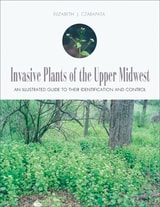
Invasive plants are a growing threat to ecosystems everywhere. Often originating in distant climes, they spread to woodlands, wetlands, prairies, roadsides, and backyards that lack the biological controls which kept these plant populations in check in their homelands.
Invasive Plants of the Upper Midwest includes more than 250 color photos that will help anyone identify problem trees, shrubs, vines, grasses, sedges, and herbaceous plants (including aquatic invaders). The text offers further details of plant identification; manual, mechanical, biological, and chemical control techniques; information and advice about herbicides; and suggestions for related ecological restoration and community education efforts. Also included are literature references, a glossary, a matrix of existing and potential invasive species in the Upper Midwest, an index with both scientific and common plant names, advice on state agencies to contact with invasive plant questions, and other helpful resources.
The information in this book has been carefully reviewed by staffs of the Wisconsin Department of Natural Resources Bureau of Endangered Resources and the University of Wisconsin-Madison Arboretum and other invasive plant experts.
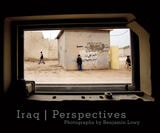
Iraq | Perspectives
Benjamin Lowy
Duke University Press, 2011
The Center for Documentary Studies / Honickman First Book Prize in Photography
Benjamin Lowy’s powerful and arresting color photographs, taken over a six-year period through Humvee windows and military-issue night vision goggles, capture the desolation of a war-ravaged Iraq as well as the tension and anxiety of both U.S. soldiers and Iraqi civilians. To photograph on the streets unprotected was impossible for Lowy, so he made images that illuminate this difficulty by shooting photographs through the windows and goggles meant to help him, and soldiers, to see. In doing so he provides us with a new way of looking at the war—an entirely different framework for regarding and thinking about the everyday activities of Iraqis in a devastated landscape and the movements of soldiers on patrol, as well as the alarm and apprehension of nighttime raids.
“Iraq was a land of blast walls and barbed wire fences. I made my first image of a concrete blast wall through the window of my armored car. These pictures show a fragment of Iraqi daily life taken by a transient passenger in a Humvee; yet they are a window to a world where work, play, tension, grief, survival, and everything in between are as familiar as the events of our own lives. . . . [In] the ‘Nightvision’ images . . . as soldiers weave through the houses and bedrooms of civilians during nighttime military raids, they encounter the faces of their suspects as well as bystanders, many of whom are parents protecting their children. . . . I hope that these images provide the viewer with momentary illumination of the fear and desperation that is war.”—Benjamin Lowy

Irina Baronova and the Ballets Russes de Monte Carlo
Victoria Tennant
University of Chicago Press, 2014
Drawing on letters, correspondence, oral histories, and interviews, Baronova’s daughter, the actress Victoria Tennant, warmly recounts Baronova’s dramatic life, from her earliest aspirations to her grueling time on tour to her later years in Australia as a pioneer of the art. She begins with the Baronov family’s flight from Russia during the Revolution, which led them to Romania and later Paris, where at the age of thirteen, Baronova became a star, chosen by the legendary George Balanchine to join the Ballets Russes, where she danced the lead in Swan Lake. Tennant provides an intimate account of Baronova’s life as a dancer and rare behind-the-scenes stories of life on the road with the stars of the company. Spectacular photographs, a mix of archival images and family snapshots, offer many rare views of rehearsals, costumes, set designs, and the dancers themselves both at their most dazzling and in their most everyday.
The story of Irina Baronova is also the story of the rise of ballet in America thanks to the Ballets Russes, who brought the magisterial beauty and star power of dance to big cities and small towns alike. Irina Baronova and the Ballet Russes de Monte Carlo offers a unique perspective on this history, sure to be treasured by dance patrons and aspiring stars.
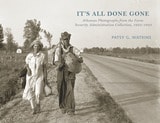
It's All Done Gone
Arkansas Photographs from the Farm Security Administration Collection, 1935-1943Patsy Watkins
University of Arkansas Press, 2018
Of the roughly one thousand FSA photographs taken in Arkansas, approximately two hundred have been selected for inclusion in this volume. Portraying workers picking cotton for five cents an hour, families evicted from homes for their connection with the Southern Tenant Farmers Union, and the effects of flood and drought that cruelly exacerbated the impact of economic disaster, these remarkable black-and-white images from Ben Shahn, Arthur Rothstein, Dorothea Lange, Walker Evans, Russell Lee, and other acclaimed photographers illustrate the extreme hardships that so many Arkansans endured throughout this era.
These powerful photographs continue to resonate, providing a glimpse of life in Arkansas that will captivate readers as they connect to a shared past.