Results by title
74 books match the query 'Puerto Rico' and 4 start with i
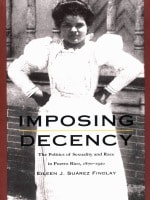
Imposing Decency
The Politics of Sexuality and Race in Puerto Rico, 1870–1920Eileen J. Suárez Findlay
Duke University Press, 2000
Feminists, socialists, Afro-Puerto Rican activists, and elite politicians join laundresses, prostitutes, and dissatisfied wives in populating the pages of Imposing Decency. Through her analyses of Puerto Rican anti-prostitution campaigns, attempts at reforming marriage, and working-class ideas about free love, Eileen J. Suárez Findlay exposes the race-related double standards of sexual norms and practices in Puerto Rico between 1870 and 1920, the period that witnessed Puerto Rico’s shift from Spanish to U.S. colonialism.
In showing how political projects and alliances in Puerto Rico were affected by racially contingent definitions of “decency” and “disreputability,” Findlay argues that attempts at moral reform and the state’s repression of “sexually dangerous” women were weapons used in batttles between elite and popular, American and Puerto Rican, and black and white. Based on a thorough analysis of popular and elite discourses found in both literature and official archives, Findlay contends that racialized sexual norms and practices were consistently a central component in the construction of social and political orders. The campaigns she analyzes include an attempt at moral reform by elite male liberals and a movement designed to enhance the family and cleanse urban space that ultimately translated into repression against symbollically darkened prostitutes. Findlay also explores how U.S. officials strove to construct a new colonial order by legalizing divorce and how feminist, labor, and Afro-Puerto Rican political demands escalated after World War I, often focusing on the rehabilitation and defense of prostitutes.
Imposing Decency forces us to rethink previous interpretations of political chronologies as well as reigning conceptualizations of both liberalism and the early working-class in Puerto Rico. Her work will appeal to scholars with an interest in Puerto Rican or Latin American studies, sexuality and national identity, women in Latin America, and general women’s studies.
[more]
Inhabiting the Impossible
Dance and Experimentation in Puerto RicoSusan Homar and nibia pastrana santiago, Editors
University of Michigan Press, 2023
This first-of-its-kind book brings together writing by artists and scholars to survey the lively field of Puerto Rican experimental dance across four decades. Originally published as Habitar lo Imposible, the translation in English features essays, artist statements, and interviews plus more than 100 photos of productions, programs, posters, and scores. Throughout, Inhabiting the Impossible provides fresh, invaluable perspectives on experimentation in dance as a sustained practice that has from the start deeply engaged issues of race, gender, sexuality, and politics. The book is also enhanced by a bibliographic section with detailed resources for further study.
[more]
Interrogating the Future of Puerto Rican Studies
Aurora Santiago Ortiz and Jorell A. Meléndez-Badillo, editors
Duke University Press, 2026
Interrogating The Future of Puerto Rican Studies brings together emerging and established scholars from a wide range of disciplines to examine the disciplinary and epistemic transformations that have given way to new understandings of the field of Puerto Rican studies. Documenting the intellectual contours that have shaped the field of Puerto Rican Studies in the last decade, a diverse range of contributors survey the field with new lenses that are attentive to gender, queerness, disability, and Blackness among other things. A foreword by Yarimar Bonilla situates the volume in the context of the field’s shift, specifically in the aftermath of Hurricane Maria, while other sections, including “Queering Puerto Rican Studies,” “Centering Blackness,” and “Disaster Studies and Environmental Studies,” as well as “Puerto Rican Studies in Broader Fields of Knowledges,” “Prefigurative Politics and Social Movements,” and “Legal and Political Disruptions,” create a vibrant archive of conversations taking place within the field of Puerto Rican studies with the aim of interrogating its future.
Contributors. José Atiles, Bárbara Abadía Rexach, Yarimar Bonilla, daniela crespo-miró, Marie Cruz Soto, Yomaira Figueroa-Vásquez, Marcela Guerrero, Gustavo García López, Mónica Jiménez, Lawrence LaFountain Stokes, Marisol LeBrón, Pedro Lebrón Ortiz, Beatriz Llenín Figueroa, Jorell Meléndez-Badillo, Sarah Molinari, Marisel Moreno, Daniel Nevárez Araújo, Aurora Santiago Ortiz, Karrieann Soto Vega, Daniel Vázquez Sanabria, Roberto Vélez-Vélez, Joaquín Villanueva, Jacqueline Villarrubia-Mendoza
Contributors. José Atiles, Bárbara Abadía Rexach, Yarimar Bonilla, daniela crespo-miró, Marie Cruz Soto, Yomaira Figueroa-Vásquez, Marcela Guerrero, Gustavo García López, Mónica Jiménez, Lawrence LaFountain Stokes, Marisol LeBrón, Pedro Lebrón Ortiz, Beatriz Llenín Figueroa, Jorell Meléndez-Badillo, Sarah Molinari, Marisel Moreno, Daniel Nevárez Araújo, Aurora Santiago Ortiz, Karrieann Soto Vega, Daniel Vázquez Sanabria, Roberto Vélez-Vélez, Joaquín Villanueva, Jacqueline Villarrubia-Mendoza
[more]
Island Paradox
Puerto Rico in the 1990sFrancisco Rivera-Batiz
Russell Sage Foundation, 1996
"One of the year's best books on Puerto Rico."—El Nuevo Dia, San Juan "[The authors] are highly regarded labor economists who have written extensively and intelligently in the past, and again in this volume, on Puerto Rican migration and labor markets... There isabundant statistical data and careful analysis, some of which challenges the conventional wisdom. Highly recommended." —Choice Island Paradox is the first comprehensive, census-based portrait of social and economic life in Puerto Rico. During its nearly fiftyyears as a U.S. commonwealth, the relationship between Puerto Rico's small, developing economy and the vastly larger, more industrialized United States has triggered profound changes in the island's industry and labor force. Puerto Rico has been deeply affected by the constant flow of its people to and from the mainland, and by the influx of immigrant workers from other nations. Distinguished economists Francisco Rivera-Batiz and Carlos Santiago provide the latest data on the socioeconomic status of Puerto Rico today, and examine current conditions within the context of the major trends of the past two decades. Island Paradox describes many improvements in Puerto Rico's standard of living, including rising per-capita income, longer life expectancies, greater educational attainment, and increased job prospects for women. But it also discusses the devastating surge in unemployment. Rapid urbanization and a vanishing agricultural sector have led to severe inequality, as family income has become increasingly dependent on education and geographic location. Although Puerto Rico's close ties to the United States were the major source of the island's economic growth prior to 1970, they have also been at the root of recent hardships. Puerto Rico's trade andbusiness transactions remain predominantly with the United States, but changes in federal tax, social, and budgetary policies, along with international agreements such as NAFTA, now threaten to alter the economic ties between the island and the mainland. Island Paradox reveals the social and family changes that have occurred among Puerto Ricans on the island and the mainland. The significant decline in the island's population growth is traced in part to women's increased pursuit of educational and employment opportunities before marrying. More children are being raised by singleparents, but this stems from a higher divorce rate and not a rise in teenage pregnancy. The widespread circular migration to and from the United States has had strong repercussions for the island's labor markets and social balance, leading to concerns about an island brain drain. The Puerto Rican population in the United States hasbecome increasingly diverse, less regionally concentrated and not, as some have claimed, in danger of becoming an underclass. Within a single generation Puerto Rico has experienced social and economic shifts of an unprecedented magnitude. Island Paradox charts Puerto Rico's economic fortunes, summarizes the major demographic trends, and identifies the issues that will have the strongest bearings on Puerto Rico's prospects for a successful future. A Volume in the Russell Sage Foundation Census Series
[more]