72 books match the query 'Railroads' and 2 start with i
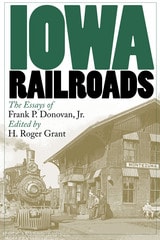
cover of Iowa Railroads: The Essays of Frank P. Donovan, Jr.

Iowa Railroads

The Essays of Frank P. Donovan, Jr.

H. Roger Grant

University of Iowa Press, 2000

What began as a study of the Minneapolis & St. Louis Railway stretched into more than a dozen contributions on Hawkeye state railroad topics. By 1969 Donovan had examined Iowa's “Little Three”: Chicago Great Western, Illinois Central, and Minneapolis & St. Paul as well as the state's “Big Four”: Chicago & North Western; Chicago, Burlington & Quincy; Chicago, Milwaukee, St. Paul & Pacific; and Chicago, Rock Island & Pacific. In addition to these seven core carriers, Donovan covered the state's less prominent railroads: Atchison, Topeka & Santa Fe; Great Northern; and Union Pacific and Wabash. Moreover, he contributed an issue on Iowa's principal interurbans, most of which survived into the 1950s as electric-powered freight-only short lines. In uniting Donovan's articles into a single volume, Iowa Railroads provides the most complete history of Iowa's rail heritage.
[more]
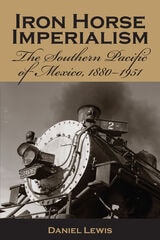
cover of Iron Horse Imperialism: The Southern Pacific of Mexico, 1880-1951

Iron Horse Imperialism

The Southern Pacific of Mexico, 1880-1951

Daniel Lewis

University of Arizona Press, 2008

The Southern Pacific of Mexico was a U.S.–owned railroad that operated between 1898 and 1951, running from the Sonoran town of Nogales, just across the border from Arizona, to the city of Guadalajara, stopping at several northwestern cities and port towns along the way. Owned by the Southern Pacific Company, which operated a highly profitable railroad system north of the border, the SP de Mex transported millions of passengers as well as millions of tons of freight over the years, both within Mexico and across its northern border. However, as Daniel Lewis discloses in this thoroughly researched investigation of the railroad, it rarely turned a profit. So why, Lewis wonders, did a savvy, money-minded U.S. corporation continue to operate the railroad until it was nationalized by the Mexican government more than a half-century after it was constructed? Iron Horse Imperialism reveals that the relationship between the Mexican government and the Southern Pacific Company was a complex one, complicated by Mexico’s defeat by U.S. forces in the mid-nineteenth century and by SP’s failure to understand that it was conducting business in a country whose leaders were ambivalent about its presence. Lewis contends that SP executives, urged on by the media of the day, operated with a reflexive imperialism that kept the company committed to the railroad long after it ceased to make business sense. Incorporating information discovered in both Mexican and American archives, some of which was previously unavailable to researchers, this comprehensive book deftly describes the complicated, decades-long dance between oblivious U.S. entrepreneurs and wary Mexican officials. It is a fascinating story.
[more]