436 books match the query 'Renaissance' and 19 start with i
cover of I Tatti Studies in the Italian Renaissance, volume 24 number 2 (Fall 2021)

I Tatti Studies in the Italian Renaissance, volume 24 number 2 (Fall 2021)

The University of Chicago Press

University of Chicago Press Journals, 2021
This is volume 24 issue 2 of I Tatti Studies in the Italian Renaissance. Published twice a year, I Tatti Studies in the Italian Renaissance features groundbreaking work written in Italian and in English on every aspect of the literary, religious, artistic, historical, and scientific dimensions of Renaissance Italy. Articles offer pioneering work in a number of areas, ranging from Botticelli’s illustrations for Dante’s Commedia to Florentine sermons on the Dives and Lazarus story to images of Ottoman culture in Mantua. The journal regularly publishes clusters of essays and other special sections.
[more]
cover of I Tatti Studies in the Italian Renaissance, volume 25 number 1 (Spring 2022)

I Tatti Studies in the Italian Renaissance, volume 25 number 1 (Spring 2022)

The University of Chicago Press

University of Chicago Press Journals, 2022
This is volume 25 issue 1 of I Tatti Studies in the Italian Renaissance. Published twice a year, I Tatti Studies in the Italian Renaissance features groundbreaking work written in Italian and in English on every aspect of the literary, religious, artistic, historical, and scientific dimensions of Renaissance Italy. Articles offer pioneering work in a number of areas, ranging from Botticelli’s illustrations for Dante’s Commedia to Florentine sermons on the Dives and Lazarus story to images of Ottoman culture in Mantua. The journal regularly publishes clusters of essays and other special sections.
[more]
cover of I Tatti Studies in the Italian Renaissance, volume 25 number 2 (Fall 2022)

I Tatti Studies in the Italian Renaissance, volume 25 number 2 (Fall 2022)

The University of Chicago Press

University of Chicago Press Journals, 2022
This is volume 25 issue 2 of I Tatti Studies in the Italian Renaissance. Published twice a year, I Tatti Studies in the Italian Renaissance features groundbreaking work written in Italian and in English on every aspect of the literary, religious, artistic, historical, and scientific dimensions of Renaissance Italy. Articles offer pioneering work in a number of areas, ranging from Botticelli’s illustrations for Dante’s Commedia to Florentine sermons on the Dives and Lazarus story to images of Ottoman culture in Mantua. The journal regularly publishes clusters of essays and other special sections.
[more]
cover of I Tatti Studies in the Italian Renaissance, volume 26 number 1 (Spring 2023)

I Tatti Studies in the Italian Renaissance, volume 26 number 1 (Spring 2023)

The University of Chicago Press

University of Chicago Press Journals, 2023
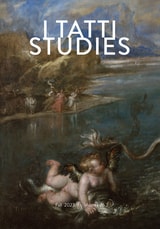
This is volume 26 issue 1 of I Tatti Studies in the Italian Renaissance. Published twice a year, I Tatti Studies in the Italian Renaissance features groundbreaking work written in Italian and in English on every aspect of the literary, religious, artistic, historical, and scientific dimensions of Renaissance Italy. Articles offer pioneering work in a number of areas, ranging from Botticelli’s illustrations for Dante’s Commedia to Florentine sermons on the Dives and Lazarus story to images of Ottoman culture in Mantua. The journal regularly publishes clusters of essays and other special sections.
[more]
cover of I Tatti Studies, volume 26 number 2 (Fall 2023)

I Tatti Studies, volume 26 number 2 (Fall 2023)

The University of Chicago Press

University of Chicago Press Journals, 2023
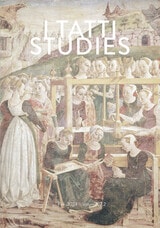
This is volume 26 issue 2 of I Tatti Studies. Published twice a year, I Tatti Studies features groundbreaking work written in Italian and in English on every aspect of the literary, religious, artistic, historical, and scientific dimensions of Renaissance Italy. Articles offer pioneering work in a number of areas, ranging from Botticelli’s illustrations for Dante’s Commedia to Florentine sermons on the Dives and Lazarus story to images of Ottoman culture in Mantua. The journal regularly publishes clusters of essays and other special sections.
[more]
cover of I Tatti Studies, volume 27 number 2 (Fall 2024)

I Tatti Studies, volume 27 number 2 (Fall 2024)

The University of Chicago Press

University of Chicago Press Journals, 2024
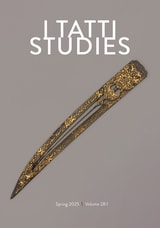
This is volume 27 issue 2 of I Tatti Studies. Published twice a year, I Tatti Studies features important new work on every aspect of the literary, religious, musical, artistic, philosophical, historical, and scientific dimensions of early modern Italy in a global context. The journal regularly publishes clusters of essays and other special sections.
[more]
cover of I Tatti Studies, volume 28 number 1 (Spring 2025)

I Tatti Studies, volume 28 number 1 (Spring 2025)

The University of Chicago Press

University of Chicago Press Journals, 2025
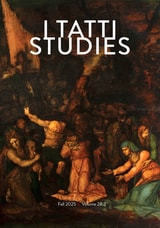
This is volume 28 issue 1 of I Tatti Studies. Published twice a year, I Tatti Studies features important new work on every aspect of the literary, religious, musical, artistic, philosophical, historical, and scientific dimensions of early modern Italy in a global context. The journal regularly publishes clusters of essays and other special sections.
[more]
cover of I Tatti Studies, volume 28 number 2 (Fall 2025)

I Tatti Studies, volume 28 number 2 (Fall 2025)

The University of Chicago Press

University of Chicago Press Journals, 2025
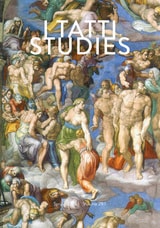
This is volume 28 issue 2 of I Tatti Studies. Published twice a year, I Tatti Studies features important new work on every aspect of the literary, religious, musical, artistic, philosophical, historical, and scientific dimensions of early modern Italy in a global context. The journal regularly publishes clusters of essays and other special sections.
[more]
cover of I Tatti Studies, volume 29 number 1 (Spring 2026)

I Tatti Studies, volume 29 number 1 (Spring 2026)

The University of Chicago Press

University of Chicago Press Journals, 2026
This is volume 29 issue 1 of I Tatti Studies. Published twice a year, I Tatti Studies features important new work on every aspect of the literary, religious, musical, artistic, philosophical, historical, and scientific dimensions of early modern Italy in a global context. The journal regularly publishes clusters of essays and other special sections.
[more]
cover of Iconoclasm

Iconoclasm

David Freedberg

University of Chicago Press, 2021

With new surges of activity from religious, political, and military extremists, the destruction of images has become increasingly relevant on a global scale. A founder of the study of early modern and contemporary iconoclasm, David Freedberg has addressed this topic for five decades. His work has brought this subject to a central place in art history, critical to the understanding not only of art but of all images in society.  This volume collects the most significant of Freedberg’s texts on iconoclasm and censorship, bringing five key works back into print alongside new assessments of contemporary iconoclasm in places ranging from the Near and Middle East to the United States, as well as a fresh survey of the entire subject. The writings in this compact volume explore the dynamics and history of iconoclasm, from the furious battles over images in the Reformation to government repression in modern South Africa, the American culture wars of the early 1990s, and today’s cancel culture. 

Freedberg combines fresh thinking with deep expertise to address the renewed significance of iconoclasm, its ideologies, and its impact.  This volume also provides a supplement to Freedberg’s essay on idolatry and iconoclasm from his pathbreaking book, The Power of Images. Freedberg’s writings are of foundational importance to this discussion, and this volume will be a welcome resource for historians, museum professionals, international law specialists, preservationists, and students.
[more]
cover of Imperfect Creatures: Vermin, Literature, and the Sciences of Life, 1600-1740

Imperfect Creatures

Vermin, Literature, and the Sciences of Life, 1600-1740

Lucinda Cole

University of Michigan Press, 2016

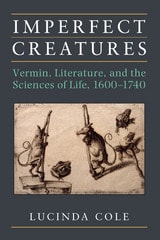
Lucinda Cole’s Imperfect Creatures offers the first full-length study of the shifting, unstable, but foundational status of “vermin” as creatures and category in the early modern literary, scientific, and political imagination. In the space between theology and an emergent empiricism, Cole’s argument engages a wide historical swath of canonical early modern literary texts—William Shakespeare’s Macbeth, Christopher Marlowe’s The Jew of Malta, Abraham Cowley’s The Plagues of Egypt, Thomas Shadwell’s The Virtuoso, the Earl of Rochester’s “A Ramble in St. James’s Park,” and Daniel Defoe’s Robinson Crusoe and Journal of the Plague Year—alongside other nonliterary primary sources and under-examined archival materials from the period, including treatises on animal trials, grain shortages, rabies, and comparative neuroanatomy.

As Cole illustrates, human health and demographic problems—notably those of feeding populations periodically stricken by hunger, disease, and famine—were tied to larger questions about food supplies, property laws, national identity, and the theological imperatives that underwrote humankind’s claim to dominion over the animal kingdom. In this context, Cole’s study indicates, so-called “vermin” occupied liminal spaces between subject and object, nature and animal, animal and the devil, the devil and disease—even reason and madness. This verminous discourse formed a foundational category used to carve out humankind’s relationship to an unpredictable, irrational natural world, but it evolved into a form for thinking about not merely animals but anything that threatened the health of the body politic—humans, animals, and even thoughts.

[more]
cover of In Defense of Women: A Bilingual Edition

In Defense of Women

A Bilingual Edition

Pompeo Colonna

Iter Press, 2024

An important contribution to early public debates on the nature of women written by a cardinal in the Roman Catholic Church.

Pompeo Colonna’s In Defense of Women (1530), presented in this volume in Latin and English translation, is one of several important defenses of women composed in the fifteenth and sixteenth centuries by male advocates of women’s moral and intellectual worth. Known as a cardinal and a warrior, but also as an active participant in sixteenth-century Italian literary circles, Colonna addresses the work to his cousin Vittoria Colonna, the most renowned Italian woman poet of the era, who, he writes, had urged him to undertake it. His Defense not only refutes arguments of women’s inferiority and incapacity but, remarkably, asserts their ability to hold political office and govern. It contains original Latin text and a critical introduction by Franco Minonzio. It also features a foreword by Margaret L. King, as well as a postscript by King, tracing the separate male-authored and female-authored Renaissance defenses of women.
 
[more]
cover of In Dialogue with the Other Voice in Sixteenth-century Italy: Literary and Social Contexts for Women's Writing

In Dialogue with the Other Voice in Sixteenth-century Italy

Literary and Social Contexts for Women's Writing

Edited by Julie D. Campbell and Maria Galli Stampino

Iter Press, 2011

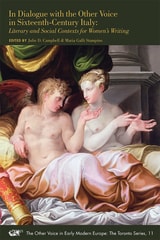
This excellent collection of essays and texts surveys the culture and intellectual context of early modern Italy in order to render more intelligible the writing of Italian women. The role of women in society and the persistent misogyny even of the most pro-woman texts are explored in the essays, and the recent critical debates are examined. The translations make available in English a selection of male-authored texts which directly or indirectly elicited the spirited responses of women, for which the volume is aptly entitled “In Dialogue.” A valuable classroom resource, the volume is an important addition to The Other Voice: Toronto series.
—Elissa Weaver
Professor of Italian, Emerita, University of Chicago
[more]
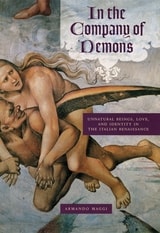
cover of In the Company of Demons: Unnatural Beings, Love, and Identity in the Italian Renaissance

In the Company of Demons

Unnatural Beings, Love, and Identity in the Italian Renaissance

Armando Maggi

University of Chicago Press, 2006

Who are the familiar spirits of classical culture and what is their relationship to Christian demons? In its interpretation of Latin and Greek culture, Christianity contends that Satan is behind all classical deities, semi-gods, and spiritual creatures, including the gods of the household, the lares and penates.But with In the Company of Demons, the world’s leading demonologist Armando Maggi argues that the great thinkers of the Italian Renaissance had a more nuanced and perhaps less sinister interpretation of these creatures or spiritual bodies.

Maggi leads us straight to the heart of what Italian Renaissance culture thought familiar spirits were. Through close readings of Giovan Francesco Pico della Mirandola, Strozzi Cigogna, Pompeo della Barba, Ludovico Sinistrari, and others, we find that these spirits or demons speak through their sudden and striking appearances—their very bodies seen as metaphors to be interpreted. The form of the body, Maggi explains, relies on the spirits’ knowledge of their human interlocutors’ pasts. But their core trait is compassion, and sometimes their odd, eerie arrivals are seen as harbingers or warnings to protect us. It comes as no surprise then that when spiritual beings distort the natural world to communicate, it is vital that we begin to listen.
[more]
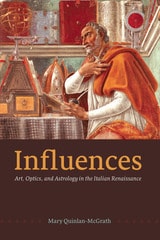
cover of Influences: Art, Optics, and Astrology in the Italian Renaissance

Influences

Art, Optics, and Astrology in the Italian Renaissance

Mary Quinlan-McGrath

University of Chicago Press, 2013

Today few would think of astronomy and astrology as fields related to theology. Fewer still would know that physically absorbing planetary rays was once considered to have medical and psychological effects. But this was the understanding of light radiation held by certain natural philosophers of early modern Europe, and that, argues Mary Quinlan-McGrath, was why educated people of the Renaissance commissioned artworks centered on astrological themes and practices.
 
Influences is the first book to reveal how important Renaissance artworks were designed to be not only beautiful but also—perhaps even primarily—functional. From the fresco cycles at Caprarola, to the Vatican’s Sala dei Pontefici, to the Villa Farnesina, these great works were commissioned to selectively capture and then transmit celestial radiation, influencing the bodies and minds of their audiences. Quinlan-McGrath examines the sophisticated logic behind these theories and practices and, along the way, sheds light on early creation theory; the relationship between astrology and natural theology; and the protochemistry, physics, and mathematics of rays.
 
An original and intellectually stimulating study, Influences adds a new dimension to the understanding of aesthetics among Renaissance patrons and a new meaning to the seductive powers of art.  
[more]
cover of Inventing the Critic in Renaissance England

Inventing the Critic in Renaissance England

William Russell

University of Delaware Press, 2011

The turn of the seventeenth century was an important moment in the history of English criticism. In a series of pioneering works of rhetoric and poetics, writers such as Philip Sidney, George Puttenham, and Ben Jonson laid the foundations of critical discourse in English, and the English word “critic” began, for the first time, to suggest expertise in literary judgment. Yet the conspicuously ambivalent attitude of these critics toward criticism—and the persistent fear that they would be misunderstood, marginalized, scapegoated, or otherwise “branded with the dignity of a critic”—suggests that the position of the critic in this period was uncertain. In Inventing the Critic in Renaissance England, William Russell reveals that the critics of the English Renaissance did not passively absorb their practice from Continental and classical sources but actively invented it in response to a confluence of social and intellectual factors.

Published by University of Delaware Press. Distributed worldwide by Rutgers University Press.
 
 
[more]
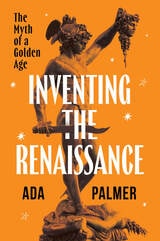
cover of Inventing the Renaissance: The Myth of a Golden Age

Inventing the Renaissance

The Myth of a Golden Age

Ada Palmer

University of Chicago Press, 2025

WINNER OF THE HUGO AWARD

A New Yorker Best Book of 2025

An irreverent new take on the Renaissance, which reveals it as anything but Europe’s golden age.

From the darkness of a plagued and war-torn Middle Ages, the Renaissance (we’re told) heralds the dawning of a new world—a halcyon age of art, prosperity, and rebirth. Hogwash! or so says award-winning novelist and historian Ada Palmer. In Inventing the Renaissance, Palmer turns her witty and irreverent eye on the fantasies we’ve told ourselves about Europe’s not-so-golden age, myths she sets right with sharp clarity.

Palmer’s Renaissance is altogether desperate. Troubled by centuries of conflict, she argues, Europe looked to a long-lost Roman Empire (even its education practices) to save it from unending war. Later historians met their own political challenges with a similarly nostalgic vision, only now they looked to the Renaissance and told a partial story. To right this wrong, Palmer offers fifteen provocative portraits of Renaissance men and women (some famous, some obscure) whose lives reveal a far more diverse, fragile, and wild Renaissance than its glowing reputation suggests.
[more]
cover of Inventing the Renaissance: The Myth of a Golden Age

Inventing the Renaissance

The Myth of a Golden Age

Ada Palmer

University of Chicago Press, 2025

WINNER OF THE HUGO AWARD

A New Yorker Best Book of 2025

An irreverent new take on the Renaissance, which reveals it as anything but Europe’s golden age.

From the darkness of a plagued and war-torn Middle Ages, the Renaissance (we’re told) heralds the dawning of a new world—a halcyon age of art, prosperity, and rebirth. Hogwash! or so says award-winning novelist and historian Ada Palmer. In Inventing the Renaissance, Palmer turns her witty and irreverent eye on the fantasies we’ve told ourselves about Europe’s not-so-golden age, myths she sets right with sharp clarity.

Palmer’s Renaissance is altogether desperate. Troubled by centuries of conflict, she argues, Europe looked to a long-lost Roman Empire (even its education practices) to save it from unending war. Later historians met their own political challenges with a similarly nostalgic vision, only now they looked to the Renaissance and told a partial story. To right this wrong, Palmer offers fifteen provocative portraits of Renaissance men and women (some famous, some obscure) whose lives reveal a far more diverse, fragile, and wild Renaissance than its glowing reputation suggests.

[more]
cover of Inwardness and Theater in the English Renaissance

Inwardness and Theater in the English Renaissance

Katharine Eisaman Maus

University of Chicago Press, 1995

Katharine Eisaman Maus explores Renaissance writers' uneasy preoccupation with the inwardness and invisibility of truth. The perceived discrepancy between a person's outward appearance and inward disposition, she argues, deeply influenced the ways English Renaissance dramatists and poets conceived of the theater, imagined dramatic characters, and reflected upon their own creativity.

Reading works by Kyd, Marlowe, Shakespeare, Jonson, and Milton in conjuction with sectarian polemics, gynecological treatises, and accounts of criminal prosecutions, Maus delineates unexplored connections among religious, legal, sexual, and theatrical ideas of inward truth. She reveals what was at stake—ethically, politically, epistemologically, and theologically—when a writer in early modern England appealed to the difference between external show and interior authenticity. Challenging the recent tendency to see early modern selfhood as defined in wholly public terms, Maus argues that Renaissance dramatists continually payed homage to aspects of inner life they felt could never be manifested onstage.
[more]