82 books match the query 'Revolution, 1775-1783' and 6 start with i
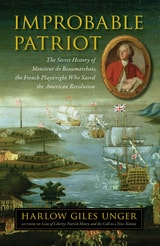
cover of Improbable Patriot: The Secret History of Monsieur de Beaumarchais, the French Playwright Who Saved the American Revolution

Improbable Patriot

The Secret History of Monsieur de Beaumarchais, the French Playwright Who Saved the American Revolution

Harlow Giles Unger

University Press of New England, 2011
Pierre-Augustin Caron de Beaumarchais was an eighteenth-century French inventor, famed playwright, and upstart near-aristocrat in the court of King Louis XVI. In 1776, he conceived an audacious plan to send aid to the American rebels. What’s more, he convinced the king to bankroll the project, and singlehandedly carried it out. By war’s end, he had supplied Washington’s army with most of its weapons and powder, though he was never paid or acknowledged by the United States. To some, he was a dashing hero—a towering intellect who saved the American Revolution. To others, he was pure rogue—a double-dealing adventurer who stopped at nothing to advance his fame and fortune. In fact, he was both, and more: an advisor to kings, an arms dealer, and author of some of the most enduring works of the stage, including The Marriage of Figaro and The Barber of Seville.
[more]
cover of Inequality in Early America

Inequality in Early America

Carla Gardina Pestana

Dartmouth College Press, 2015
This book was designed as a collaborative effort to satisfy a long-felt need to pull together many important but separate inquiries into the nature and impact of inequality in colonial and revolutionary America. It also honors the scholarship of Gary Nash, who has contributed much of the leading work in this field. The 15 contributors, who constitute a Who's Who of those who have made important discoveries and reinterpretations of this issue, include Mary Beth Norton on women's legal inequality in early America; Neal Salisbury on Puritan missionaries and Native Americans; Laurel Thatcher Ulrich on elite and poor women's work in early Boston; Peter Wood and Philip Morgan on early American slavery; as well as Gary Nash himself writing on Indian/white history. This book is a vital contribution to American self-understanding and to historical analysis.
[more]
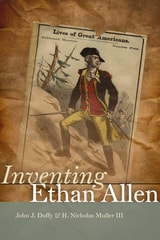
cover of Inventing Ethan Allen

Inventing Ethan Allen

John J. Duffy and H. Nicholas Muller

University Press of New England, 2014
Since 1969, Ethan Allen has been the subject of three biographical studies, all of which indulge in sustaining and revitalizing the image of Allen as a physically imposing Vermont yeoman, a defender of the rights of Americans, an eloquent military hero, and a master of many guises, from rough frontiersman to gentleman philosopher. Seeking the authentic Ethan Allen, the authors of this volume ask: How did that Ethan Allen secure his place in popular culture? As they observe, this spectacular persona leaves little room for a more accurate assessment of Allen as a self-interested land speculator, rebellious mob leader, inexperienced militia officer, and truth-challenged man who would steer Vermont into the British Empire. Drawing extensively from the correspondence in Ethan Allen and his Kin and a wide range of historical, political, and cultural sources, Duffy and Muller analyze the factors that led to Ethan Allen’s two-hundred-year-old status as the most famous figure in Vermont’s past. Placing facts against myths, the authors reveal how Allen acquired and retained his iconic image, how the much-repeated legends composed after his death coincide with his life, why recollections of him are synonymous with the story of Vermont, and why some Vermonters still assign to Allen their own cherished and idealized values.
[more]
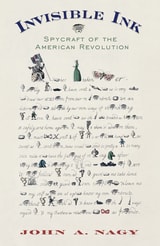
cover of Invisible Ink: Spycraft of the American Revolution

Invisible Ink

Spycraft of the American Revolution

John A. Nagy

Westholme Publishing, 2010

The Critical Role of Espionage During the War of Independence and the Techniques Spies Used
During the American Revolution, espionage was critical to the successes and failures of both Continental and British efforts, and those employed in cloakand- dagger operations always risked death. While the most notorious episode of spying during the war—the Benedict Arnold affair—was a failure, most intelligence operations succeeded. Spycraft was no more wholly embraced than by the American commander-in-chief, George Washington. Washington relied on a vast spy network and personally designed sophisticated battle plan deceptions and counterintelligence efforts, some surprisingly modern in form. In Invisible Ink: Spycraft of the American Revolution, award-winning author John A. Nagy briefly traces the history of spy techniques from ancient China through Elizabethan England before embarking on the various techniques used by spies on both sides of the war to exchange secret information. These methods included dictionary codes, diplomatic ciphers, dead drops, hidden compartments (such as a hollowed-out bullet or a woman’s garter), and even musical notation, as well as efforts of counterintelligence, including “Black Chambers,” where postal correspondence was read by cryptologists. Throughout, the author provides examples of the various codes and ciphers employed, many of which have not been previously described. In addition, the author analyzes some of the key spy rings operating during the war, most notably the Culper ring that provided information to Washington from inside British-controlled New York City. Based on nearly two decades of primary research, including the author’s discovery of previously unrecognized spies and methods, Invisible Ink is a major contribution to the history of conflict and technology.
[more]
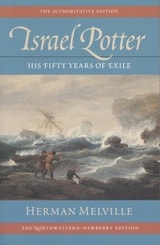
cover of Israel Potter: His Fifty Years of Exile, Volume Eight

Israel Potter

His Fifty Years of Exile, Volume Eight

Herman Melville

Northwestern University Press, 1997

Unique among Melville's works, Israel Potter was the author's only historical novel, presuming to offer the life history of Revolutionary War figure Israel Potter--based on Potter's own obscure narrative Life and Remarkable Adventures of Israel R. Potter--and featuring characters such as Benjamin Franklin and Ethan Allen. In offering the manuscript to his publisher, Melville assured him, "I engage that the story shall contain nothing of any sort to shock the fastidious. There will be very little reflective writing in it; nothing weighty. It is adventure." This came as a relief, for his previous novel, Pierre, had shocked readers and brought down universal castigation.

This edition is an Approved Text of the Center for Editions of American Authors (Modern Language Association of America).
[more]
cover of Israel Potter: His Fifty Years of Exile, Volume Eight, Scholarly Edition

Israel Potter

His Fifty Years of Exile, Volume Eight, Scholarly Edition

Herman Melville

Northwestern University Press, 1982

Unique among Melville's works, Israel Potter was the author's only historical novel, presuming to offer the life history of Revolutionary War figure Israel Potter--based on Potter's own obscure narrative Life and Remarkable Adventures of Israel R. Potter--and featuring characters such as Benjamin Franklin and Ethan Allen. In offering the manuscript to his publisher, Melville assured him, "I engage that the story shall contain nothing of any sort to shock the fastidious. There will be very little reflective writing in it; nothing weighty. It is adventure." This came as a relief, for his previous novel, Pierre, had shocked readers and brought down universal castigation.

This edition is an Approved Text of the Center for Editions of American Authors (Modern Language Association of America).
[more]