Results by title
397 books match the query 'Rome' and 7 start with i
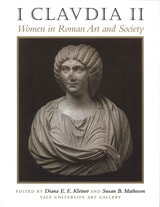
I Claudia II
Women in Roman Art and SocietyEdited by Diana E. E. Kleiner and Susan B. Matheson
University of Texas Press, 2000
I, Claudia: Women in Ancient Rome—an exhibition and catalog produced by the Yale University Art Gallery—provided the first comprehensive study of the lives of Roman women as revealed in Roman art. Responding to the popular success of the exhibit and catalog, Diana E. E. Kleiner and Susan B. Matheson here gather ten additional essays by specialists in art history, history, and papyrology to offer further reflections on women in Roman society based on the material evidence provided by art, archaeology, and ancient literary sources.
In addition to the editors, the contributors are Cornelius C. Vermeule, Rolf Winkes, Mary T. Boatwright, Susan Wood, Eve D'Ambra, Andrew Oliver, Diana Delia, and Ann Ellis Hanson. Their essays, illustrated with black-and-white photos of the art under discussion, treat such themes as mothers and sons, marriage and widowhood, aging, adornment, imperial portraiture, and patronage.
Identity Crises in Apuleius
The Empire and the Ass in Ancient RomeAshli J. E. Baker
University of Wisconsin Press, 2026
In the second century CE, the multiethnic, multilingual, and religiously diverse Roman Empire grew to its greatest extent. To maintain order, Rome relied heavily on strict social hierarchies, established not only through legal frameworks like citizenship, but also through cultural markers (such as clothing and language) and personal traits (such as educational achievement). Even as Rome grew into one of the world’s most powerful empires, however, its social systems strained under the stresses caused by that very growth, which encouraged cultural interaction, long-distance travel, and social mobility—all of which threatened the hierarchies that underpinned Roman order.
It was during this time that the North African–born, Latin-speaking, Greek-educated Apuleius—whose own background showcases the multiplicity of identities available then to Roman individuals—flourished. He remains one of the ancient world’s best-known authors today, thanks particularly to his famous novel, Metamorphoses, known also as The Golden Ass. Taking a bird’s-eye view of his work, Ashli J. E. Baker proffers a bold new reading of Apuleius, proposing that across his writings there is a consistent focus on the theme of identity and its instability. By placing close readings in conversation with sociocultural and material contexts, she shows that because the structures of Roman power depended on inherently unreliable markers of identity, Apuleius’ work can be read as a biting critique of the fraught relationship between the individual, society, and the state in his contemporary Rome.
Imperium and Cosmos
Augustus and the Northern Campus MartiusPaul Rehak; Edited by John G. Younger
University of Wisconsin Press, 2006
Rehak closely examines the artistic imagery on these monuments, providing numerous illustrations, tables, and charts. In an analysis firmly contextualized by a thorough discussion of the earlier models and motifs that inspired these Augustan monuments, Rehak shows how the princeps used these on such an unprecedented scale as to truly elevate himself above the common citizen.
In the Flesh
Embodied Identities in Roman ElegyErika Zimmermann Damer
University of Wisconsin Press, 2022
Recognizing this power of material flesh to shape elegiac poetry, she asserts, grants figures at the margins of this poetic discourse—mistresses, rivals, enslaved characters, overlooked members of households—their own identities, even when they do not speak. She demonstrates how the three poets create a prominent aesthetic of corporeal abjection and imperfection, associating the body as much with blood, wounds, and corporeal disintegration as with elegance, refinement, and sensuality.
Indo-European Sacred Space
Vedic and Roman CultRoger D. Woodard
University of Illinois Press, 2006
Looking closely at the organization of Roman religious activity, especially as regards sacrifices, festivals, and the hierarchy of priests, Woodard sheds new light on issues including the presence of the god Terminus in Jupiter's Capitoline temple, the nature of the Roman suovetaurilia, the Ambarvalia and its relationship to the rites of the Fratres Arvales, and the identification of the "Sabine" god Semo Sancus. Perhaps most significantly, this work also presents a novel and persuasive resolution to the long standing problem of "agrarian Mars."
Investment, Profit, and Tenancy
The Jurists and the Roman Agrarian EconomyDennis P. Kehoe
University of Michigan Press, 1997
In Investment, Profit, and Tenancy Dennis P. Kehoe defines the economic mentality of upper-class Romans by analyzing the assumptions that Roman jurists in the Digest of Justinian made about investment and profit in agriculture as they addressed legal issues involving private property. In particular the author analyzes the duties of guardians in managing the property of their wards, and the bequeathing of agricultural property. He bases his analysis on Roman legal sources, which offer a comprehensive picture of the economic interests of upper-class Romans. Farm tenancy was crucial to these interests, and Kehoe carefully examines how Roman landowners contended with the legal, social, and economic institutions surrounding farm tenancy as they pursued security from their agricultural investments.
Kehoe argues that Roman jurists offer a consistent picture of agriculture as a form of investment that was grounded in upper-class conceptions of the Roman economy. In the eyes of the jurists, agriculture represented the only form of investment capable of providing upper-class Romans with economic security, and this situation had important implications for the relationship between landowners and tenants. Landowners who sought economic stability from their agricultural holdings preferred to simplify the task of managing their estates by delegating the work and costs to their tenants. This tended to make landowners depend on the expertise and resources of tenants, which in turn gave the tenants significant bargaining power. This dynamic relationship is traced in the jurists' regulation of farm tenancy, as the jurists adapted Roman law to the economic realities of the Roman empire.
Investment, Profit, and Tenancy will be of interest to classicists as well as to scholars of preindustrial comparative economics.
Dennis P. Kehoe is Professor of Classical Studies, Tulane University.

Ireland and the Classical World
By Philip Freeman
University of Texas Press, 2000
On the boundary of what the ancient Greeks and Romans considered the habitable world, Ireland was a land of myth and mystery in classical times. Classical authors frequently portrayed its people as savages—even as cannibals and devotees of incest—and evinced occasional uncertainty as to the island's shape, size, and actual location. Unlike neighboring Britain, Ireland never knew Roman occupation, yet literary and archaeological evidence prove that Iuverna was more than simply terra incognita in classical antiquity.
In this book, Philip Freeman explores the relations between ancient Ireland and the classical world through a comprehensive survey of all Greek and Latin literary sources that mention Ireland. He analyzes passages (given in both the original language and English) from over thirty authors, including Julius Caesar, Strabo, Tacitus, Ptolemy, and St. Jerome. To amplify the literary sources, he also briefly reviews the archaeological and linguistic evidence for contact between Ireland and the Mediterranean world.
Freeman's analysis of all these sources reveals that Ireland was known to the Greeks and Romans for hundreds of years and that Mediterranean goods and even travelers found their way to Ireland, while the Irish at least occasionally visited, traded, and raided in Roman lands. Everyone interested in ancient Irish history or Classics, whether scholar or enthusiast, will learn much from this pioneering book.