Results by title
137 books match the query 'Science & Technology' and 3 start with i
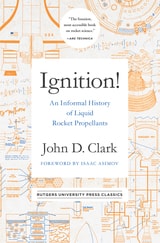
Ignition!
An Informal History of Liquid Rocket PropellantsClark, John D
Rutgers University Press, 1972
A classic work in the history of science, and described as “a good book on rocket stuff…that’s a really fun one” by SpaceX founder Elon Musk, readers will want to get their hands on this influential classic, available for the first time in decades.
This newly reissued debut book in the Rutgers University Press Classics imprint is the story of the search for a rocket propellant which could be trusted to take man into space. This search was a hazardous enterprise carried out by rival labs who worked against the known laws of nature, with no guarantee of success or safety.
Acclaimed scientist and sci-fi author John Drury Clark writes with irreverent and eyewitness immediacy about the development of the explosive fuels strong enough to negate the relentless restraints of gravity. The resulting volume is as much a memoir as a work of history, sharing a behind-the-scenes view of an enterprise which eventually took men to the moon, missiles to the planets, and satellites to outer space.
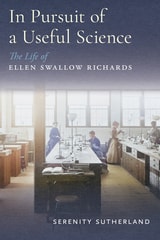
In Pursuit of a Useful Science
The Life of Ellen Swallow RichardsSerenity Sutherland
University of Massachusetts Press, 2027
Recovering the life of a woman who believed science could and should change the world
In May 1921, Marie Curie stood at Carnegie Hall and accepted a prize named for a woman she had never met. Ellen Swallow Richards had been dead for ten years, but her network of college-educated women had raised $2,000 to fund Curie’s research into the medical uses of radium. In Pursuit of a Useful Science offers a richly layered biography of Richards: the first woman to study and teach at MIT—a pioneer of nutrition science, water chemistry, sanitation, and what would now be called science communication.
At the heart of this book is Richards’s defining conviction that science should be useful—applied to the everyday problems of real people, from baking bread to safe drinking water to the management of sewage—and communicated clearly to the public. She tested nutrition science in a public kitchen, researched sewage treatment at a physical water treatment plant, and proved that women could study science without threat to their health at MIT’s Woman’s Laboratory. She published over one hundred works for public audiences, organized exhibits and lectures, and at the end of her life gathered her wide-ranging work into one of the first scientifically informed calls to protect the natural environment.
As Serenity Sutherland shows, Richards grappled with the gap between scientific authority and everyday practice, even as she rarely confronted how her own assumptions shaped the knowledge she advanced. Drawing on extensive archival sources, this study situates Richards within the expanding role of women in science and the rising cultural authority of scientific expertise in American life.
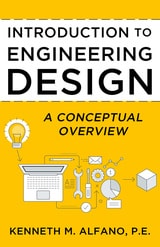
Introduction to Engineering Design
A Conceptual OverviewKenneth Alfano
Michigan Publishing Services, 2025
Engineering design courses are often project-oriented, and rightly so, given that the process is best understood through some amount of experience. But a conceptual foundation is likewise critical for this subject. It helps enable experiential learning to relate the broad context of design process elements to the specific context of a given project. Further, engineering students tend to start out more acquainted with thinking about math and science subjects, where there is often one way – or at least a clear best way – to a “right” answer. The design process, by marked contrast, is largely qualitative and open-ended. Relatedly, it can (perhaps ironically) aid early learners to point out how varied and inconsistent the usage can be for some terminology – so the book does so at times, to help preempt confusion down the road.
In addition to being a text for an introductory college course, the book can also serve as a supplemental or reference text for later courses or on the job, or simply a general overview for those curious about the subject.