Results by title
64 books match the query 'Self in literature' and 5 start with i
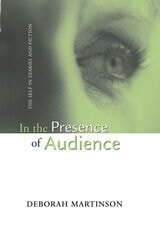
IN THE PRESENCE OF AUDIENCE
THE SELF IN DIARIES AND FICTIONDeborah Martinson
The Ohio State University Press, 2003
As a diary writer imagines shadow readers rifling diary pages, she tweaks images of the self, creating multiple readings of herself, fixed and unfixed. When the readers and potential readers are husbands and publishers, the writer maneuvers carefully in a world of men who are quick to judge and to take offense. She fills the pages with reflections, anecdotes, codes, stories, biographies, and fictions. The diary acts as a site for the writer’s tension, rebellion, and remaking of herself.
In this book Martinson examines the diaries of Virginia Woolf, Katherine Mansfield, Violet Hunt, and Doris Lessing’s fictional character Anna Wulf, and shows that these diaries (and others like them) are not entirely private writings as has been previously assumed. Rather, their authors wrote them knowing they would be read. In these four cases, the audience is the author’s male lover or husband, and Martinson reveals how knowledge of this audience affects the language and content in each diary. Ultimately, she argues, this audience enforces a certain “male censorship” which changes the shape of the revelations, the shape of the writer herself, making it impossible for the female author to be honest in writing about her true self.
Even sophisticated readers often assume that diaries are primarily private. This study interrogates the myth of authenticity and self-revelation in diaries written under the gaze of particular peekers.
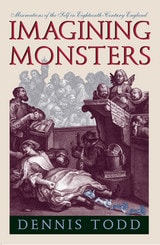
Imagining Monsters
Miscreations of the Self in Eighteenth-Century EnglandDennis Todd
University of Chicago Press, 1995
Mary Toft's outrageous claim was accepted because of a common belief that the imagination of a pregnant woman could deform her fetus, creating a monster within her. Drawing on largely unexamined material from medicine, embryology, philosophy, and popular "monster" exhibitions, Todd shows that such ideas about monstrous births expressed a fear central to scientific, literary, and philosophical thinking: that the imagination could transgress the barrier between mind and body.
In his analysis of the Toft case, Todd exposes deep anxieties about the threat this transgressive imagination posed to the idea of the self as stable, coherent, and autonomous. Major works of Pope and Swift reveal that they, too, were concerned with these issues, and Imagining Monsters provides detailed discussions of Gulliver's Travels and The Dunciad illustrating how these writers used images of monstrosity to explore the problematic nature of human identity. It also includes a provocative analysis of Pope's later work that takes into account his physical deformity and his need to defend himself in a society that linked a deformed body with a deformed character.
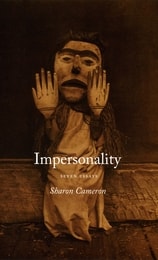
Impersonality
Seven EssaysSharon Cameron
University of Chicago Press, 2007
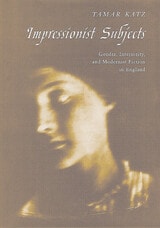
Impressionist Subjects
Gender, Interiority, and Modernist Fiction in EnglandTamar Katz
University of Illinois Press, 2000
Sophisticated and tightly argued, Impressionist Subjects is a substantial contribution to the reassessment and expansion of the modernist fiction canon.
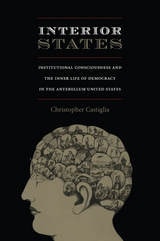
Interior States
Institutional Consciousness and the Inner Life of Democracy in the Antebellum United StatesChristopher Castiglia
Duke University Press, 2008
In the late eighteenth century and early nineteenth, as discourses of interiority gained prominence, so did powerful counter-narratives. Castiglia reveals the flamboyant pages of antebellum popular fiction to be an archive of unruly democratic aspirations. Through close readings of works by Maria Monk and George Lippard, Walt Whitman and Timothy Shay Arthur, Hannah Webster Foster and Hannah Crafts, and Nathaniel Hawthorne and Herman Melville, Castiglia highlights a refusal to be reformed or self-contained. In antebellum authors’ representations of nervousness, desire, appetite, fantasy, and imagination, he finds democratic strivings that refused to disappear. Taking inspiration from those writers and turning to the present, Castiglia advocates a humanism-without-humans that, denied the adjudicative power of interiority, promises to release democracy from its inner life and to return it to the public sphere where U.S. citizens may yet create unprecedented possibilities for social action.