Results by title
82 books match the query 'Semantics' and 2 start with i
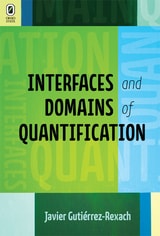
Interfaces and Domains of Quantification
Javier Gutiérrez-Rexach
The Ohio State University Press, 2014
Quantification is an intrinsically complex mechanism of expression in natural language, comprising a variety of structural shapes and semantic domains whose inventory has not been completely charted to date. Several linguistic forms associated with quantification in Spanish are explored in Interfaces and Domains of Quantification by Javier Gutiérrez-Rexach, from indefiniteness and ellipsis to the quantificational properties of relative clauses and adverbial particles.
Interfaces and Domains of Quantification advocates an interface approach to the grammar of Spanish quantification. Only a precise characterization of the syntactic properties of quantificational constructions and of their associated meanings allows us to understand how more general syntactic and semantic constraints are at work. Among other findings, the interaction of scope and parallelism with ellipsis is reconsidered; the structural significance of modal anchoring and essential properties for the interpretation of indefiniteness is explored in detail; additionally, quantificational variability and correlativity phenomena in relative clauses are analyzed; degree expression is characterized for concessive conditionals and superlatives; and, finally, several discourse particles with a quantificational core are shown to be critical for the articulation of semantic and discourse-pragmatic relations. Taking a detailed look at the different forms, patterns and structures associated with several quantificational domains seems to be the only fully explanatory way to advance our knowledge of the syntax, semantics and pragmatics of quantificational structures.
Interfaces and Domains of Quantification advocates an interface approach to the grammar of Spanish quantification. Only a precise characterization of the syntactic properties of quantificational constructions and of their associated meanings allows us to understand how more general syntactic and semantic constraints are at work. Among other findings, the interaction of scope and parallelism with ellipsis is reconsidered; the structural significance of modal anchoring and essential properties for the interpretation of indefiniteness is explored in detail; additionally, quantificational variability and correlativity phenomena in relative clauses are analyzed; degree expression is characterized for concessive conditionals and superlatives; and, finally, several discourse particles with a quantificational core are shown to be critical for the articulation of semantic and discourse-pragmatic relations. Taking a detailed look at the different forms, patterns and structures associated with several quantificational domains seems to be the only fully explanatory way to advance our knowledge of the syntax, semantics and pragmatics of quantificational structures.
[more]

Introduction to Natural Language Semantics
Henriëtte de Swart
CSLI, 1998
Semantics is defined as the study of meaning expressed by elements of a language or combinations thereof. Utterances are not just noises or scribbles, they are used to convey information, and they are linked with kinds of events and with states of mind.
This text examines what issues semantics, as a theory of meaning, should address; determining what the meanings of words of the language are and how to semantically combine elements of a language to build up complex meanings. Logical languages are then developed as formal metalanguages to natural language. Subsequent chapters address propositional logic, the syntax and semantics of (first-order) predicate logic as an extension of propositional logic, and Generalized Quantifier theory. Going beyond extensional theory, Henri'tte de Swart relativizes the interpretation of expressions to times to account for verbal tense, time adverbials and temporal connectives and introduces possible worlds to model intensions, modal adverbs and modal auxiliaries.
This broad overview of natural language semantics should cover most of the points addressed in an introductory course. Numerous exercises punctuate each chapter and an example exam based on the materials presented is included, making this volume a perfect textbook and resource for any undergraduate or graduate-level introductory course in semantics.
[more]