Results by title
127 books match the query 'Sexual behavior' and 3 start with i

I Live in the Country & other dirty poems
Arielle Greenberg
Four Way Books, 2020
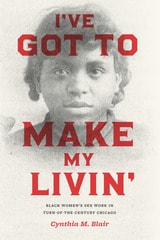
I've Got to Make My Livin'
Black Women's Sex Work in Turn-of-the-Century ChicagoCynthia M. Blair
University of Chicago Press, 2010
For many years, the interrelated histories of prostitution and cities have perked the ears of urban scholars, but until now the history of urban sex work has dealt only in passing with questions of race. In I’ve Got to Make My Livin’, Cynthia Blair explores African American women’s sex work in Chicago during the decades of some of the city’s most explosive growth, expanding not just our view of prostitution, but also of black women’s labor, the Great Migration, black and white reform movements, and the emergence of modern sexuality.
Focusing on the notorious sex districts of the city’s south side, Blair paints a complex portrait of black prostitutes as conscious actors and historical agents; prostitution, she argues here, was both an arena of exploitation and abuse, as well as a means of resisting middle-class sexual and economic norms. Blair ultimately illustrates just how powerful these norms were, offering stories about the struggles that emerged among black and white urbanites in response to black women’s increasing visibility in the city’s sex economy. Through these powerful narratives, I’ve Got to Make My Livin’ reveals the intersecting racial struggles and sexual anxieties that underpinned the celebration of Chicago as the quintessentially modern twentieth-century city.
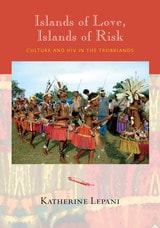
Islands of Love, Islands of Risk
Culture and HIV in the TrobriandsKatherine Lepani
Vanderbilt University Press, 2012
Written by an anthropologist who has direct ties to the Trobriands through marriage and who has been involved in Papua New Guinea's national response to the HIV epidemic since the mid-1990s, Islands of Love, Islands of Risk is an unusual insider ethnography. Katherine Lepani describes in vivid detail the cultural practices of regeneration, from the traditional dance called Wosimwaya to the elaborate exchanges that are part of the mortuary feasts called sagali. Focusing on the sexual freedom of young people, the author reveals the social value of sexual practice. By bringing cultural context and lived experience to the fore, the book addresses the failure of standardized public health programs to bridge the persistent gap between HIV awareness and prevention. The book offers insights on the interplay between global and local understandings of gender, sexuality, and disease and suggests the possibility of viewing sexuality in terms other than risk.
Islands of Love, Islands of Risk illustrates the contribution of ethnographic research methodology in facilitating dialogue between different ways of knowing. As a contemporary perspective on Malinowski's classic accounts of Trobriand sexuality, the book reaffirms the Trobriands' central place in the study of anthropology.
This book is the recipient of the annual Norman L. and Roselea J. Goldberg Prize for the best project in the area of medicine.