Results by title
238 books match the query 'Social Classes & Economic Disparity' and 7 start with i

Idiotism
Capitalism and the Privatisation of LifeNeal Curtis
Pluto Press, 2012
Constructing a new vocabulary with which to understand contemporary society, Curtis examines 'idiotism' across the spheres of economics, politics and culture, drawing on the philosophy and political theories of Martin Heidegger, Louis Althusser, Franco Berardi, Jacques Rancière and Cornelius Castoriadis.
Idiotism recasts our conception of the new neoliberal 'common sense', presenting it as not simply a case of false consciousness, but an ontological problem related to our being-in-the-world.

In Search of the Mexican Beverly Hills
Latino Suburbanization in Postwar Los AngelesGonzález, Jerry
Rutgers University Press, 2018

In the Barrios
Latinos and the Underclass DebateJoan Moore
Russell Sage Foundation, 1993

In the Shadow of Jane Addams
Hull-House and Planning in a Working-Class NeighborhoodAnn Durkin Keating and Rima Lunin Schultz
University of Illinois Press, 2027
The authors focus on five plans proposed between 1889 and 1961 by Hull-House, the US government, the Chicago Plan Commission, residents, and finally the 1961 University of Illinois plan that destroyed the existing neighborhood. Proposals often expected residents to leave while eliminating the diversity of people, industries, and businesses in favor of the homogeneity favored by the middle and upper classes. At the same time, other plans tried but failed to improve the Near West Side’s inadequate housing, environmental conditions, and poor access to social services. Keating and Schultz also show how the definition of urban planning changed over time and how it impacted ideas for the neighborhood.
Detailed and perceptive, In the Shadow of Jane Addams explores how power, policy, and local voices shaped urban neighborhoods in Chicago and across the United States.
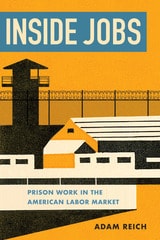
Inside Jobs
Prison Work in the Making of the American Labor Marketreich
Russell Sage Foundation, 2026
From the stone quarries of Sing Sing that supplied marble for early New York City landmarks, to twenty-first-century construction projects staffed by formerly incarcerated workers, Inside Jobs traces the relationship between prison work and the labor market over the past two hundred years. Sociologist Adam Reich demonstrates how prison labor has repeatedly been used to solve economic problems—disciplining workers, lowering labor costs, managing unemployment—revealing unexpected connections that challenge our assumptions about freedom, coercion, and labor itself.
Reich examines the history of work in prisons to understand how it has related to the free labor market. He finds that the organization of prison work, and debates over it, have changed dramatically over time. In the mid to late nineteenth century, prisons helped shape the emerging factory system as the apprentice-based labor market gave way to industrial production. Labor unions opposed prison labor as immoral, and in the early to mid-twentieth century, the moral character of the workforce became central to economic life within the prison and without. Therapeutic professionals worked in prisons to rehabilitate the incarcerated and determine what motivated them to work. Following prison uprisings in the late twentieth century, prison work became a tool of population control. Yet, paradoxically, work programs were remodeled to mirror the free labor market, requiring applications and hiring processes.
Blending archival research, political economy, and sociological theory, Inside Jobs offers a powerful new framework for understanding mass incarceration and reentry today. Reich examines how the dynamics of mass incarceration have begun to shift. He explores how the "mark of a criminal record"—the stigma traditionally associated with felony convictions—has given way to a "market" for criminal records, as employers discover advantages in hiring disadvantaged, dependent, and disciplined workers recently released from prison. Looking toward the future, Reich focuses on promising efforts to transform this system.
Inside Jobs is an illuminating examination of prison work's history, its relationship to work outside prison walls, and how the criminal justice system disempowers workers both behind bars and beyond.
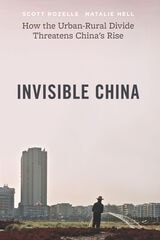
Invisible China
How the Urban-Rural Divide Threatens China’s RiseScott Rozelle and Natalie Hell
University of Chicago Press, 2020
As the glittering skyline in Shanghai seemingly attests, China has quickly transformed itself from a place of stark poverty into a modern, urban, technologically savvy economic powerhouse. But as Scott Rozelle and Natalie Hell show in Invisible China, the truth is much more complicated and might be a serious cause for concern.
China’s growth has relied heavily on unskilled labor. Most of the workers who have fueled the country’s rise come from rural villages and have never been to high school. While this national growth strategy has been effective for three decades, the unskilled wage rate is finally rising, inducing companies inside China to automate at an unprecedented rate and triggering an exodus of companies seeking cheaper labor in other countries. Ten years ago, almost every product for sale in an American Walmart was made in China. Today, that is no longer the case. With the changing demand for labor, China seems to have no good back-up plan. For all of its investment in physical infrastructure, for decades China failed to invest enough in its people. Recent progress may come too late. Drawing on extensive surveys on the ground in China, Rozelle and Hell reveal that while China may be the second-largest economy in the world, its labor force has one of the lowest levels of education of any comparable country. Over half of China’s population—as well as a vast majority of its children—are from rural areas. Their low levels of basic education may leave many unable to find work in the formal workplace as China’s economy changes and manufacturing jobs move elsewhere.
In Invisible China, Rozelle and Hell speak not only to an urgent humanitarian concern but also a potential economic crisis that could upend economies and foreign relations around the globe. If too many are left structurally unemployable, the implications both inside and outside of China could be serious. Understanding the situation in China today is essential if we are to avoid a potential crisis of international proportions. This book is an urgent and timely call to action that should be read by economists, policymakers, the business community, and general readers alike.
Invisible Men
Mass Incarceration and the Myth of Black ProgressBecky Pettit
Russell Sage Foundation, 2012