Results by title
322 books match the query 'Social Policy' and 9 start with i

INSIDE WEST VIRGINIA
PUBLIC POLICY PERSPECTIVES FOR THE 21ST CENTURYBRUCE KEITH
West Virginia University Press, 1999
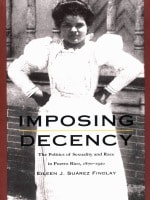
Imposing Decency
The Politics of Sexuality and Race in Puerto Rico, 1870–1920Eileen J. Suárez Findlay
Duke University Press, 2000
In showing how political projects and alliances in Puerto Rico were affected by racially contingent definitions of “decency” and “disreputability,” Findlay argues that attempts at moral reform and the state’s repression of “sexually dangerous” women were weapons used in batttles between elite and popular, American and Puerto Rican, and black and white. Based on a thorough analysis of popular and elite discourses found in both literature and official archives, Findlay contends that racialized sexual norms and practices were consistently a central component in the construction of social and political orders. The campaigns she analyzes include an attempt at moral reform by elite male liberals and a movement designed to enhance the family and cleanse urban space that ultimately translated into repression against symbollically darkened prostitutes. Findlay also explores how U.S. officials strove to construct a new colonial order by legalizing divorce and how feminist, labor, and Afro-Puerto Rican political demands escalated after World War I, often focusing on the rehabilitation and defense of prostitutes.
Imposing Decency forces us to rethink previous interpretations of political chronologies as well as reigning conceptualizations of both liberalism and the early working-class in Puerto Rico. Her work will appeal to scholars with an interest in Puerto Rican or Latin American studies, sexuality and national identity, women in Latin America, and general women’s studies.
In Defense of Youth
A Study of the Role of Counsel in American Juvenile CourtsWilliam Vaughn Stapleton
Russell Sage Foundation, 1972
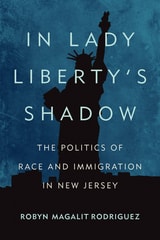
In Lady Liberty's Shadow
The Politics of Race and Immigration in New JerseyRobyn Magalit Rodriguez
Rutgers University Press, 2017
In Lady Liberty’s Shadow examines popular white perceptions of danger represented by immigrants and their children, as well the specter that lurks at the edges of suburbs in the shape of black and Latino urban underclasses and the ever more nebulous hazard of (presumed-Islamic) terrorism that threatening to undermine “life as we know it.” Robyn Magalit Rodriguez explores the impact of anti-immigrant municipal ordinances on a range of immigrant groups living in varied suburban communities, from undocumented Latinos in predominantly white suburbs to long-established Asian immigrants in “majority-minority” suburbs. The “American Dream” that suburban life is supposed to represent is shown to rest on a racialized, segregated social order meant to be enjoyed only by whites. Although it is a case study of New Jersey, In Lady Liberty’s Shadow offers crucial insights that can shed fresh light on the national immigration debate.
For more information, go to: https://www.facebook.com/inlibertysshadow
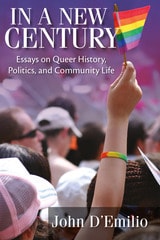
In a New Century
Essays on Queer History, Politics, and Community LifeJohn D’Emilio
University of Wisconsin Press, 2014
A pioneering scholar of gay history, John D’Emilio reflects in this wide-ranging collection of essays upon the social, cultural, and political changes provoked by LGBT activism. He offers provocative questions and historical analyses: What can we learn from a life-long activist like Bayard Rustin, who questioned the wisdom of “identity politics”? Was Richard Nixon a “gay liberationist”? How can knowing local stories—like those of Chicago in the 1950s, 1960s, and 1970s—help build stronger communities and enrich traditions of activism? Might the focus on achieving actually be evidence of growing conservatism in LGBT communities?
In a New Century provides a dynamic, thoughtful, and important resource for identifying changes that have occurred in the United States since 1960, taking stock of the work that still needs to be done, and issuing an urgent call to action for getting there.
Best Books for General Audiences, selected by the American Association of School Librarians
Best Special Interest Books, selected by the Public Library Reviewers
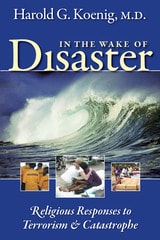
In the Wake of Disaster
Religious Responses to Terrorism and CatastropheHarold G Koenig
Templeton Press, 2006
In a timely book with a powerful and persuasive message, Dr. Harold G. Koenig addresses federal, state, and local government policy leaders, urging them to more fully integrate religious organizations into the formal disaster response system, and he then provides recommendations on how this can effectively be done. Koenig also advocates faith communities and organizations to learn more about the role they can play in responding to disasters and terrorism.
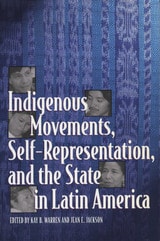
Indigenous Movements, Self-Representation, and the State in Latin America
Edited by Kay B. Warren and Jean E. Jackson
University of Texas Press, 2003
Throughout Latin America, indigenous peoples are responding to state violence and pro-democracy social movements by asserting their rights to a greater measure of cultural autonomy and self-determination. This volume's rich case studies of movements in Colombia, Guatemala, and Brazil weigh the degree of success achieved by indigenous leaders in influencing national agendas when governments display highly ambivalent attitudes about strengthening ethnic diversity.
The contributors to this volume are leading anthropologists and indigenous activists from the United States and Latin America. They address the double binds of indigenous organizing and "working within the system" as well as the flexibility of political tactics used to achieve cultural goals outside the scope of state politics. The contributors answer questions about who speaks for indigenous communities, how indigenous movements relate to the popular left, and how conflicts between the national indigenous leadership and local communities play out in specific cultural and political contexts. The volume sheds new light on the realities of asymmetrical power relations and on the ways in which indigenous communities and their representatives employ Western constructions of subjectivity, alterity, and authentic versus counterfeit identity, as well as how they manipulate bureaucratic structures, international organizations, and the mass media to advance goals that involve distinctive visions of an indigenous future.
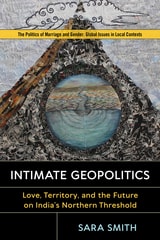
Intimate Geopolitics
Love, Territory, and the Future on India’s Northern ThresholdSara Smith
Rutgers University Press, 2020
2021 Foreword Indies Finalist - Politics and Social Sciences
Intimate Geopolitics begins with a love story set in the Himalayan region of Ladakh, in India’s Jammu and Kashmir State, but this is also a story about territory, and the ways that love, marriage, and young people are caught up in contemporary global processes. In Ladakh, children grow up to adopt a religious identity in part to be counted in the census, and to vote in elections. Religion, population, and voting blocs are implicitly tied to territorial sovereignty and marriage across religious boundaries becomes a geopolitical problem in an area that seeks to define insiders and outsiders in relation to borders and national identity. This book populates territory, a conventionally abstract rendering of space, with the stories of those who live through territorial struggle at marriage and birth ceremonies, in the kitchen and in the bazaar, in heartbreak and in joy. Intimate Geopolitics argues for the incorporation of the role of time–temporality–into our understanding of territory.
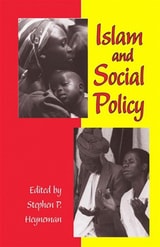
Islam and Social Policy
Stephen P. Heyneman
Vanderbilt University Press, 2004
The essays encompass many regional cultures and draw on court records and legal debates, field work on government ministries, and an extensive reading of Islamic law. In his overview of waqf (similar to the Western idea of a foundation, in which an endowment is set aside in perpetuity for specified purposes), Ahmad Dallal explains how charity, a central organizing principle in Islam, is itself organized and how waqf, traditionally a source of revenue for charitable purposes, can also become a source of tension and conflict. Donna Lee Bowen, in her essay on the position of women in Islamic law, points out the crucial differences between the Islamic principles of family equity and the Western notion of individual equality. In a subsequent essay, Bowen addresses the problems surrounding family planning and the dilemmas that have arisen within the Muslim world over differing ideas about birth control. The two final essays look at specific instances of how the modern state has treated Islamic social policy. Gail Richardson examines zakat, an Islamic tax used to assist the poor, and its administration in Pakistan. Carol Underwood, meanwhile, explores public health policy in Iran, both before and after the Islamic revolution that deposed the Shah.
Addressing some of the most profound misunderstandings between Islamic and Western societies, Islam and Social Policy will be of vital interest not only to scholars and policymakers but to anyone concerned with Islam's critical place in the modern world.