Results by title
100 books match the query 'Sociolinguistics' and 3 start with i
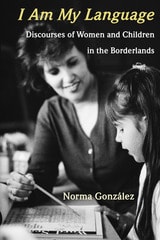
I Am My Language
Discourses of Women and Children in the BorderlandsNorma González
University of Arizona Press, 2001
“I am my language,” says the poet Gloria Anzaldúa, because language is at the heart of who we are. But what happens when a person has more than one language? Is there an overlay of language on identity, and do we shift identities as we shift languages? More important, what identities do children construct for themselves when they use different languages in particular ways?
In this book, Norma González uses language as a window on the multiple levels of identity construction in children—as well as on the complexities of life in the borderlands—to explore language practices and discourse patterns of Mexican-origin mothers and the language socialization of their children. She shows how the unique discourses that result from the interplay of two cultures shape perceptions of self and community, and how they influence the ways in which children learn and families engage with their children’s schools.
González demonstrates that the physical presence of the border profoundly affects the practices and ideologies of Mexican-origin women and children. She then argues that language and cultural background should be used as a basis for building academic competencies, and she demonstrates why the evocative/emotive dimension of language should play a major part in studies of discourse, language socialization, and language ideology.
Drawing on women’s own narratives of their experiences as both mothers and borderland residents, I Am My Language is firmly rooted in the words of common people in their everyday lives. It combines personal odyssey with cutting-edge ethnographic research, allowing us to hear voices that have been muted in the academic and public policy discussions of “what it means to be Latina/o” and showing us new ways to connect language to complex issues of education, political economy, and social identity.
International Sign
Linguistic, Usage, and Status IssuesRachel Rosenstock
Gallaudet University Press, 2015
Editors Rachel Rosenstock and Jemina Napier have assembled an international group of renowned linguists and interpreters to examine various aspects of International Sign. Their contributions are divided into three parts: International Sign as a Linguistic System; International Sign in Action—Interpreting, Translation, and Teaching; and International Sign Policy and Language Planning. The chapters cover a range of topics, including the morphosyntactic and discursive structures of interpreted IS, the interplay between conventional linguistic elements and nonconventional gestural elements in IS discourse, how deaf signers who use different signed languages establish communication, Deaf/hearing IS interpreting teams and how they sign depicting verbs, how best to teach foundation-level IS skills, strategies used by IS interpreters when interpreting from IS into English, and explorations of the best ways to prepare interpreters for international events.
The work of the editors and contributors in this volume makes International Sign the most comprehensive, research-based analysis of a young but growing field in linguistics and interpretation.

Intimate Grammars
An Ethnography of Navajo PoetryAnthony K. Webster
University of Arizona Press, 2015
Intimate Grammars takes an ethnographic and ethnopoetic approach to language and culture in contemporary time, in which poetry and poets are increasingly important and visible in the Navajo Nation. Webster uses interviews and linguistic analysis to understand the kinds of social work that Navajo poets engage in through their poetry.
Based on more than a decade of ethnographic and linguistic research, Webster’s book explores a variety of topics: the emotional value assigned to various languages spoken on the Navajo Nation through poetry (Navajo English, Navlish, Navajo, and English), why Navajo poets write about the “ugliness” of the Navajo Nation, and the way contemporary Navajo poetry connects young Navajos to the Navajo language. Webster also discusses how contemporary Navajo poetry challenges the creeping standardization of written Navajo and how boarding school experiences influence how Navajo poets write poetry and how Navajo readers appreciate contemporary Navajo poetry.
Through the work of poets such as Luci Tapahonso, Laura Tohe, Rex Lee Jim, Gloria Emerson, Blackhorse Mitchell, Esther Belin, Sherwin Bitsui, and many others, Webster provides new ways of thinking about contemporary Navajo poets and poetry. Intimate Grammars offers an exciting new ethnography of speaking, ethnopoetics, and discourse-centered examinations of language and culture.