Results by title
53 books match the query 'Statesmen' and 2 start with i
Ignacy Paderewski
PolandAnita Prazmowska
Haus Publishing, 2009
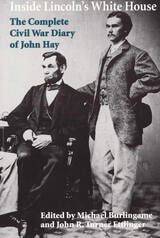
Inside Lincoln's White House
The Complete Civil War Diary of John HayEdited by Michael Burlingame and John R. Turner Ettlinger
Southern Illinois University Press, 1999
On 18 April 1861, assistant presidential secretary John Hay recorded in his diary the report of several women that "some young Virginian long haired swaggering chivalrous of course. . . and half a dozen others including a daredevil guerrilla from Richmond named Ficklin would do a thing within forty eight hours that would ring through the world."
The women feared that the Virginian planned either to assassinate or to capture the president. Calling this a "harrowing communication," Hay continued his entry: "They went away and I went to the bedside of the Chief couché. I told him the yarn; he quietly grinned."
This is but one of the dramatic entries in Hay’s Civil War diary, presented here in a definitive edition by Michael Burlingame and John R. Turner Ettlinger. Justly deemed the most intimate record we will ever have of Abraham Lincoln in the White House, the Hay diary is, according to Burlingame and Ettlinger, "one of the richest deposits of high-grade ore for the smelters of Lincoln biographers and Civil War historians." While the Cabinet diaries of Salmon P. Chase, Edward Bates, and Gideon Welles also shed much light on Lincoln’s presidency, as does the diary of Senator Orville Hickman Browning, none of these diaries has the literary flair of Hay’s, which is, as Lincoln’s friend Horace White noted, as "breezy and sparkling as champagne." An aspiring poet, Hay recorded events in a scintillating style that the lawyer-politician diarists conspicuously lacked.
Burlingame and Ettlinger’s edition of the diary is the first to publish the complete text of all of Hay’s entries from 1861 through 1864. In 1939 Tyler Dennett published Lincoln and the Civil War in the Diaries and Letters of John Hay, which, as Civil War historian Allan Nevins observed, was "rather casually edited." This new edition is essential in part because Dennett omitted approximately 10 percent of Hay’s 1861–64 entries.
Not only did the Dennett edition omit important parts of the diaries, it also introduced some glaring errors. More than three decades ago, John R. Turner Ettlinger, then in charge of Special Collections at the Brown University Library, made a careful and literal transcript of the text of the diary, which involved deciphering Hay’s difficult and occasionally obscure writing. In particular, passages were restored that had been canceled, sometimes heavily, by the first editors for reasons of confidentiality and propriety. Ettlinger’s text forms the basis for the present edition, which also incorporates, with many additions and much updating by Burlingame, a body of notes providing a critical apparatus to the diary, identifying historical events and persons.