Results by title
265 books match the query 'To 1500' and 9 start with i
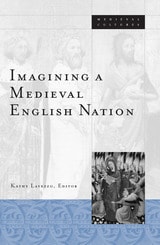
Imagining A Medieval English Nation
Kathy Lavezzo
University of Minnesota Press, 2003
The first comprehensive analysis of English national identity in the late Middle Ages
During the late Middle Ages, the increasing expansion of administrative, legal, and military systems by a central government, together with the greater involvement of the commons in national life, brought England closer than ever to political nationhood. Examining a diverse array of texts—ranging from Latin and vernacular historiography to Lollard tracts, Ricardian poetry, and chivalric treatises—this volume reveals the variety of forms “England” assumed when it was imagined in the medieval West.
These essays disrupt conventional thinking about the relationship between premodernity and modernity, challenge traditional preconceptions regarding the origins of the nation, and complicate theories about the workings of nationalism. Imagining a Medieval English Nation is not only a collection of new readings of major canonical works by leading medievalists, it is among the first book-length analyses on the subject and of critical interest. Contributors: Kathleen Davis, Bucknell U; L. O. Aranye Fradenburg, U of California, Santa Barbara; Andrew Galloway, Cornell U; Jill C. Havens, Baylor U; Peggy A. Knapp, Carnegie Mellon U; Larry Scanlon, Rutgers U; D. Vance Smith, Princeton U; Claire Sponsler, U of Iowa; Lynn Staley, Colgate U; Thorlac Turville-Petre, U of Nottingham.
Imperial Peripheries in the Neo-Assyrian Period
Craig W. Tyson
University Press of Colorado, 2018
An international team of archaeologists and historians draws upon both new and existing evidence from excavations, surveys, texts, and material culture to highlight the strategies that the Neo-Assyrian Empire applied to manage its diverse and widespread empire as well as the mixed reception of those strategies by subjects close to and far from the center. Case studies from around the ancient Near East illustrate a remarkable variety of responses to Assyrian aggression, economic policies, and cultural influences. As a whole, the volume demonstrates both the destructive and constructive roles of empire, including unintended effects of imperialism on socioeconomic and cultural change.
Imperial Peripheries in the Neo-Assyrian Period aligns with the recent movement in imperial studies to replace global, top-down materialist models with theories of contingency, local agency, and bottom-up processes. Such approaches bring to the foreground the reality that the development and lifecycles of empires in general, and the Neo-Assyrian Empire in particular, cannot be completely explained by the activities of the core. The book will be welcomed by archaeologists of the Ancient Near East, Assyriologists, and scholars concerned with empires and imperial power in history.
Contributors: Stephanie H. Brown, Anna Cannavò, Megan Cifarelli, Erin Darby, Bleda S. Düring, Avraham Faust, Guido Guarducci, Bradley J. Parker
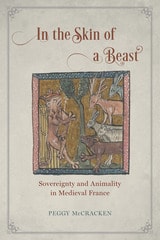
In the Skin of a Beast
Sovereignty and Animality in Medieval FrancePeggy McCracken
University of Chicago Press, 2017
Peggy McCracken discusses a range of literary texts and images from medieval France, including romances in which animal skins appear in symbolic displays of power, fictional explorations of the wolf’s desire for human domestication, and tales of women and snakes converging in a representation of territorial claims and noble status. These works reveal that the qualities traditionally used to define sovereignty—lineage and gender among them—are in fact mobile and contingent. In medieval literary texts, as McCracken demonstrates, human dominion over animals is a disputed model for sovereign relations among people: it justifies exploitation even as it mandates protection and care, and it depends on reiterations of human-animal difference that paradoxically expose the tenuous nature of human exceptionalism.
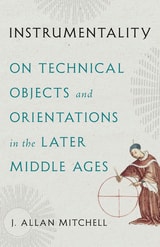
Instrumentality
On Technical Objects and Orientations in the Later Middle AgesJ. Allan Mitchell
University of Minnesota Press, 2024
From medieval to modern, exploring instrumental attitudes toward physical gadgets, diagrams, concepts, methods, and disciplines
Opening up the instrumental condition of the human for critical reflection and renewal, Instrumentality illuminates key moments in the intellectual history of the European Middle Ages. J. Allan Mitchell reveals how, in the predigital past, we can recognize many of the operative technics, analytics, and metaphorics that continue to shape human sense and cognition today.
Exploring the diverse modalities of medieval instruments, Mitchell’s case studies encompass techniques as seemingly distinct as time-keeping mechanisms, mathematical diagrams, logical syllogisms, and the literary devices of Geoffrey Chaucer and John Gower. A cultural and intellectual history, Mitchell’s work leads readers from three-dimensional objects (physical mechanisms) to two-dimensional inscriptions (maps and diagrams) and onward to overarching disciplinary norms in the early liberal and mechanical arts. Prying loose the subtle, adaptable, and generative concept of technical objects from limiting contemporary frameworks, he shows how these instruments are indispensable to the past—and the future—of the arts and culture at large.
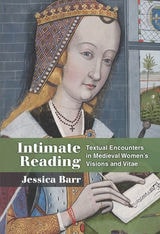
Intimate Reading
Textual Encounters in Medieval Women’s Visions and VitaeJessica Barr
University of Michigan Press, 2020
This new volume is structured around five case studies. Chapters consider the biographies of 13th-century holy women from Liège, the writings of Margery Kempe, Gertrude of Helfta, Mechthild of Magdeburg, Marguerite Porete, and Julian of Norwich. At the heart of Intimate Reading is the question of how reading works—what it means to enter imaginatively and intellectually into the words of another. The volume showcases the complexity of medieval understandings of the work of reading, deepening our perception of the written word’s capacity to signify something that lies even beyond rational comprehension.
Inventing Womanhood
Gender and Language in Later Middle English WritingTara Williams
The Ohio State University Press, 2011
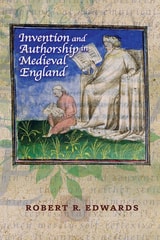
Invention and Authorship in Medieval England
Robert R. Edwards
The Ohio State University Press, 2017
Authorial invention in the Middle Ages is the base of a national tradition that English writers in the Renaissance saw as stable and capable of emulating the canons of classical languages and the Italian and French vernaculars. In Invention and Authorship in Medieval England, Robert R. Edwards brings new interpretive perspectives to Walter Map, Marie de France, John Gower, Geoffrey Chaucer, Thomas Hoccleve, and John Lydgate. He offers a critical reading of key moments that define the emergence of medieval English authorship by showing how writers adapt the commonplaces of authorship to define themselves and their works externally and to construct literary meaning internally.
Isabel Rules
Constructing Queenship, Wielding PowerBarbara F. Weissberger
University of Minnesota Press, 2003
A deconstruction of the strategies used to shape the image of a powerful woman ruler
As queen of Spain, Isabel I of Castile (known to history as Isabella the Catholic, 1474–1504) oversaw the creation of Europe’s first nation-state and laid the foundations for its emergence as the largest empire the West has ever known—nearly a century before the better-known and more widely studied Elizabeth I of England.
What we know of this remarkable ruler is typically gleaned from hagiographic texts that negate her power and accept her own propagandistic self-fashioning as legitimate heir, pious princess, devoted wife, and heaven-sent healer of the wounds inflicted on Spain’s body politic by impotent kings, seditious nobles, and such undesirable others as Jews, Muslims, and sodomites. Isabel Rules is the first book to examine the formation of the queen’s public image, focusing on strategies designed to cope with the ideological and cultural dissonance created by the combination of her gender and her profoundly patriarchal political program for unifying and purifying Spain.Barbara Weissberger identifies two primary and interrelated strategies among the supporters of the queen—often writing in her employ—and her critics. Her loyalists use Marian imagery to portray Isabel as a pious, chaste, and submissive queen consort to her husband Ferdinand, while her opponents imagine the queen as a voracious and lascivious whore whose illicit power threatens the virility of her male subjects and inverts the traditional gender hierarchy. Weissberger applies a materialist feminist perspective to a wide array of texts of the second half of the fifteenth century in order to uncover and study the masculine psychosexual anxiety created by Isabel’s anomalous power. She then demonstrates the persistence of the two sides of the propagandistic construction of the Catholic queen, reviewing modern treatments in Francoist schoolbooks and in the fiction of Juan Goytisolo, Alejo Carpentier, and Salman Rushdie.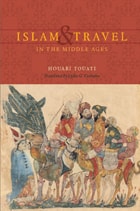
Islam and Travel in the Middle Ages
Houari Touati
University of Chicago Press, 2010
In the Middle Ages, Muslim travelers embarked on a rihla, or world tour, as surveyors, emissaries, and educators. On these journeys, voyagers not only interacted with foreign cultures—touring Greek civilization, exploring the Middle East and North Africa, and seeing parts of Europe—they also established both philosophical and geographic boundaries between the faithful and the heathen. These voyages thus gave the Islamic world, which at the time extended from the Maghreb to the Indus Valley, a coherent identity.
Islam and Travel in the Middle Ages assesses both the religious and philosophical aspects of travel, as well as the economic and cultural conditions that made the rihla possible. Houari Touati tracks the compilers of the hadith who culled oral traditions linked to the prophet, the linguists and lexicologists who journeyed to the desert to learn Bedouin Arabic, the geographers who mapped the Muslim world, and the students who ventured to study with holy men and scholars. Travel, with its costs, discomforts, and dangers, emerges in this study as both a means of spiritual growth and a metaphor for progress. Touati’s book will interest a broad range of scholars in history, literature, and anthropology.