Results by title
155 books match the query 'Toward' and 2 start with i
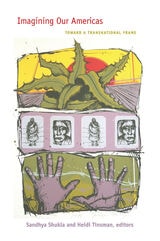
Imagining Our Americas
Toward a Transnational FrameSandhya Shukla and Heidi Tinsman, eds.
Duke University Press, 2007
Scholars of literature, ethnic studies, and regional studies as well as of anthropology and history, the contributors focus on the Americas as a broadly conceived geographic, political, and cultural formation. Among the essays are explorations of the varied histories of African Americans’ presence in Mexican and Chicano communities, the different racial and class meanings that the Colombian musical genre cumbia assumes as it is absorbed across national borders, and the contrasting visions of anticolonial struggle embodied in the writings of two literary giants and national heroes: José Martí of Cuba and José Rizal of the Philippines. One contributor shows how a pidgin-language mixture of Japanese, Hawaiian, and English allowed second-generation Japanese immigrants to critique Hawaii’s plantation labor system as well as Japanese hierarchies of gender, generation, and race. Another examines the troubled history of U.S. gay and lesbian solidarity with the Cuban Revolution. Building on and moving beyond previous scholarship, this collection illuminates the productive intellectual and political lines of inquiry opened by a focus on the Americas.
Contributors. Rachel Adams, Victor Bascara, John D. Blanco, Alyosha Goldstein, Héctor Fernández L’Hoeste, Ian Lekus, Caroline F. Levander, Susan Y. Najita, Rebecca Schreiber, Sandhya Shukla, Harilaos Stecopoulos, Michelle Stephens, Heidi Tinsman, Nick Turse, Rob Wilson
Internal Rhetorics
Toward a History and Theory of Self-PersuasionJean Nienkamp
Southern Illinois University Press, 2001
Since its early history in Greek culture, traditional rhetorical study has focused primarily on persuasive language used in the public sphere. There has been little study, however, of what Jean Nienkamp calls internal rhetoric, which “occurs between one aspect of the self and another” inside one’s mind. Nienkamp opens the study of internal rhetoric by discussing how the concept developed alongside traditional classical and modern rhetorical theory.
Nienkamp shows how we talk to ourselves, or more specifically, how we talk ourselves into things: justifications, actions, opinions, theories. She explains that just because we see ourselves as divided, as torn in different directions by conflicting desires, duties, and social mores, it does not mean that we are fragmented, nor does it mean that we are split into discrete identities that neither interrelate nor interact.
In this groundbreaking study, Nienkamp identifies two major aspects of internal rhetoric: “the conscious ‘art’ of cultivated internal rhetoric” and “the unconscious ‘nature’ of primary internal rhetoric.” Selecting a small number of figures from the history of rhetoric—including Isocrates, Plato, Aristotle, Francis Bacon, Lord Shaftesbury, Richard Whately, Kenneth Burke, Chaim Perelman and Lucie Olbrechts-Tyteca, George Herbert Mead, and Lev Vygotsky—Nienkamp argues for a “version of the rhetorical self that takes into account both the ways we are formed by and formulate internal and external rhetorics and the ways our physical bodies act as a contributing scene—an agora—for internal rhetoric.”