Results by title
81 books match the query 'Tradition' and 3 start with i
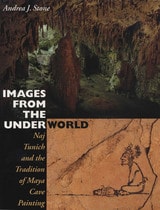
Images from the Underworld
Naj Tunich and the Tradition of Maya Cave PaintingBy Andrea J. Stone
University of Texas Press, 1995
In 1979, a Kekchi Maya Indian accidentally discovered the entrance to Naj Tunich, a deep cave in the Maya Mountains of El Peten, Guatemala. One of the world's few deep caves that contain rock art, Naj Tunich features figural images and hieroglyphic inscriptions that have helped to revolutionize our understanding of ancient Maya art and ritual.
In this book, Andrea Stone takes a comprehensive look at Maya cave painting from Preconquest times to the Colonial period. After surveying Mesoamerican cave and rock painting sites and discussing all twenty-five known painted caves in the Maya area, she focuses extensively on Naj Tunich. Her text analyzes the images and inscriptions, while photographs and line drawings provide a complete visual catalog of the cave art, some of which has been subsequently destroyed by vandals.
This important new body of images and texts enlarges our understanding of the Maya view of sacred landscape and the role of caves in ritual. It will be important reading for all students of the Maya, as well as for others interested in cave art and in human relationships with the natural environment.
Innovation and Tradition in the Writings of the Venerable Bede
SCOTT DEGREGORIO
West Virginia University Press, 2006
Works prior to this book focused on Bede as not only a European, but also as an English scholar, historian, scientist, or a biographer of saints, and have used a traditional approach towards his explanation of the Bible. Bede's interpretation of his work, its continuous progress, and the reasons behind his hurried appointment to an authority almost as high as the Church Fathers are all topics examined within the text. Essays are by Roger Ray, Faith Wallis, Calvin B. Kendall, George Hardin Brown, Scott DeGregorio, Arthur G. Holder, Lawrence T. Martin, Walter Goffart, and Joyce Hill.
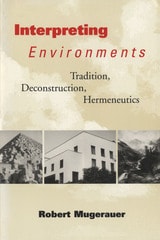
Interpreting Environments
Tradition, Deconstruction, HermeneuticsBy Robert Mugerauer
University of Texas Press, 1995
In this pioneering book, Robert Mugerauer seeks to make deconstruction and hermeneutics accessible to people in the environmental disciplines, including architecture, planning, urban studies, environmental studies, and cultural geography.
Mugerauer demonstrates each methodology through a case study. The first study uses the traditional approach to recover the meaning of Jung's and Wittgenstein's houses by analyzing their historical, intentional contexts. The second case study utilizes deconstruction to explore Egyptian, French neoclassical, and postmodern attempts to use pyramids to constitute a sense of lasting presence. And the third case study employs hermeneutics to reveal how the American understanding of the natural landscape has evolved from religious to secular to ecological since the nineteenth century.