94 books match the query 'Transnationalism' and 5 start with i
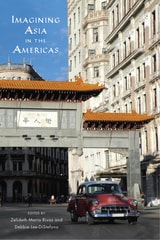
cover of Imagining Asia in the Americas

Imagining Asia in the Americas

Zelideth María Rivas and Debbie Lee-DiStefano

Rutgers University Press, 2016
For centuries, Asian immigrants have been making vital contributions to the cultures of North and South America. Yet in many of these countries, Asians are commonly viewed as undifferentiated racial “others,” lumped together as chinos regardless of whether they have Chinese ancestry. How might this struggle for recognition in their adopted homelands affect the ways that Asians in the Americas imagine community and cultural identity? 
 
The essays in Imagining Asia in the Americas investigate the myriad ways that Asians throughout the Americas use language, literature, religion, commerce, and other cultural practices to establish a sense of community, commemorate their countries of origin, and anticipate the possibilities presented by life in a new land. Focusing on a variety of locations across South America, Central America, the Caribbean, and the United States, the book’s contributors reveal the rich diversity of Asian American identities. Yet taken together, they provide an illuminating portrait of how immigrants negotiate between their native and adopted cultures.  
 
Drawing from a rich array of source materials, including texts in Spanish, Portuguese, Korean, Japanese, Chinese, and Gujarati that have never before been translated into English, this collection represents a groundbreaking work of scholarship. Through its unique comparative approach, Imagining Asia in the Americas opens up a conversation between various Asian communities within the Americas and beyond. 
 
[more]
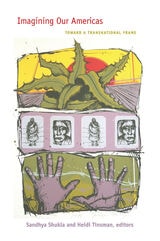
cover of Imagining Our Americas: Toward a Transnational Frame

Imagining Our Americas

Toward a Transnational Frame

Sandhya Shukla and Heidi Tinsman, eds.

Duke University Press, 2007

This rich interdisciplinary collection of essays advocates and models a hemispheric approach to the study of the Americas. Taken together, the essays examine North and South America, the Caribbean, and the Pacific as a broad region transcending both national boundaries and the dichotomy between North and South. In the volume’s substantial introduction, the editors, an anthropologist and a historian, explain the need to move beyond the paradigm of U.S. American Studies and Latin American Studies as two distinct fields. They point out the Cold War origins of area studies, and they note how many of the Americas’ most significant social formations have spanned borders if not continents: diverse and complex indigenous societies, European conquest and colonization, African slavery, Enlightenment-based independence movements, mass immigrations, and neoliberal economies.

Scholars of literature, ethnic studies, and regional studies as well as of anthropology and history, the contributors focus on the Americas as a broadly conceived geographic, political, and cultural formation. Among the essays are explorations of the varied histories of African Americans’ presence in Mexican and Chicano communities, the different racial and class meanings that the Colombian musical genre cumbia assumes as it is absorbed across national borders, and the contrasting visions of anticolonial struggle embodied in the writings of two literary giants and national heroes: José Martí of Cuba and José Rizal of the Philippines. One contributor shows how a pidgin-language mixture of Japanese, Hawaiian, and English allowed second-generation Japanese immigrants to critique Hawaii’s plantation labor system as well as Japanese hierarchies of gender, generation, and race. Another examines the troubled history of U.S. gay and lesbian solidarity with the Cuban Revolution. Building on and moving beyond previous scholarship, this collection illuminates the productive intellectual and political lines of inquiry opened by a focus on the Americas.

Contributors. Rachel Adams, Victor Bascara, John D. Blanco, Alyosha Goldstein, Héctor Fernández L’Hoeste, Ian Lekus, Caroline F. Levander, Susan Y. Najita, Rebecca Schreiber, Sandhya Shukla, Harilaos Stecopoulos, Michelle Stephens, Heidi Tinsman, Nick Turse, Rob Wilson
[more]
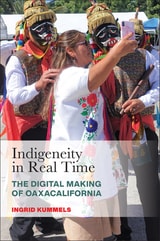
cover of Indigeneity in Real Time: The Digital Making of Oaxacalifornia

Indigeneity in Real Time

The Digital Making of Oaxacalifornia

Ingrid Kummels

Rutgers University Press, 2023
Long before the COVID-19 crisis, Mexican Indigenous peoples were faced with organizing their lives from afar, between villages in the Oaxacan Sierra Norte and the urban districts of Los Angeles, as a result of unauthorized migration and the restrictive border between Mexico and the United States. By launching cutting-edge Internet radio stations and multimedia platforms and engaging as community influencers, Zapotec and Ayuujk peoples paved their own paths to a transnational lifeway during the Trump era. This meant adapting digital technology to their needs, setting up their own infrastructure, and designing new digital formats for re-organizing community life in all its facets—including illness, death and mourning, collective celebrations, sport tournaments, and political meetings—across vast distances. Author Ingrid Kummels shows how mediamakers and users in the Sierra Norte villages and in Los Angeles created a transborder media space and aligned time regimes. By networking from multiple places, they put into practice a communal way of life called Comunalidad and an indigenized American Dream—in real time.
 
[more]
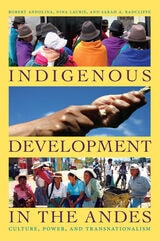
cover of Indigenous Development in the Andes: Culture, Power, and Transnationalism

Indigenous Development in the Andes

Culture, Power, and Transnationalism

Robert Andolina, Nina Laurie, and Sarah A. Radcliffe

Duke University Press, 2009

As indigenous peoples in Latin America have achieved greater prominence and power, international agencies have attempted to incorporate the agendas of indigenous movements into development policymaking and project implementation. Transnational networks and policies centered on ethnically aware development paradigms have emerged with the goal of supporting indigenous cultures while enabling indigenous peoples to access the ostensible benefits of economic globalization and institutionalized participation. Focused on Bolivia and Ecuador, Indigenous Development in the Andes is a nuanced examination of the complexities involved in designing and executing “culturally appropriate” development agendas. Robert Andolina, Nina Laurie, and Sarah A. Radcliffe illuminate a web of relations among indigenous villagers, social movement leaders, government officials, NGO workers, and staff of multilateral agencies such as the World Bank.

The authors argue that this reconfiguration of development policy and practice permits Ecuadorian and Bolivian indigenous groups to renegotiate their relationship to development as subjects who contribute and participate. Yet it also recasts indigenous peoples and their cultures as objects of intervention and largely fails to address fundamental concerns of indigenous movements, including racism, national inequalities, and international dependencies. Andean indigenous peoples are less marginalized, but they face ongoing dilemmas of identity and agency as their fields of action cross national boundaries and overlap with powerful institutions. Focusing on the encounters of indigenous peoples with international development as they negotiate issues related to land, water, professionalization, and gender, Indigenous Development in the Andes offers a comprehensive analysis of the diverse consequences of neoliberal development, and it underscores crucial questions about globalization, governance, cultural identity, and social movements.
[more]
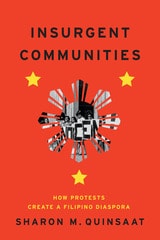
cover of Insurgent Communities: How Protests Create a Filipino Diaspora

Insurgent Communities

How Protests Create a Filipino Diaspora

Sharon M. Quinsaat

University of Chicago Press, 2024

Sociologist Sharon M. Quinsaat sheds new light on the formation of diasporic connections through transnational protests. 

When people migrate and settle in other countries, do they automatically form a diaspora? In Insurgent Communities, Sharon M. Quinsaat explains the dynamic process through which a diaspora is strategically constructed. Quinsaat looks to Filipinos in the United States and the Netherlands—examining their resistance against the dictatorship of Ferdinand Marcos, their mobilization for migrants’ rights, and the construction of a collective memory of the Marcos regime—to argue that diasporas emerge through political activism. Social movements provide an essential space for addressing migrants’ diverse experiences and relationships with their homeland and its history. A significant contribution to the interdisciplinary field of migration and social movements studies, Insurgent Communities illuminates how people develop collective identities in times of social upheaval.
 
[more]