Results by title
90 books match the query 'Trees' and 6 start with i
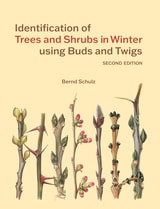
Identification of Trees & Shrubs in Winter Using Buds and Twigs, Second Edition
Bernd Schulz
Royal Botanic Gardens, Kew, 2025
An updated edition of Bernd Schulz’s unrivaled practical guide to identifying trees and shrubs in winter.
This second edition of the essential reference book for plant identification in winter is updated with new illustrations and fully revised text.
To many plant lovers winter seems like lost time, but a glance at the twigs of trees and shrubs shows that this does not need to be the case. In contrast to other life forms, trees and shrubs do not die above ground but enclose their shoots for the next year in buds, presenting many characters which hardly change over time. Using these bud and twig characters, deciduous trees and shrubs can be classified reliably in winter, which is particularly important during planting time.
Comprehensive and easy to use, Identification of Trees & Shrubs in Winter using Buds and Twigs contains over seven hundred species identifiable via their winter buds and twigs. The illustrated identification keys are easy to use, and a summary set of keys is provided as an appendix. Detailed descriptions are accompanied with 1,900 illustrations.
[more]
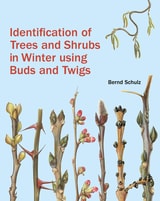
Identification of Trees and Shrubs in Winter Using Buds and Twigs
Bernd Schulz
Royal Botanic Gardens, Kew, 2018
For many plant lovers, winter seems like a lost time. The bursts of color and distinctive leaf shapes disappear, leaving what seems like ambiguous branches. But there is no need for botanical enthusiasts to hunker down until spring. What we overlook as “dead trees” are simply shoots covered up for the season. If we look closer, we’ll see that trees and shrubs have distinct shapes to their buds and twigs that allow them to be classified reliably in winter.
While most books focus on identifying leaves and other seasonal characteristics, this practical guide is one of the few that will allow gardeners to identify trees and shrubs while they are in their dormant state. It covers more than seven hundred species and includes easy-to-use illustrated identification keys. More than 1,400 color images make it even easier to spot the distinctive pieces of these plants.
While most books focus on identifying leaves and other seasonal characteristics, this practical guide is one of the few that will allow gardeners to identify trees and shrubs while they are in their dormant state. It covers more than seven hundred species and includes easy-to-use illustrated identification keys. More than 1,400 color images make it even easier to spot the distinctive pieces of these plants.
[more]
If Trees Could Talk
Stories About Wisconsin TreesR. Bruce Allison
Wisconsin Historical Society Press, 2009
Inside the pages of If Trees Could Talk, Allison gives readers aged 7 to 12 fascinating stories that introduce them to noteworthy trees, both past and present, across Wisconsin. From Kenosha's buried forest on the shores of Lake Michigan to the Wyalusing maple that saw the last of the passenger pigeons; from Aldo Leopold's "good oak" to the disappeared elms of State Street in Madison, these stories open up a fascinating ecological and social history of Wisconsin to young readers. Other stories showcase the state's history: readers will encounter Chief Black Hawk hiding in a hickory, Civil War soldiers enlisting for battle under "sign-up" trees, and trees used to hang criminals without a trial. They will also learn of large and unusual trees like the Columbus Cottonwood, which was over 26 feet around or, in the words of the author, so large that "it would take you and eight of your friends with your arms outstretched to reach all the way around it!"
Told in a compelling narrative style and supplemented with historic photographs and illustrations, these stories instill a sense of place and understanding of the rich heritage of our trees and forests. The book also carries an environmental message encouraging children to appreciate and manage natural resources wisely and respectfully. The highly accessible format includes a map of historic trees locations, a glossary of tree terms, a tree identification chart, and a list of suggested books and websites for further reading.
[more]
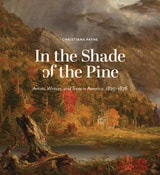
In the Shade of the Pine
Artists, Writers, and Trees in America, 1825-1876Christiana Payne
University of Arkansas Press, 2026
In recent years, there has been a growing recognition of the importance of trees both as allies in the fight against climate change and as sources of emotional well-being. In nineteenth-century America, against a backdrop of accelerating deforestation much like today’s, writers and artists found emotional solace and symbolic meaning in the woods, identifying trees as a civic and spiritual good in need of preservation.
In the Shade of the Pine: Artists, Writers, and Trees in America, 1825–1876 explores the significance of trees in the visual and literary imagination of mid-nineteenth-century America through the work of seven artists and writers: Thomas Cole’s explorations of the Catskills; Albert Bierstadt’s portrayal of the splendid trees of California, including the ancient giant sequoias; the paintings and drawings of Asher Brown Durand and Frederic Edwin Church; the photographs of William James Stillman; and the environmental writings of Susan Fenimore Cooper and Henry David Thoreau.
This richly illustrated volume shows the unique influence the ecology of their land had on the emotional and intellectual landscapes of a generation. In their careful study of the woods—the beauty of trees, their practical importance to human beings and other living creatures, and the power of the forest to confer spiritual and emotional benefits—these artists and writers laid the groundwork for an ecological consciousness that remains vitally relevant today.
[more]
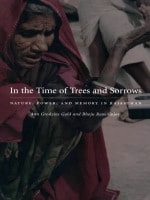
In the Time of Trees and Sorrows
Nature, Power, and Memory in RajasthanAnn Grodzins Gold and Bhoju Ram Gujar
Duke University Press, 2002
In the Time of Trees and Sorrows showcases peasants’ memories of everyday life in North India under royal rule and their musings on the contrast between the old days and the unprecedented shifts that a half century of Indian Independence has wrought. It is an oral history of the former Kingdom of Sawar in the modern state of Rajasthan as it was from the 1930s to the 1950s.
Based on testimonies from the 1990s, this book stands as a polyvocal account of the radical political and environmental changes the region and its people have faced in the twentieth century. Not just the story of modernity from the perspective of a rural village, these interviews and author commentaries narrate this small rural community’s relatively sudden transformation from subjection to a local despot and to a remote colonial power to citizenship in a modern postcolonial democracy. Unlike other recent studies of Rajasthan, the current study gives voice exclusively to former subjects who endured the double oppression of colonial and regional rulers. Gold and Gujar thus place subjective subaltern experiences of daily routines, manifestations of power relations, and sweeping changes to the environment (after the fall of kings) that turned lush forests into a barren landscape on equal footing with historical “fact” and archival sources. Ambiguous, complex, and culturally laden as it is in Western thought, the concept of nature is queried in this ethnographic text. For persons in Sawar the environment is not only a means of sustenance, its deterioration is linked to human morality and to power, both royal and divine. The framing questions of this South Asian history revealed through memories are: what was it like in the time of kings and what happened to the trees?
Based on testimonies from the 1990s, this book stands as a polyvocal account of the radical political and environmental changes the region and its people have faced in the twentieth century. Not just the story of modernity from the perspective of a rural village, these interviews and author commentaries narrate this small rural community’s relatively sudden transformation from subjection to a local despot and to a remote colonial power to citizenship in a modern postcolonial democracy. Unlike other recent studies of Rajasthan, the current study gives voice exclusively to former subjects who endured the double oppression of colonial and regional rulers. Gold and Gujar thus place subjective subaltern experiences of daily routines, manifestations of power relations, and sweeping changes to the environment (after the fall of kings) that turned lush forests into a barren landscape on equal footing with historical “fact” and archival sources. Ambiguous, complex, and culturally laden as it is in Western thought, the concept of nature is queried in this ethnographic text. For persons in Sawar the environment is not only a means of sustenance, its deterioration is linked to human morality and to power, both royal and divine. The framing questions of this South Asian history revealed through memories are: what was it like in the time of kings and what happened to the trees?
[more]
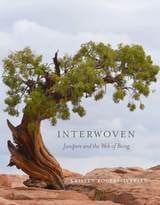
Interwoven
Junipers and the Web of BeingKristen Rogers-Iversen
University of Utah Press, 2017
Copublished with the Utah State Historical Society. Affiliated with the Utah Division of State History, Utah Department of Heritage & Arts.
Throughout prehistory and history, junipers have influenced ecosystems, cultures, mythologies, economics, politics, and environmental controversies. In terms of their effects on human lives the juniper may be the most significant tree in the interior West. Interwoven explores these interconnecting aspects of junipers. Ghost beads, biotic communities, gin, tree masticators, Puebloan diapers, charcoal, folklore, historic explorers, spiral grain, tree life cycles, spirituality, packrat middens, climate changes, wildfire, ranching, wilderness, and land management policies are among the many different threads the book follows. These and other topics shed light on a fascinating organism, but the book is more than a compilation of facts. At once a scientific, experiential, historical, and metaphorical walk among junipers and their interrelationships, Interwoven may change readers’ experiences with these trees and the natural world.
Finalist for the Utah State Historical Society Best Book Award.
Finalist for the 2019 ASLE Book Award for excellence in ecocriticism and environmental creative writing.
Named a “notable book” by the prize committee of the 2018 Sigurd F. Olson Nature Writing Award.
[more]