Results by title
60 books match the query 'Ukraine' and 4 start with i
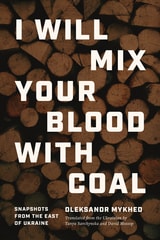
I Will Mix Your Blood with Coal
Snapshots from the East of UkraineOleksandr Mykhed, Tanya Savchynska, and David Mossop
Northwestern University Press, 2025
In 2014, the Russian army, with support from local militants, occupied parts of Ukraine’s two easternmost regions—once the beating industrial heart of the Soviet Union—where coal extraction has since exhausted both the human population and the natural resources. In late 2016, Oleksandr Mykhed set out on a research trip to explore the deep history and contested present of the area from the perspective of a fellow countryman who’d never been there.
Mykhed brings us on a painful yet hopeful journey across the Ukrainian east, sharing conversations with locals, snippets from archival documents, and the complicated perspectives of prominent cultural figures, such as writer Serhiy Zhadan, historian Olena Stiazhkina, and philosopher Ihor Kozlovsky, who was imprisoned and tortured for nearly two years.
I Will Mix Your Blood with Coal invites us to meet generations of coal miners. To learn about the Belgian and British investors who founded the east’s industrial cities. To remember the harrowing events of the First and Second World Wars and the incalculable brutality of Soviet history. To see the activists who are even now working to improve the country. To hear sweet memories of a lost utopia that never existed. Mykhed provides a unique portrait of life in the east during the war, before the full-scale invasion that would change everything.

Ice-Age Hunters of the Ukraine
Richard G. Klein
University of Chicago Press, 1973
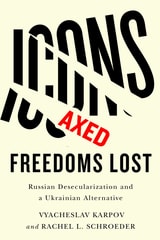
Icons Axed, Freedoms Lost
Russian Desecularization and a Ukrainian AlternativeVyacheslav Karpov
Rutgers University Press, 2025
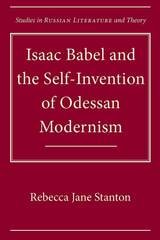
Isaac Babel and the Self-Invention of Odessan Modernism
Rebecca Jane Stanton
Northwestern University Press, 2012
In what marks an exciting new critical direction, Rebecca Stanton contends that the city of Odessa—as a canonical literary image and as a kaleidoscopic cultural milieu—shaped the narrative strategies developed by Isaac Babel and his contemporaries of the Revolutionary generation. Modeling themselves on the tricksters and rogues of Odessa lore, Babel and his fellow Odessans Valentin Kataev and Yury Olesha manipulated their literary personae through complex, playful, and often subversive negotiations of the boundary between autobiography and fiction. In so doing, they cannily took up a place prepared for them in the Russian canon and fostered modes of storytelling that both reflected and resisted the aesthetics of Socialist Realism. Stanton concludes with a rereading of Babel’s “autobiographical” stories and examines their legacy in post-Thaw works by Kataev, Olesha, and Konstantin Paustovsky.