Results by title
246 books match the query 'Violence in Society' and 4 start with i

Imperial Affects
Sensational Melodrama and the Attractions of American CinemaEagle, Jonna
Rutgers University Press, 2017
Imperial Affects is the first sustained account of American action-based cinema as melodrama. From the earliest war films through the Hollywood Western and the late-century action cinema, imperialist violence and mobility have been produced as sites of both visceral pleasure and moral virtue. Suffering and omnipotence operate as twinned affects in this context, inviting identification with an American national subject constituted as both victimized and invincible—a powerful and persistent conjunction traced here across a century of cinema.
[more]
In the Crossfire of History
Women's War Resistance Discourse in the Global SouthLava Asaad
Rutgers University Press, 2022
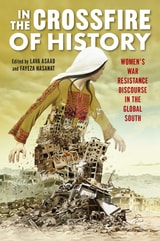
In the global south, women have and continue to resist multiple forms of structural violence. The atrocities committed against Yazidi women by ISIS have been recognized internationally, and the Nobel Peace Prize awarded to Nadia Murad in 2018 was a tribute to honor women whose bodies have been battered in the name of race, nationality, war, and religion. In the Crossfire of History:Women's War Resistance Discourse in the Global South is an edited collection that incorporates literary works, testimonies, autobiographies, women’s resistance movements, and films that add to the conversation on the resilience of women in the global south. The collection focuses on Palestine, Kashmir, Syria, Kurdistan, Congo, Argentina, Central America, Sri Lanka, and Bangladesh. The essays question historical accuracy and politics of representation that usually undermine women’s role during conflict, and they reevaluate how women participated, challenged, sacrificed, and vehemently opposed war discourses that erase women’s role in shaping resistance movements.
The transformative mode of these examples expands the definition of heroism and defiance. To prevent these types of heroism from slipping into the abyss of history, this collection brings forth and celebrates women’s fortitude in conflict zones. In the Crossfire of History shines a light onwomen across the globe who are resisting the sociopolitical and economic injustices in their nation-states.
The transformative mode of these examples expands the definition of heroism and defiance. To prevent these types of heroism from slipping into the abyss of history, this collection brings forth and celebrates women’s fortitude in conflict zones. In the Crossfire of History shines a light onwomen across the globe who are resisting the sociopolitical and economic injustices in their nation-states.
[more]
In/visible War
The Culture of War in Twenty-first-Century AmericaJon Simons and John Louis Lucaites
Rutgers University Press, 2017
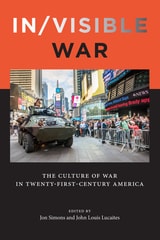
In/Visible War addresses a paradox of twenty-first century American warfare. The contemporary visual American experience of war is ubiquitous, and yet war is simultaneously invisible or absent; we lack a lived sense that “America” is at war. This paradox of in/visibility concerns the gap between the experiences of war zones and the visual, mediated experience of war in public, popular culture, which absents and renders invisible the former. Large portions of the domestic public experience war only at a distance. For these citizens, war seems abstract, or may even seem to have disappeared altogether due to a relative absence of visual images of casualties. Perhaps even more significantly, wars can be fought without sacrifice by the vast majority of Americans.
Yet, the normalization of twenty-first century war also renders it highly visible. War is made visible through popular, commercial, mediated culture. The spectacle of war occupies the contemporary public sphere in the forms of celebrations at athletic events and in films, video games, and other media, coming together as MIME, the Military-Industrial-Media-Entertainment Network.
Yet, the normalization of twenty-first century war also renders it highly visible. War is made visible through popular, commercial, mediated culture. The spectacle of war occupies the contemporary public sphere in the forms of celebrations at athletic events and in films, video games, and other media, coming together as MIME, the Military-Industrial-Media-Entertainment Network.
[more]
Indigenous Women and Violence
Feminist Activist Research in Heightened States of InjusticeEdited by Lynn Stephen and Shannon Speed
University of Arizona Press, 2021
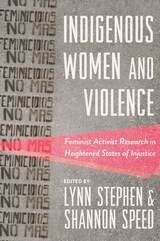
Indigenous Women and Violence offers an intimate view of how settler colonialism and other structural forms of power and inequality created accumulated violences in the lives of Indigenous women. This volume uncovers how these Indigenous women resist violence in Mexico, Central America, and the United States, centering on the topics of femicide, immigration, human rights violations, the criminal justice system, and Indigenous justice. Taking on the issues of our times, Indigenous Women and Violence calls for the deepening of collaborative ethnographies through community engagement and performing research as an embodied experience. This book brings together settler colonialism, feminist ethnography, collaborative and activist ethnography, emotional communities, and standpoint research to look at the links between structural, extreme, and everyday violences across time and space.
Indigenous Women and Violence is built on engaging case studies that highlight the individual and collective struggles that Indigenous women face from the racial and gendered oppression that structures their lives. Gendered violence has always been a part of the genocidal and assimilationist projects of settler colonialism, and it remains so today. These structures—and the forms of violence inherent to them—are driving criminalization and victimization of Indigenous men and women, leading to escalating levels of assassination, incarceration, or transnational displacement of Indigenous people, and especially Indigenous women.
This volume brings together the potent ethnographic research of eight scholars who have dedicated their careers to illuminating the ways in which Indigenous women have challenged communities, states, legal systems, and social movements to promote gender justice. The chapters in this book are engaged, feminist, collaborative, and activism focused, conveying powerful messages about the resilience and resistance of Indigenous women in the face of violence and systemic oppression.
Contributors: R. Aída Hernández-Castillo, Morna Macleod, Mariana Mora, María Teresa Sierra, Shannon Speed, Lynn Stephen, Margo Tamez, Irma Alicia Velásquez Nimatuj
[more]