95 books match the query 'Whites' and 2 start with i

cover of Imperial White: Race, Diaspora, and the British Empire

Imperial White

Race, Diaspora, and the British Empire

Radhika Mohanram

University of Minnesota Press, 2007

Radhika Mohanram shows not just how British imperial culture shaped the colonies, but how the imperial rule of colonies shifted—and gave new meanings to—what it meant to be British.

Imperial White looks at literary, social, and cultural texts on the racialization of the British body and investigates British whiteness in the colonies to address such questions as: How was the whiteness in Britishness constructed by the presence of Empire? How was whiteness incorporated into the idea of masculinity? Does heterosexuality have a color? And does domestic race differ from colonial race? In addition to these inquiries on the issues of race, class, and sexuality, Mohanram effectively applies the methods of whiteness studies to British imperial material culture to critically racialize the relationship between the metropole and the peripheral colonies.

Considering whether whiteness, like theory, can travel, Mohanram also provides a new perspective on white diaspora, a phenomenon of the nineteenth century that has been largely absent in diaspora studies, ultimately rereading—and rethinking—British imperial whiteness.

Radhika Mohanram teaches postcolonial cultural studies in the School of English, Communication and Philosophy at Cardiff University, Wales. She is the author of Black Body: Women, Colonialism, Space (Minnesota, 1999) and edits the journal Social Semiotics.
[more]
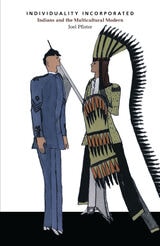
cover of Individuality Incorporated: Indians and the Multicultural Modern

Individuality Incorporated

Indians and the Multicultural Modern

Joel Pfister

Duke University Press, 2004

Spanning the 1870s to the present, Individuality Incorporated demonstrates how crucial a knowledge of Native American-White history is to rethinking key issues in American studies, cultural studies, and the history of subjectivity. Joel Pfister proposes an ingenious critical and historical reinterpretation of constructions of “Indians” and “individuals.” Native Americans have long contemplated the irony that the government used its schools to coerce children from diverse tribes to view themselves first as “Indians”—encoded as the evolutionary problem—and then as “individuals”—defined as the civilized industrial solution. As Luther Standing Bear, Charles Eastman, and Black Elk attest, tribal cultures had their own complex ways of imagining, enhancing, motivating, and performing the self that did not conform to federal blueprints labeled “individuality.” Enlarging the scope of this history of “individuality,” Pfister elaborates the implications of state, corporate, and aesthetic experiments that moved beyond the tactics of an older melting pot hegemony to impose a modern protomulticultural rule on Natives. The argument focuses on the famous Carlisle Indian School; assimilationist novels; Native literature and cultural critique from Zitkala-Sa to Leslie Marmon Silko; Taos and Santa Fe bohemians (Mabel Dodge Luhan, D. H. Lawrence, Mary Austin); multicultural modernisms (Fred Kabotie, Oliver La Farge, John Sloan, D’Arcy McNickle); the Southwestern tourism industry’s development of corporate multiculturalism; the diversity management schemes that John Collier implemented as head of the Indian New Deal; and early formulations of ethnic studies. Pfister’s unique analysis moves from Gilded Age incorporations of individuality to postmodern incorporations of multicultural reworkings of individuality to unpack what is at stake in producing subjectivity in World America.
[more]