Results by title
441 books match the query 'Women and literature' and 13 start with i
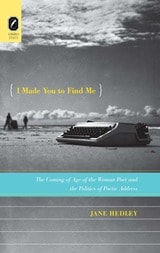
I Made You to Find Me
The Coming of Age of the Woman Poet and the Politics of Poetic AddressJane Hedley
The Ohio State University Press, 2009
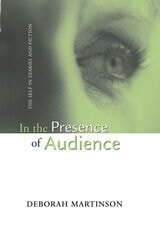
IN THE PRESENCE OF AUDIENCE
THE SELF IN DIARIES AND FICTIONDeborah Martinson
The Ohio State University Press, 2003
As a diary writer imagines shadow readers rifling diary pages, she tweaks images of the self, creating multiple readings of herself, fixed and unfixed. When the readers and potential readers are husbands and publishers, the writer maneuvers carefully in a world of men who are quick to judge and to take offense. She fills the pages with reflections, anecdotes, codes, stories, biographies, and fictions. The diary acts as a site for the writer’s tension, rebellion, and remaking of herself.
In this book Martinson examines the diaries of Virginia Woolf, Katherine Mansfield, Violet Hunt, and Doris Lessing’s fictional character Anna Wulf, and shows that these diaries (and others like them) are not entirely private writings as has been previously assumed. Rather, their authors wrote them knowing they would be read. In these four cases, the audience is the author’s male lover or husband, and Martinson reveals how knowledge of this audience affects the language and content in each diary. Ultimately, she argues, this audience enforces a certain “male censorship” which changes the shape of the revelations, the shape of the writer herself, making it impossible for the female author to be honest in writing about her true self.
Even sophisticated readers often assume that diaries are primarily private. This study interrogates the myth of authenticity and self-revelation in diaries written under the gaze of particular peekers.
Imitations of Life
Fannie Hurst’s Gaslight SonatasAbe C. Ravitz
Southern Illinois University Press, 2009
In the early 1920s, Fannie Hurst’s enormous popularity made her the highest-paid writer in America. She conquered the literary scene at the same time the silent movie industry began to emerge as a tremendously profitable and popular form of entertainment. Abe C. Ravitz parallels Hurst’s growing acclaim with the evolution of silent films, from which she borrowed ideas and techniques that furthered her career. Ravitz notes that Hurst was amazingly adept at anticipating what the public wanted. Sensing that the national interest was shifting from rural to urban subjects, Hurst set her immigrant tales and her "woiking goil" tales in urban America. In her early stories, she tried to bridge the gap between Old World and New World citizens, each somewhat fearful and suspicious of the other. She wrote of love and ethnicity—bringing the Jewish Mother to prominence—of race relations and prejudice, of the woman alone in her quest for selfhood. Ravitz argues, in fact, that her socially oriented tales and her portraits of women in the city clearly identify her as a forerunner of contemporary feminism.
Ravitz brings to life the popular culture from 1910 through the 1920s, tracing the meteoric rise of Hurst and depicting the colorful cast of characters surrounding her. He reproduces for the first time the Hurst correspondence with Theodore Dreiser, Charles and Kathleen Norris, and Gertrude Atherton. Fellow writers Rex Beach and Vachel Lindsay also play important roles in Ravitz’s portrait of Hurst, as does Zora Neale Hurston, who awakened Hurst’s interest in the Harlem Renaissance and in race relations, as shown in Hurst’s novel Imitation of Life.

Imperial Bibles, Domestic Bodies
Women, Sexuality, and Religion in the Victorian MarketMary Wilson Carpenter
Ohio University Press, 2003
Of the many literary phenomena that sprang up in eighteenth-century England and later became a staple of Victorian culture, one that has received little attention until now is the “Family Bible with Notes.” Published in serial parts to make it affordable, the Family Bible was designed to enhance the family’s status and sense of national and imperial identity.
Imperial Bibles, Domestic Bodies reveals in its study of the production and consumption of British commercial Family Bibles startling changes in “family values.” Advertised in the eighteenth century as providing the family with access to “universal knowledge,” these Bibles suddenly shifted in the early nineteenth century to Bibles with bracketed sections marked “to be omitted from family reading” and reserved for reading “in the closet” by the “Master of the family.” These disciplinary Bibles were paralleled by Family Bibles designed to appeal to the newly important female consumer. Illustrations featured saintly women and charming children, and “family registers” with vignettes of family life emphasized the prominent role of the “angel in the house.”
As Mary Wilson Carpenter documents in Imperial Bibles, Domestic Bodies, the elaborate notes and “elegant engravings” in these Bibles bring to light a wealth of detail about the English commonsense view of such taboo subjects as same-sex relations, masturbation, menstruation, and circumcision. Her reading of literary texts by Charlotte Brontë, George Eliot, and Elizabeth Barrett Browning in the context of these commercial representations of the “Authorized Version” or King James translation of the Bible indicates that when the Victorians spoke about religion, they were also frequently speaking about sex.

In Common Cause
The “Conservative” Frances Trollope and the “Radical” Frances WrightSusan S. Kissel
University of Wisconsin Press, 1993
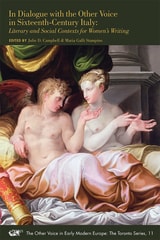
In Dialogue with the Other Voice in Sixteenth-century Italy
Literary and Social Contexts for Women's WritingEdited by Julie D. Campbell and Maria Galli Stampino
Iter Press, 2011
—Elissa Weaver
Professor of Italian, Emerita, University of Chicago
In a Closet Hidden
The Life and Work of Mary E. Wilkins FreemanLeah Blatt Glasser
University of Massachusetts Press, 1996
The first literary biography of a much-neglected American writer, this book explores the multiple tensions at the core of Mary E. Wilkins Freeman's life and work. A prolific short story writer and novelist, Freeman (1852–1930) developed a reputation as a local colorist who depicted the peculiarities of her native New England. Yet as Leah Blatt Glasser shows, Freeman was one of the first American authors to write extensively about the relationships women form outside of marriage and motherhood, the role of work in women's lives, the complexity of women's sexuality, and the interior lives of women who rebel rather than conform to patriarchal strictures.
In a Closet Hidden traces Freeman's evolution as a writer, showing how her own inner conflicts repeatedly found expression in her art. As Glasser demonstrates, Freeman's work examined the competing claims of creativity and convention, self-fulfillment and self-sacrifice, spinsterhood and marriage, lesbianism and heterosexuality.
In the Neighborhood
Women's Publication in Early AmericaCaroline Wigginton
University of Massachusetts Press, 2016
Winner of the 2018 Early American Literature Book Prize
In this compelling and original book, Caroline Wigginton reshapes our understanding of early American literary history. Overturning long-standing connections between the male-dominated print culture of pamphlets, broadsides, and newspapers and the transformative ideas that instigated the American Revolution, Wigginton explores how women's “relational publications”—circulated texts, objects, and performances—transformed their public and intimate worlds. She argues that Native, black, and white women's interpersonal "publications" revolutionized the dynamics of power and connection in public and private spaces, whether those spaces were Quaker meeting houses, Creek talwas, trading posts, burial grounds, or the women's own "neighborhoods."
Informed by deep and rich archival research, Wigginton's case studies explore specific instances of “relational publication.” The book begins with a pairing of examples—the statement a grieving Lenape mother made through a wampum belt and the political affiliations created when a salon hostess shared her poetry. Subsequent chapters trace a history of women's publication practice, including a Creek woman's diplomatic and legal procession-spectacles in the colonial Southeast, a black mother's expression of protest in Newport, Rhode Island, and the resulting evangelical revival, Phillis Wheatley's elegies that refigured neighborhoods of enslaved and free Bostonians, and a Quaker woman's pious and political commonplace book in Revolutionary Philadelphia.
Inscribing the Daily
Critical Essays on Women's DiariesSuzanne L. Bunkers
University of Massachusetts Press, 1996
Intersecting Realities and Fictions of Virginia Woolf and Colette
& COLETTEHelen Southworth
The Ohio State University Press, 2004
Intimate Commerce
Exchange, Gender, and Subjectivity in Greek TragedyBy Victoria Wohl
University of Texas Press, 1997
Exchanges of women between men occur regularly in Greek tragedy—and almost always with catastrophic results. Instead of cementing bonds between men, such exchanges rend them. They allow women, who should be silent objects, to become monstrous subjects, while men often end up as lifeless corpses. But why do the tragedies always represent the transferal of women as disastrous?
Victoria Wohl offers an illuminating analysis of the exchange of women in Sophocles' Trachiniae, Aeschylus' Agamemnon, and Euripides' Alcestis. She shows how the attempts of women in these plays to become active subjects rather than passive objects of exchange inevitably fail. While these failures seem to validate male hegemony, the women's actions, however futile, blur the distinction between male subject and female object, calling into question the very nature of the tragic self. What the tragedies thus present, Wohl asserts, is not only an affirmation of Athens' reigning ideologies (including its gender hierarchy) but also the possibility of resistance to them and the imagination of alternatives.
Inventing Womanhood
Gender and Language in Later Middle English WritingTara Williams
The Ohio State University Press, 2011
Isak Dinesen and the Engendering of Narrative
Susan Hardy Aiken
University of Chicago Press, 1990
In a series of readings that range across Dinesen's career, Aiken demonstrates that Dinesen persistently asserted the inseparability of gender and the engendering of narrative. She argues that Dinesen's texts anticipate in remarkable ways some of the most radical insights of contemporary literary theories, particularly those of French feminist criticism. Aiken also offers a major rereading of Out of Africa that both addresses its distinctiveness as a colonialist text and places it within Dinesen's larger oeuvre.
In Aiken's account, Dinesen's work emerges as a compelling inquiry into sexual difference and the ways it informs culture, subjectivity, and the language that is their medium. This important book will at last give Isak Dinesen's work the prominence it deserves in literary studies.