Results by title
1726 books match the query 'Film' and 60 start with i
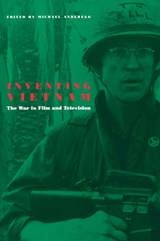
Inventing Vietnam
The War in Film and Televisionedited by Michael Anderegg
Temple University Press, 1991
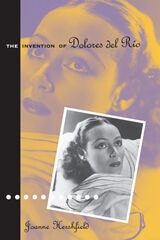
Invention Of Dolores Del Rio
Joanne Hershfield
University of Minnesota Press, 2000
Dolores del Río first came to Hollywood from Mexico in 1925 and within a year had become an international star for her role in Raoul Walsh's 1926 film What Price Glory. She would go on to work with Hollywood’s top directors, including John Ford and King Vidor, and star opposite such leading men as Henry Fonda, Fred Astaire, Orson Welles (with whom she had a scandalous affair), and Elvis Presley. Voted by Photoplay magazine in 1933 as having "the most perfect feminine figure in Hollywood," del Río was billed as one of cinema’s most "exotic" and "aristocratic" beauties. This image-carefully crafted by her producers, her studio publicists, and by del Río herself-reveals many fascinating insights into Hollywood’s evolving attitudes toward race and femininity.
In The Invention of Dolores del Río, Joanne Hershfield explores the intersection of ethnicity, gender, and stardom in American popular culture through the lens of del Río’s successful and unusually lengthy career, which lasted until the 1960s. Hershfield offers close readings of del Río’s films—discussing in detail the roles she played, her costumes and makeup, the music and mise-en-scène, advertising, publicity, and reviews—that provide a nuanced understanding of how Hollywood constructed del Río as an exotic commodity and blunted the inherent challenge her sexual and ethnic image posed to both prevailing standards of white femininity and widespread injunctions against miscegenation. Throughout this astute and imaginative case study, Hershfield looks at del Río’s Hollywood films in relation to shifting ideologies about nationality, gender, and race between the 1920s and 1960s, offering an important contribution to the debate surrounding Hollywood’s ability to both reflect the nation’s racial and sexual obsessions and influence its perceptions about ethnic and gender identity.

Iranian Cinema and Globalization
National, Transnational, and Islamic DimensionsShahab Esfandiary
Intellect Books, 2012
Despite critical acclaim and a recent surge of popularity with Western audiences, Iranian cinema has been the subject of lamentably few academic studies—and those have by and large been limited to the films and filmmakers most visible on the international film circuit. Iranian Cinema and Globalization seeks to broaden readers’ exposure to other dimensions of Iranian cinema, including the works of the many prolific filmmakers whose films have received little outside attention despite being widely popular within Iran. Combining theories of globalization and national cinema with in-depth, interdisciplinary analyses of individual films, this volume expands the current literature on Iranian cinema with insights into the social, and religious political contexts involved.
Islands of Empire
Pop Culture and U.S. PowerBy Camilla Fojas
University of Texas Press, 2014
Camilla Fojas explores a broad range of popular culture media—film, television, journalism, advertisements, travel writing, and literature—with an eye toward how the United States as an empire imagined its own military and economic projects. Impressive in its scope, Islands of Empire looks to Cuba, Guam, Hawai‘i, Puerto Rico, and the Philippines, asking how popular narratives about these island outposts expressed the attitudes of the continent throughout the twentieth century. Through deep textual readings of Bataan, Victory at Sea, They Were Expendable, and Back to Bataan (Philippines); No Man Is an Island and Max Havoc: Curse of the Dragon (Guam); Cuba, Havana, and Dirty Dancing: Havana Nights (Cuba); Blue Hawaii, Gidget Goes Hawaiian, and Paradise, Hawaiian Style (Hawai‘i); and West Side Story, Fame, and El Cantante (Puerto Rico), Fojas demonstrates how popular texts are inseparable from U.S. imperialist ideology.
Drawing on an impressive array of archival evidence to provide historical context, Islands of Empire reveals the role of popular culture in creating and maintaining U.S. imperialism. Fojas’s textual readings deftly move from location to location, exploring each island’s relationship to the United States and its complementary role in popular culture. Tracing each outpost’s varied and even contradictory political status, Fojas demonstrates that these works of popular culture mirror each location’s shifting alignment to the U.S. empire, from coveted object to possession to enemy state.
Israeli Cinema
Identities in MotionEdited by Miri Talmon and Yaron Peleg
University of Texas Press, 2011
With top billing at many film forums around the world, as well as a string of prestigious prizes, including consecutive nominations for the Best Foreign Film Oscar, Israeli films have become one of the most visible and promising cinemas in the first decade of the twenty-first century, an intriguing and vibrant site for the representation of Israeli realities. Yet two decades have passed since the last wide-ranging scholarly overview of Israeli cinema, creating a need for a new, state-of-the-art analysis of this exciting cinematic oeuvre.
The first anthology of its kind in English, Israeli Cinema: Identities in Motion presents a collection of specially commissioned articles in which leading Israeli film scholars examine Israeli cinema as a prism that refracts collective Israeli identities through the medium and art of motion pictures. The contributors address several broad themes: the nation imagined on film; war, conflict, and trauma; gender, sexuality, and ethnicity; religion and Judaism; discourses of place in the age of globalism; filming the Palestinian Other; and new cinematic discourses. The authors' illuminating readings of Israeli films reveal that Israeli cinema offers rare visual and narrative insights into the complex national, social, and multicultural Israeli universe, transcending the partial and superficial images of this culture in world media.

It's Alive!
The Science of B-Movie MonstersMichael LaBarbera
University of Chicago Press, 2013

It's All in the Delivery
Pregnancy in American Film and Television ComedyVictoria Sturtevant
University of Texas Press, 2024
2025 John G. Cawelti Award for the Best Textbook/Primer, Popular Culture Association/American Culture Association (PCA/ACA)
2025 Longlist, Kraszna-Krausz Moving Image Book Award
How changing depictions of pregnancy in comedy from the start of the twentieth century to the present show an evolution in attitudes toward women’s reproductive roles and rights.
Some of the most groundbreaking moments in American film and TV comedy have centered on pregnancy, from Lucille Ball’s real-life pregnancy on I Love Lucy, to the abortion plot on Maude; Murphy Brown’s controversial single motherhood; Arnold Schwarzenegger’s pregnancy in Junior; or the third-trimester stand-up special Ali Wong: Baby Cobra.
In the first book-length study of pregnancy in popular comedy, Victoria Sturtevant examines the slow evolution of pregnancy tropes during the years of the Production Code; the sexual revolution and changing norms around nonmarital pregnancy in the 1960s and ‘70s; and the emphasis on biological clocks, infertility, adoption, and abortion from the 1980s to now.
Across this history, popular media have offered polite evasions and sentimentality instead of real candor about the physical and social complexities of pregnancy. But comedy has often led the way in puncturing these clichés, pointing an irreverent and satiric lens at the messy and sometimes absurd work of gestation. Ultimately, Sturtevant argues that comedy can reveal the distortions and lies that treat pregnancy as simple and natural “women’s work,” misrepresentations that rest at the heart of contemporary attacks on reproductive rights in the US.
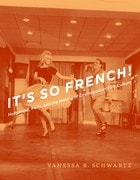
It's So French!
Hollywood, Paris, and the Making of Cosmopolitan Film CultureVanessa R. Schwartz
University of Chicago Press, 2007
Hollywood was once enamored with everything French and this infatuation blossomed in a wildly popular series of films including An American in Paris, Gigi,and Funny Face. Schwartz here examines the visual appeal of such films, and then broadens her analysis to explore their production and distribution, probing the profitable influences that Hollywood and Paris exerted on each other. This exchange moved beyond individual films with the sensational spectacle of the Cannes Film Festival and the meteoric career of Brigitte Bardot. And in turn, their success led to a new kind of film that celebrated internationalism and cultural hybridity. Ultimately, Schwartz uncovers an intriguing paradox: that the road to globalization was paved with nationalist clichés, and thus, films beloved for being so French were in fact the first signs of a nascent cosmopolitan culture.
Packed with an array of colorful film stills, publicity photographs, paparazzi shots, ads, and never before seen archival images, It’s So French! is an incisive account of the fertile collaboration between France and the United States that expanded the geographic horizons of both filmmaking and filmgoing, forever changing what the world saw and dreamed of when they went to the movies.

Italian Locations
Reinhabiting the Past in Postwar CinemaNoa Steimatsky
University of Minnesota Press, 2008
Fascism and the Second World War left Italy indelibly changed, and cinema was arguably the art that most rigorously confronted the devastated nation. In this examination of four Italian filmmakers, Noa Steimatsky brilliantly maps their forceful negotiation of Italy’s identity and posits that the cinematic forms they employ constitute an imaginary reinhabiting of Italy-one that is inextricably linked with the political, physical, and symbolic predicament of reconstruction.
A dynamic intersection of pictorial and photographic, architectural and literary discourses inform Steimatsky’s revisionist interrogation of exemplary works from the 1940s to the mid–1960s. From the earliest documentary work of Michelangelo Antonioni on the River Po to Pier Paolo Pasolini’s re-siting of the Gospel in the arid, peripheral landscape of the Italian south, and from Roberto Rossellini’s tracing of a neorealist project in ruinous Berlin to Luchino Visconti’s wrought grandeur visited upon a humble Sicilian fishing village, Italian Locations probes the historical experience of displacement, anachronism, and a thoroughly contemporary anxiety in the cinematic arena.
For Steimatsky, Antonioni’s modernist achievement, informed by his native landscape, Rossellini’s neorealist image of Italy as a nation of ruins, Visconti’s reaching back to the nineteenth century and even more archaic pasts, and Pasolini’s ambivalence about modernity-all partake in a search for a politically and culturally redeemed Italy.
Noa Steimatsky is associate professor of the history of art and film studies at Yale University.
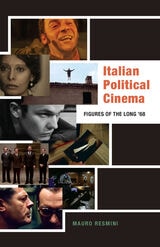
Italian Political Cinema
Figures of the Long ’68Mauro Resmini
University of Minnesota Press, 2022
An exploration of how film has made legible the Italian long ’68 as a moment of crisis and transition
Traditionally, the definition of political cinema assumes a relationship between cinema and politics. In contrast to this view, author Mauro Resmini sees this relationship as an impasse. To illustrate this theory, Resmini turns to Italian cinema to explore how films have reinvented the link between popular art and radical politics in Italy from 1968 to the early 1980s, a period of intense political and cultural struggles also known as the long ’68.
Italian Political Cinema conjures a multifaceted, complex portrayal of Italian society. Centered on emblematic figures in Italian cinema, it maps the currents of antagonism and repression that defined this period in the country’s history. Resmini explores how film imagined the possibilities, obstacles, and pitfalls that characterized the Italian long ’68 as a moment of crisis and transition. From workerism to autonomist Marxism to feminism, this book further expands the debate on political cinema with a critical interpretation of influential texts, some of which are currently only available in Italian.
A comprehensive and novel redefinition of political film, Italian Political Cinema introduces its audience to lesser-known directors alongside greats such as Pasolini, Bertolucci, Antonioni, and Bellocchio. Resmini offers access to untranslated work in Italian philosophy, political theory, and film theory, and forcefully advocates for the continued artistic and political relevance of these films in our time.