Results by title
1228 books match the query 'Library & Information Science' and 80 start with i
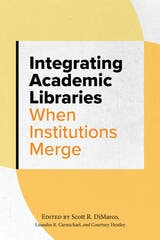
Integrating Academic Libraries When Institutions Merge
Edited by Scott R. DiMarco, Lisandra R. Carmichael, and Courtney Heatley
American Library Association, 2026
University and college mergers are increasingly common, and merging institutions have consequences for and demand new skills from their academic libraries. How do you turn an independent organization steeped in its own procedures and mission into a merged library that is effective, cohesive, and student-centered?
Integrating Academic Libraries When Institutions Merge can help library workers experiencing a merger understand the process and prepare for some of the challenges. In three sections, authors who have undergone a merger provide strategies for integrating collections, systems, and teams while maintaining critical library operations.
- Preparing to Merge
- The New Integrated Culture
- Managing Change
The key to every merger is almost always the same: People and culture working together to get the job done and, in the process, creating a new culture. Integrating Academic Libraries When Institutions Merge can help you confront the past, adapt to the present, and strategize for a sustainable future.

Intellectual Freedom Manual
Trina Magi
American Library Association, 2015
Intellectual Freedom Manual
Trina Magi
American Library Association, 2021
The newest edition of the Intellectual Freedom Manual is more than simply an update of a foundational text that has served as a crucial resource for more than four decades. It is a living document that serves as the authoritative reference for day-to-day guidance on maintaining free and equal access to information for all people. Whether you’re developing or revising policies, on-boarding new staff or trustees, responding to challenges and controversies, or studying librarianship, you’ll find this an indispensable resource, with features such as
- ALA policy statements, approved by committees and Council, articulating core intellectual freedom principles and best practices;
- 8 new interpretations of the Library Bill of Rights, which address urgent issues like internet filtering, public performances, political activity, religion, and equity, diversity, and inclusion;
- “Issues at a Glance” sidebars which present key concepts, points of law, tips, and questions for reflection;
- expanded content about developing library policies that support intellectual freedom;
- updated information on censorship of library programs, displays, and databases;
- “Advocacy and Assistance,” a section offering concrete guidance when you’re called on to talk to the media or meet with legislators;
- Deeper Look essays which examine the laws related to library operations;
- advice on when to call the police, when not to, and how to handle personally identifiable information when they arrive; and
- an expanded glossary.
Intellectual Freedom Manual
American Library Association, 2006
Intellectual Freedom Manual
American Library Association, 2010
Intellectual Freedom Manual, Eleventh Edition
Erin Office for Intellectual Freedom
American Library Association, 2026
When someone faces a difficult intellectual freedom (IF) issue, they usually don’t have time to wade through dense text to find the answers they need. Designed as a real-world reference, OIF’s Intellectual Freedom Manual provides trusted, comprehensive guidance for every library worker, from the volunteer to the director, in plain language. Whether you’re developing or reviewing policies, on-boarding new staff or trustees, responding to challenges and controversies, or studying librarianship, you’ll find this a vital tool, with features such as
- contributions that center the voices of Black, Indigenous, and other People of Color (BIPOC) and LGBTQIA+ people, who are often targeted by censorship efforts;
- chapters that begin with an overview explaining the big ideas and offering reflection questions;
- an introduction to IF and why it matters, drawing on ALA's core IF documents and supported with adaptable policy worksheets;
- information and best practice guidance on key topics such as access, children and youth, censorship and internet filtering, collection development and management, copyright, meeting rooms and exhibit spaces, library programming, politics and religion, privacy, and visits and requests from law enforcement;
- stories from real people whose lives have been impacted by IF, showing how library policies shape culture, protect staff and users, and affect real people;
- concise breakdowns of IF issues from legal experts, helping you understand the laws and how they apply in real situations;
- practical advice on advocating for IF, getting help when challenges arise, lobbying, and working with your elected officials;
- a thorough index to help you quickly find the information you need; and
- a helpful glossary and selected bibliography of additional resources.
Intellectual Freedom Stories from a Shifting Landscape
Valerie Nye
American Library Association, 2020
Intellectual freedom is a complex concept that democracies and free societies around the world define in different ways but always strive to uphold. And ALA has long recognized the crucial role that libraries play in protecting this right. But what does it mean in practice? How do library workers handle the ethical conundrums that often accompany the commitment to defending it? Rather than merely laying out abstract policies and best practices, this important new collection gathers real-world stories of intellectual freedom in action to illuminate the difficulties, triumphs, and occasional setbacks of advocating for free and equal access to information for all people in a shifting landscape. Offering insight to LIS students and current practitioners on how we can advance the profession of librarianship while fighting censorship and other challenges, these personal narratives explore such formidable situations as
- presenting drag queen story times in rural America;
- a Black Lives Matter “die-in” at the undergraduate library of the University of Wisconsin-Madison;
- combating censorship at a prison library;
- hosting a moderated talk about threats to modern democracy that included a neo-Nazi spokesman;
- a provocative exhibition that triggered intimidating phone calls, emails, and a threat to burn down an art library;
- calls to eliminate non-Indigenous children’s literature from the collection of a tribal college library; and
- preserving patrons’ right to privacy in the face of an FBI subpoena.
Intellectual Freedom for Teens
A Practical Guide for Young Adult & School LibrariansKristin Fletcher-Spear
American Library Association, 2014
Intellectual Property
Everything the Digital-Age Librarian Needs to KnowTimothy Lee American Library Association
American Library Association, 2008
Interacting with History
Teaching with Primary SourcesKatharine Lehman
American Library Association, 2014

Interdisciplinarity And Academic Libraries
ACRL 66Craig Gibson
Assoc of College & Research Libraries, 2012
Interdisciplinary and Academic Libraries
Daniel C. Mack
Assoc of College & Research Libraries, 2012
Interim Leadership in Libraries
Building Relationships, Making Decisions, and Moving OnJennifer E. Knievel
American Library Association, 2022
Interim Leadership in Libraries: Building Relationships, Making Decisions, and Moving On draws on evidence-based research, professional expertise, and personal experience to address the practical implications that arise from the decision to appoint interim leaders. Authors from a variety of institutions who have served in many different interim roles explore this unique type of leadership in five thorough sections:
- Building Relationships for Interim Leaders
- Leading with Confidence
- Making Long-Term Decisions as an Interim Leader
- Leading Through Contraction: When No One Can Be Hired
- Moving On: When the Dust Settles
Interlibrary Loan Practices Handbook
Cherié L. Weible
American Library Association, 2011
Interlibrary Loan Practices Handbook
American Library Association, 1997
Intermediate Horizons
Book History and Digital HumanitiesEdited by Mark Vareschi and Heather Wacha
University of Wisconsin Press, 2024
Integrating intermedial practices and assessments, the editors and contributors explore issues surrounding the access to and materiality of digitized materials, and the challenge of balancing preservation of traditional archival materials with access. They offer an assessment in our present moment of the early visions of book history and DH projects. In revisiting these projects, they ask us to shift our thinking on the promises and perils of archival and creative work in different media. Taken together, this volume reconsiders the historical intersections of book history and DH and charts a path for future scholarship across disciplinary boundaries.
International Students And Academic Libraries Initiatives
Pamela Jackson
Assoc of College & Research Libraries, 2011
International Students and Academic Libraries
Initiatives for SuccessPamela A. Jackson
Assoc of College & Research Libraries, 2011
Introducing RDA
A Guide To The Basics After 3RChris Oliver
American Library Association, 2021
Since Oliver’s guide was first published in 2010, thousands of LIS students, records managers, and catalogers and other library professionals have relied on its clear, plainspoken explanation of RDA: Resource Description and Access as their first step towards becoming acquainted with the cataloging standard. Now, reflecting the changes to RDA after the completion of the 3R Project, Oliver brings her Special Report up to date. This essential primer
- concisely explains what RDA is, its basic features, and the main factors in its development;
- describes RDA’s relationship to the international standards and models that continue to influence its evolution;
- provides an overview of the latest developments, focusing on the impact of the 3R Project, the results of aligning RDA with IFLA’s Library Reference Model (LRM), and the outcomes of internationalization;
- illustrates how information is organized in the post 3R Toolkit and explains how to navigate through this new structure; and
- discusses how RDA continues to enable improved resource discovery both in traditional and new applications, including the linked data environment.
Introducing RDA
A Guide to the BasicsChris Oliver
American Library Association, 2010
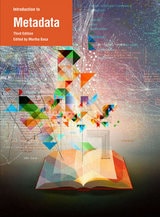
Introduction to Metadata
Third EditionMurtha Baca
J. Paul Getty Trust, The, 2016
The third edition of Introduction to Metadata, first published in 1998, provides an overview of metadata, including its types, roles, and characteristics; a discussion of metadata as it relates to Web resources; and a description of methods, tools, standards, and protocols for publishing and disseminating digital collections. This revised edition is an indispensable resource in the field, addressing advances in standards such as Linked Open Data, changes in intellectual property law, and new computing technologies, and offering an expanded glossary of essential terms.
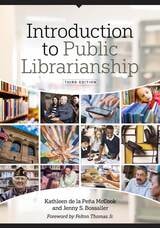
Introduction to Public Librarianship
Kathleen de la Peña McCook
American Library Association, 2018
Put simply, there is no text about public librarianship more rigorous or comprehensive than McCook's survey. Now, the REFORMA Lifetime Achievement Award-winning author has teamed up with noted public library scholar and advocate Bossaller to update and expand her work to incorporate the field's renewed emphasis on outcomes and transformation. This "essential tool" (Library Journal) remains the definitive handbook on this branch of the profession. It covers every aspect of the public library, from its earliest history through its current incarnation on the cutting edge of the information environment, including
- statistics, standards, planning, evaluations, and results;
- legal issues, funding, and politics;
- organization, administration, and staffing;
- all aspects of library technology, from structure and infrastructure to websites and makerspaces;
- adult services, youth services, and children's services;
- associations, state library agencies, and other professional organizations;
- global perspectives on public libraries; and
- advocacy, outreach, and human rights.
Exhaustively researched and expansive in its scope, this benchmark text continues to serve both LIS students and working professionals.
Introduction to Public Librarianship
Kathleen de la Peña McCook
American Library Association, 2011
Introduction to Public Librarianship
American Library Association, 2004
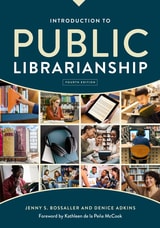
Introduction to Public Librarianship, Fourth Edition
Jenny S. Bossaller and Denice Adkins; Foreword by Kathleen de la Peña McCook
American Library Association, 2024
Dubbed "a peerless ambassador for public libraries, educating future professionals, current professionals in other parts of the field, and anyone else interested about the irreplaceable and irrepressible entities that are public libraries” (Library Quarterly), the newest edition of this trusted resource has been reimagined and restructured to make it even more relevant and useful. The definitive handbook on this branch of the profession, it covers every aspect of the public library, from its earliest history through its current incarnation on the cutting edge of the information environment, including
- a summary of current and historical issues in public libraries;
- a new chapter on financing which covers traditional sources, creative funding, capital campaigns, special projects, and the pros and cons of public/private partnerships;
- statistics, standards, planning, evaluations, and results;
- legal issues and politics, including how different states are set up, the role of state libraries, defining service population, and when the law and values conflict (such as union/non-union scenarios);
- updated coverage of important advocacy issues, including advocacy for access, the legal limits of advocacy, involving the community in advocacy, and communicating the effectiveness of the public library to stakeholders;
- organization, administration, and staffing, from the differences between small libraries and large systems to current issues like non-MLIS library workers and unionization;
- learning about who public libraries serve by utilizing community analysis, community needs assessments, and diversity considerations;
- adult services, youth services, children's services, and serving special populations such as older adults, adults with special needs, schools, daycares, and the incarcerated;
- library technology, from structure and infrastructure to websites and makerspaces;
- issues related to library buildings and master plans, such as gathering community input and working with an architect on library spaces and library services outside of the library;
- library associations, state library agencies, and other professional organizations;
- disaster planning and recovery from technological, ecological, and biological disasters; and
- global perspectives on public libraries.
Introduction to Reference Sources in Health Science
American Library Association, 2008
Introduction to Reference Sources in the Health Sciences
Jeffrey T. Huber
American Library Association, 2014
Irrepressible Reformer
Wayne A. Wiegand
American Library Association, 1996
Is Consulting for You?
American Library Association, 2008
Issues in Librarianship
Presented Papers at the ALA 2008 Annual ConferenceAmerican Library Association, 2008