Results by title
642 books match the query 'Linguistics' and 55 start with i
Interrogative Investigations
The Form, Meaning, and Use of English InterrogativesJonathan Ginzburg and Ivan A. Sag
CSLI, 2001
This book closes the gap in research on this subject. By developing the frameworks of Head Driven Phrase Structure Grammar and Situation Semantics, the authors provide an account that rigorously integrates syntactic, semantic, and contextual dimensions of interrogatives. The challenge of providing exhaustive coverage of the interrogative constructions of English, including various constructions that occur solely in dialogue interaction, leads to new insights about a variety of contentious theoretical issues. These include matters of semantic ontology, the quantificational status of wh-phrases, the semantic effect of wh-fronting, the status of constructions in grammatical theory, the integration of illocutionary information in the grammar, and the nature of ellipsis resolution in dialogue. The account is stated with sufficient rigor to enable fairly direct computational implementation.
Intimate Grammars
An Ethnography of Navajo PoetryAnthony K. Webster
University of Arizona Press, 2015
Intimate Grammars takes an ethnographic and ethnopoetic approach to language and culture in contemporary time, in which poetry and poets are increasingly important and visible in the Navajo Nation. Webster uses interviews and linguistic analysis to understand the kinds of social work that Navajo poets engage in through their poetry.
Based on more than a decade of ethnographic and linguistic research, Webster’s book explores a variety of topics: the emotional value assigned to various languages spoken on the Navajo Nation through poetry (Navajo English, Navlish, Navajo, and English), why Navajo poets write about the “ugliness” of the Navajo Nation, and the way contemporary Navajo poetry connects young Navajos to the Navajo language. Webster also discusses how contemporary Navajo poetry challenges the creeping standardization of written Navajo and how boarding school experiences influence how Navajo poets write poetry and how Navajo readers appreciate contemporary Navajo poetry.
Through the work of poets such as Luci Tapahonso, Laura Tohe, Rex Lee Jim, Gloria Emerson, Blackhorse Mitchell, Esther Belin, Sherwin Bitsui, and many others, Webster provides new ways of thinking about contemporary Navajo poets and poetry. Intimate Grammars offers an exciting new ethnography of speaking, ethnopoetics, and discourse-centered examinations of language and culture.
Introduction to Natural Language Semantics
Henriëtte de Swart
CSLI, 1998
This text examines what issues semantics, as a theory of meaning, should address; determining what the meanings of words of the language are and how to semantically combine elements of a language to build up complex meanings. Logical languages are then developed as formal metalanguages to natural language. Subsequent chapters address propositional logic, the syntax and semantics of (first-order) predicate logic as an extension of propositional logic, and Generalized Quantifier theory. Going beyond extensional theory, Henri'tte de Swart relativizes the interpretation of expressions to times to account for verbal tense, time adverbials and temporal connectives and introduces possible worlds to model intensions, modal adverbs and modal auxiliaries.
This broad overview of natural language semantics should cover most of the points addressed in an introductory course. Numerous exercises punctuate each chapter and an example exam based on the materials presented is included, making this volume a perfect textbook and resource for any undergraduate or graduate-level introductory course in semantics.
Inventing Womanhood
Gender and Language in Later Middle English WritingTara Williams
The Ohio State University Press, 2011
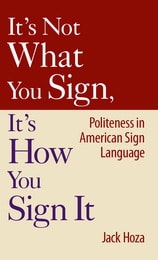
It’s Not What You Sign, It’s How You Sign It
Politeness in American Sign LanguageJack Hoza
Gallaudet University Press, 2007
The general stereotype regarding interaction between American Sign Language and English is a model of oversimplification: ASL signers are direct and English speakers are indirect. Jack Hoza’s study It’s Not What You Sign, It’s How You Sign It: Politeness in American Sign Language upends this common impression through an in-depth comparison of the communication styles between these two language communities. Hoza investigates relevant social variables in specific contexts and explores the particular linguistic strategies ASL signers and English speakers employ when they interact in these contexts.
It’s Not What You Sign, It’s How You Sign It is framed within politeness theory, an apt model to determine various interpretations of what speakers or signers mean in respect to the form of that which they say or sign. The variations reveal how linguistic and cultural differences intersect in ways that are often misinterpreted or overlooked in cross-cultural communication. To clarify these cross-linguistic differences, this volume explores two primary types of politeness and the linguistic strategies used by English speakers and ASL signers to express politeness concerns in face-to-face interaction. Hoza’s final analysis leads to a better understanding of the rich complexity of the linguistic choices of these language groups.