Results by title
1947 books match the query 'Music' and 65 start with i
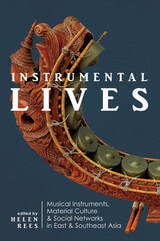
Instrumental Lives
Musical Instruments, Material Culture, and Social Networks in East and Southeast AsiaEdited by Helen Rees
University of Illinois Press, 2024
Original and expert, Instrumental Lives brings a new understanding of how musical instruments interact with their environments and societies. Contributors: Supeena Insee Adler, Marie-Pierre Lissoir, Terauchi Naoko, Jennifer C. Post, Helen Rees, Xiao Mei, Tyler Yamin, and Bell Yung
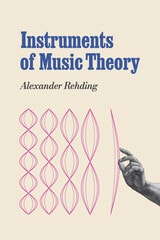
Instruments of Music Theory
Alexander Rehding
University of Chicago Press, 2027
Shows how musical instruments and the sounds they produce are not incidental, but an integral part of music theory.
Many musicians dread music theory: Its rules and diagrams can feel stern and lifeless, far removed from the sounds that make music so thrilling. In this book, Alexander Rehding looks at music theory from a different angle. He argues that the sounds of the instruments on which music theory is demonstrated—starting with the piano in the music classroom—play a much more active role than we usually notice. They are “instruments” in a double sense: musical noisemakers, but also tools in a kind of scientific experiment. Rehding strips these devices down to their sound-generating mechanisms to show us how to read musical instruments for their theoretical content.
Instruments of Music Theory turns our attention to instruments such as multiphonic sirens, tuning forks, Chladni plates, Aeolian harps, and Wheatstone concertinas—these devices generate sounds that call for new ways of listening, measuring, and thinking about music. Bringing together music theory, critical organology, and media theory, this book can be read as a user’s manual for how to put sound back into music theory. Rehding shows us how instruments do not only produce sound—they produce knowledge about music. Through the lens of these new instruments, Instruments of Music Theory recasts fundamental musical ideas such as pitch, harmony, form, and scale from the ground up to give new meaning to the stuff we call music.
Intents and Purposes
Philosophy and the Aesthetics of ImprovisationEric Lewis
University of Michigan Press, 2019
Interlochen
A Home for the ArtsDean Boal
University of Michigan Press, 1998
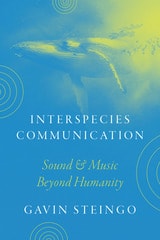
Interspecies Communication
Sound and Music beyond HumanityGavin Steingo
University of Chicago Press, 2024
In Interspecies Communication, music scholar Gavin Steingo examines significant cases of attempted communication beyond the human—cases in which the dualistic relationship of human to non-human is dramatically challenged. From singing whales to Sun Ra to searching for alien life, Steingo charts the many ways we have attempted to think about, and indeed to reach, beings that are very unlike ourselves.
Steingo focuses on the second half of the twentieth century, when scientists developed new ways of listening to oceans and cosmic space—two realms previously inaccessible to the senses and to empirical investigation. As quintessential frontiers of the postwar period, the outer space of the cosmos and the inner space of oceans were conceptualized as parallel realities, laid bare by newly technologized “ears.” Deeply engaging, Interspecies Communication explores our attempts to cross the border between the human and non-human, to connect with non-humans in the depths of the oceans, the far reaches of the universe, or right under our own noses.
Interviews with American Composers
Barney Childs in ConversationBarney Childs. Edited by Virginia Anderson
University of Illinois Press, 2022
Virginia Anderson edits the first published collection of these conversations. She pairs each interview with a contextual essay by a contemporary expert that shows how the composer's discussion with Childs fits into his life and work. Together, the interviewees cover a broad range of ideas and concerns around topics like education, notation, developments in electronic music, changing demands on performers, and tonal music.
Innovative and revealing, Interviews with American Composers is an artistic and historical snapshot of American music at an important crossroads.

Intimate Distance
Andean Music in JapanMichelle Bigenho
Duke University Press, 2012
Bolivians and Japanese involved in these musical practices often express narratives of intimacy and racial belonging that reference shared but unspecified indigenous ancestors. Along with revealing the story of Bolivian music's route to Japan and interpreting the transnational staging of indigenous worlds, Bigenho examines these stories of closeness, thereby unsettling the East-West binary that often structures many discussions of cultural difference and exotic fantasy.
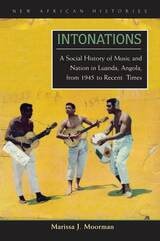
Intonations
A Social History of Music and Nation in Luanda, Angola, from 1945 to Recent TimesMarissa J. Moorman
Ohio University Press, 2008
Intonations tells the story of how Angola’s urban residents in the late colonial period (roughly 1945–74) used music to talk back to their colonial oppressors and, more importantly, to define what it meant to be Angolan and what they hoped to gain from independence. A compilation of Angolan music is included in CD format.
Marissa J. Moorman presents a social and cultural history of the relationship between Angolan culture and politics. She argues that it was in and through popular urban music, produced mainly in the musseques (urban shantytowns) of the capital city, Luanda, that Angolans forged the nation and developed expectations about nationalism. Through careful archival work and extensive interviews with musicians and those who attended performances in bars, community centers, and cinemas, Moorman explores the ways in which the urban poor imagined the nation.
The spread of radio technology and the establishment of a recording industry in the early 1970s reterritorialized an urban-produced sound and cultural ethos by transporting music throughout the country. When the formerly exiled independent movements returned to Angola in 1975, they found a population receptive to their nationalist message but with different expectations about the promises of independence. In producing and consuming music, Angolans formed a new image of independence and nationalist politics.
Is It Still Good to Ya?
Fifty Years of Rock Criticism, 1967-2017Robert Christgau
Duke University Press, 2018
Island Gospel
Pentecostal Music and Identity in Jamaica and the United StatesMelvin L. Butler
University of Illinois Press, 2019
Island Time
Speed and the Archipelago from St. Kitts and NevisJessica Swanston Baker
University of Chicago Press, 2024
In Island Time, ethnomusicologist Jessica Swanston Baker examines wylers, a musical form from St. Kitts and Nevis that is characterized by speed. Baker argues that this speed becomes a useful and highly subjective metric for measuring the relationship between Caribbean aspirations and the promises of economic modernity; women’s bodily autonomy and the nationalist fantasies that would seek to curb that autonomy; and the material realities of Kittitian-Nevisian youth living in the disillusionment following postcolonial independence. She traces the wider Caribbean musical, cultural, and media-based resonances of wylers, posing an alternative model to scholarship on Caribbean music that has tended to privilege the big islands—Trinidad, Jamaica, and Haiti—thus neglecting not only the unique cultural worlds of smaller nations but also the unbounded nature of musical exchange in the region. The archipelago emerges as a useful model for apprehending the relationality across scales that governs the temporal and spatial logics that undergird Caribbean performance. The archipelago and its speeds ultimately emerge as a meaningful medium for postcolonial, postmodern world-making.
It's About Time
The Dave Brubeck StoryFred Hall
University of Arkansas Press, 1996
A much-revered icon of jazz, Dave Brubeck is, as Doug Ramsey calls him, “one of the most celebrated and successful jazz musicians of all time.”
It’s About Time, Fred Hall’s biography, explores the many influences on Brubeck’s life and music: his youth on a cattle ranch in the foothills of the Sierras; a stint in Europe with Patton’s army during World War II; the development of the West Coast jazz scene and the rise of the Dave Brubeck Quartet; musical relationships with Paul Desmond, Eugene Wright, Joe Morello, and many more jazz greats; his phenomenal experiments with polytonality and polyrhythm; his fifty-three-year marriage to Iola, manager, collaborator, and mother of their six children; and important career breakthroughs, such as the first-ever million-selling jazz single, “Take Five.”
Including an annotated discography, It’s About Time is much more than an upbeat examination of the Brubeck phenomenon. It is also a penetrating view of the culture, the music, the musicians, the recording industry, and race relations of the country and the century that gave birth to jazz.
It's Been Beautiful
Soul! and Black Power TelevisionGayle Wald
Duke University Press, 2015
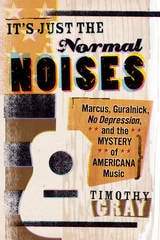
It's Just the Normal Noises
Marcus, Guralnick, No Depression, and the Mystery of Americana MusicTimothy Gray
University of Iowa Press, 2017
In It’s Just the Normal Noises, Timothy Gray examines a wide array of writing about roots music from the 1960s to the 2000s. In addition to chapters on the genre-defining work of Guralnick and Marcus, he explores the influential writings of Grant Alden and Peter Blackstock, the editors of No Depression magazine, and the writers who contributed to its pages, Bill Friskicks-Warren, Ed Ward, David Cantwell, and Allison Stewart among them. A host of memoirists and novelists, from Patti Smith and Ann Powers to Eleanor Henderson and Dana Spiotta, shed light on the social effects and personal attachments of the music’s many manifestations, from punk to alt country to hardcore. The ambivalent attitudes of rock musicians toward success and failure, the meaning of soul, the formation of alternative communities through magazine readership, and the obsession of Generation X scenes with DIY production values wend through these works.
Taking a personal approach to the subject matter, Gray reads criticism and listens to music as though rock ‘n’ roll not only explains American culture, but also shores up his life. This book is for everyone who’s heard in roots rock the sound of an individual and a nation singing themselves into being.
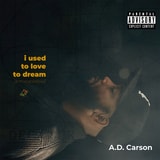
i used to love to dream
A.D. Carson
University of Michigan Press, 2020
Finalist: 2024 ACLS Open Access Book Prize Multimodal Category Finalist
“i used to love to dream” is a mixtap/e/ssay that performs hip-hop scholarship using sampled and live instrumentation; repurposed music, film, and news clips; and original rap lyrics. As a genre, the mixtap/e/ssay brings together the mixtape—a self-produced or independently released album issued free of charge to gain publicity—and the personal and scholarly essays. “i used to love to dream” names Decatur, Illinois—the author's hometown—as a reference point for place- and time-specific rapped ruminations about the ideas of growing up, moving away, and pondering one's life choices. At the same time, the tracks attempt to account for moral, philosophical, and ethical dimensions undergirding unease about authenticity, or staying true to oneself and to one’s city or neighborhood, as well as the external factors that contribute to such feelings. Using the local to ask questions about the global, “i used to love to dream” highlights outlooks on Black life generally, and Black manhood in particular, in the United States.
The tracks are presented along with liner notes and a short documentary about the making of the mixtap/e/ssay, and accompanying articles to provide context for the tracks for listeners both in classrooms and outside of them.