Results by title
3064 books match the query 'Social conditions' and 138 start with i
In the Name of El Pueblo
Place, Community, and the Politics of History in YucatánPaul K. Eiss
Duke University Press, 2010

In the Province of the Gods
Kenny Fries
University of Wisconsin Press, 2021

In the Shadow of Tungurahua
Disaster Politics in Highland EcuadorA.J. Faas
Rutgers University Press, 2023

In the Shadow of the Giant
The Americanization of Modern MexicoJoseph Contreras
Rutgers University Press, 2009
In this first book to view modern Mexico in the era of NAFTA and globalization, In the Shadow of the Giant offers insight into the land on our southern border.
What we find is a nation that looks more like the United States than even Mexicans themselves could have imagined a decade ago: Rates of obesity are second only to the United States among the world's industrialized countries. Recreational drug use is soaring among young Mexicans, Citigroup owns the largest bank in Mexico Wal-Mart is the country's biggest private employer revealing a vastly different physical and cultural landscape from his days as a young journalist living in Mexico in the mid-1980s. Joseph Contreras tracks the relentless and ongoing Americanization of his ancestral home. Although these changes may seem a natural part of globalization, the country had long prided itself on the social, political, economic, and even spiritual differences that distinguished it from the United States. In addition to embracing our virtues and vices, Contreras argues that our southern neighbor has become a de facto economic colony of the United States.
At a time when immigration looms as a leading hot-button issue in American politics, the time is ripe for examining our influences, for better or worse, on our neighbor to the south.

In the Shadow of the Palms
More-Than-Human Becomings in West PapuaSophie Chao
Duke University Press, 2022
In the Shadows of the State
Indigenous Politics, Environmentalism, and Insurgency in Jharkhand, IndiaAlpa Shah
Duke University Press, 2010
In the Time of Trees and Sorrows
Nature, Power, and Memory in RajasthanAnn Grodzins Gold and Bhoju Ram Gujar
Duke University Press, 2002
Based on testimonies from the 1990s, this book stands as a polyvocal account of the radical political and environmental changes the region and its people have faced in the twentieth century. Not just the story of modernity from the perspective of a rural village, these interviews and author commentaries narrate this small rural community’s relatively sudden transformation from subjection to a local despot and to a remote colonial power to citizenship in a modern postcolonial democracy. Unlike other recent studies of Rajasthan, the current study gives voice exclusively to former subjects who endured the double oppression of colonial and regional rulers. Gold and Gujar thus place subjective subaltern experiences of daily routines, manifestations of power relations, and sweeping changes to the environment (after the fall of kings) that turned lush forests into a barren landscape on equal footing with historical “fact” and archival sources. Ambiguous, complex, and culturally laden as it is in Western thought, the concept of nature is queried in this ethnographic text. For persons in Sawar the environment is not only a means of sustenance, its deterioration is linked to human morality and to power, both royal and divine. The framing questions of this South Asian history revealed through memories are: what was it like in the time of kings and what happened to the trees?

In the Wake
On Blackness and BeingChristina Sharpe
Duke University Press, 2016
Incidental Racialization
Performative Assimilation in Law SchoolYung-Yi Diana Pan
Temple University Press, 2017
Despite the growing number ofAsian American and Latino/a law students, many panethnic students still feel as if they do not belong in this elite microcosm, which reflects the racial inequalities in mainstream American society. While in law school, these students—often from immigrant families, and often the first to go to college—have to fight against racialized and gendered stereotypes. In Incidental Racialization, Diana Pan rigorously explores how systemic inequalities are produced and sustained in law schools.
Through interviews with more than 100 law students and participant observations at two law schools, Pan examines how racialization happens alongside professional socialization. She investigates how panethnic students negotiate their identities, race, and gender in an institutional context. She also considers how their lived experiences factor into their student organization association choices and career paths.
Incidental Racialization sheds light on how race operates in a law school setting for both students of color and in the minds of white students. It also provides broader insights regarding racial inequalities in society in general.
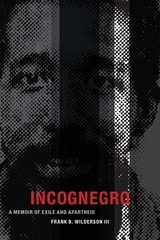
Incognegro
A Memoir of Exile and ApartheidFrank B. Wilderson III
Duke University Press, 2008
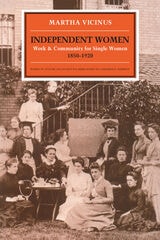
Independent Women
Work and Community for Single Women, 1850-1920Martha Vicinus
University of Chicago Press, 1985
"Feminist insight combines with vast research to produce a dramatic narrative. Independent Women chronicles the energetic lives and imaginative communal structures invented by women who 'pioneered new occupations, new living conditions, and new public roles.'"—Lee R. Edwards, Ms.
"Vicinus is to be congratulated for her brave and unflinching portraits of twisted spinsters as well as stolid saints. That she stretches her net up into the '20s and covers the women's suffrage momement is a brilliant stroke, for one may see clearly how it was possible for women to mount such an enormous and successful political campaign."—Jane Marcus, Chicago Tribune Book World
"Vicinus' beautifully written book abounds in rich historical detail and in subtle psychological insights in the character of its protagonists. The author understands the complexities of the interplay between economic and social conditions, cultural values, and the aims and aspirations of individual personalities who act in history. . . . A superb achievement."—Gerda Lerner, Reviews in American History
"Martha Vicinus has with intelligence and energy paved and landscaped the road on which scholars and students of activist women all travel for many years."—Blanche Wiesen Cook, Women's Review of Books
"Independent Women can be read by anyone with an interest in women's history. But for all contemporary women, unconsciously enjoying privileges and freedoms once bought so dearly, this book should be required reading."—Catharine E. Boyd, History
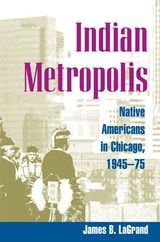
Indian Metropolis
Native Americans in Chicago, 1945-75James B. LaGrand
University of Illinois Press, 2002

Indian Reservations in the United States
Territory, Sovereignty, and Socioeconomic ChangeKlaus Frantz
University of Chicago Press, 1999
Informed by both historical research and extensive fieldwork, this book pays special attention to the natural resource base and economic outlook of the reservations, as well as the crucial issue of tribal sovereignty. Chapters also cover the demography of American Indian groups and their socioeconomic status (including standard of living, employment, and education). A new afterword treats some of the developments since the book's initial publication in German, such as the effects of the 1988 Indian gaming law that allowed Indian reservations to operate gambling establishments (with mixed success).
"Provides a good overview of the basic questions and problems facing reservation Indians today."—Peter Bolz, Journal of American History (on the German edition)
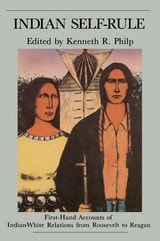
Indian Self Rule
First-Hand Accounts of Indian-White Relations from Roosevelt to Reaganedited by Kenneth R. Philp
Utah State University Press, 1995
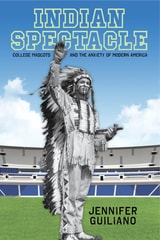
Indian Spectacle
College Mascots and the Anxiety of Modern AmericaGuiliano, Jennifer
Rutgers University Press, 2015

Indian Voices
Listening to Native AmericansOwings, Alison
Rutgers University Press, 2012
In Indian Voices, Alison Owings takes readers on a fresh journey across America, east to west, north to south, and around again. Owings's most recent oral history—engagingly written in a style that entertains and informs—documents what Native Americans say about themselves, their daily lives, and the world around them.
Young and old from many tribal nations speak with candor, insight, and (unknown to many non-Natives) humor about what it is like to be a Native American in the twenty-first century. Through intimate interviews many also express their thoughts about the sometimes staggeringly ignorant, if often well-meaning, non-Natives they encounter—some who do not realize Native Americans still exist, much less that they speak English, have cell phones, use the Internet, and might attend powwows and power lunches.
Indian Voices, an inspiring and important contribution to the literature about the original Americans, will make every reader rethink the past—and present—of the United States.
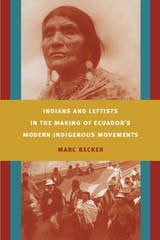
Indians and Leftists in the Making of Ecuador's Modern Indigenous Movements
Marc Becker
Duke University Press, 2008
Becker explains how rural laborers and urban activists worked together in Ecuador, merging ethnic and class-based struggles for social justice. Socialists were often the first to defend Indigenous languages, cultures, and social organizations. They introduced rural activists to new tactics, including demonstrations and strikes. Drawing on leftist influences, Indigenous peoples became adept at reacting to immediate, local forms of exploitation while at the same time addressing broader underlying structural inequities. Through an examination of strike activity in the 1930s, the establishment of a national-level Ecuadorian Federation of Indians in 1944, and agitation for agrarian reform in the 1960s, Becker shows that the history of Indigenous mobilizations in Ecuador is longer and deeper than many contemporary observers have recognized.
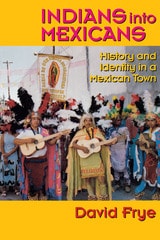
Indians into Mexicans
History and Identity in a Mexican TownBy David Frye
University of Texas Press, 1996
The people of Mexquitic, a town in the state of San Luis Potosí in rural northeastern Mexico, have redefined their sense of identity from "Indian" to "Mexican" over the last two centuries. In this ethnographic and historical study of Mexquitic, David Frye explores why and how this transformation occurred, thereby increasing our understanding of the cultural creation of "Indianness" throughout the Americas.
Frye focuses on the local embodiments of national and regional processes that have transformed rural "Indians" into modern "Mexicans": parish priests, who always arrive with personal agendas in addition to their common ideological baggage; local haciendas; and local and regional representatives of royal and later of national power and control. He looks especially at the people of Mexquitic themselves, letting their own words describe the struggles they have endured while constructing their particular corner of Mexican national identity.
This ethnography, the first for any town in northeastern Mexico, adds substantially to our knowledge of the forces that have rendered "Indians" almost invisible to European-origin peoples from the fifteenth century up to today. It will be important reading for a wide audience not only in anthropology and Latin American studies but also among the growing body of general readers interested in the multicultural heritage of the Americas.
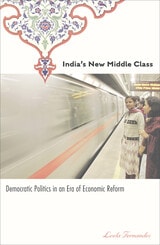
India’s New Middle Class
Democratic Politics in an Era of Economic ReformLeela Fernandes
University of Minnesota Press, 2006
Indicators of Change in the American Family
Abbott Lamoyne Ferriss
Russell Sage Foundation, 1970

Indicators of Children's Well-Being
Robert M. Hauser
Russell Sage Foundation, 1997
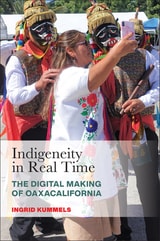
Indigeneity in Real Time
The Digital Making of OaxacaliforniaIngrid Kummels
Rutgers University Press, 2023

Indigenizing Japan
Ainu Past, Present, and FutureJoe E. Watkins
University of Arizona Press, 2025
Relaying the deep history of the islands of Japan, Watkins tells the archaeological story from the earliest arrivals some 40,000 years ago to 16,000 years ago when local cultures began utilizing pottery and stone tools. About 2,300 years ago, another group of people immigrated from the Korean peninsula into the Japanese archipelago, bringing wet rice agriculture with them. They intermarried with the people who were there, forming the basis of the contemporary Japanese majority culture. As the Japanese state developed on the central Islands of Honshu, Ryukyu, and Shikoku, the people of Hokkaido continued developing along a different trajectory with minimal interaction with the mainland until colonization in the mid-nineteenth century, when the people known as the Ainu came under Japanese governmental policy.
Watkins’s insightful analysis highlights the Ainu’s enduring spirit and their resurgence as part of the global Indigenous movement. Key events such as the 1997 Nibutani Dam case and the 2007 recognition of the Ainu as Japan’s Indigenous people are explored in depth, showcasing the Ainu’s ongoing fight for cultural preservation and self-determination. By situating the Ainu’s experiences within broader global colonial histories, Indigenizing Japan underscores the shared struggles and resilience of Indigenous communities worldwide.
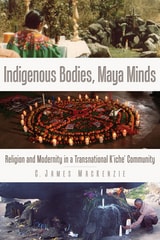
Indigenous Bodies, Maya Minds
Religion and Modernity in a Transnational K'iche' CommunityC. James MacKenzie
University Press of Colorado, 2016
Indigenous Bodies, Maya Minds examines tension and conflict over ethnic and religious identity in the K’iche’ Maya community of San Andrés Xecul in the Guatemalan Highlands and considers how religious and ethnic attachments are sustained and transformed through the transnational experiences of locals who have migrated to the United States.
Author C. James MacKenzie explores the relationship among four coexisting religious communities within Highland Maya villages in contemporary Guatemala—costumbre, traditionalist religion with a shamanic substrate; “Enthusiastic Christianity,” versions of Charismaticism and Pentecostalism; an “inculturated” and Mayanized version of Catholicism; and a purified and antisyncretic Maya Spirituality—with attention to the modern and nonmodern worldviews that sustain them. He introduces a sophisticated set of theories to interpret both traditional religion and its relationship to other contemporary religious options, analyzing the relation among these various worldviews in terms of the indigenization of modernity and the various ways modernity can be apprehended as an intellectual project or an embodied experience.
Indigenous Bodies, Maya Minds investigates the way an increasingly plural religious landscape intersects with ethnic and other identities. It will be of interest to Mesoamerican and Mayan ethnographers, as well as students and scholars of cultural anthropology, indigenous cultures, globalization, and religion.
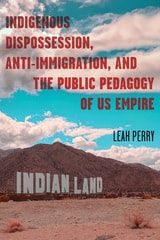
Indigenous Dispossession, Anti-Immigration, and the Public Pedagogy of US Empire
Leah Perry
The Ohio State University Press, 2024
From the founding of the United States, enduringly consequential debates over Indigeneity and immigration have occurred on the battlefield and in Congress, in courtrooms, at territorial borders, and in mainstream culture. In Indigenous Dispossession, Anti-Immigration, and the Public Pedagogy of US Empire, Leah Perry traces the ways that the US created its empire through public pedagogies—which she defines as policy and media discourses—surrounding Indigenous dispossession, gendered state violence, and racialized immigration. These pedagogies have propelled the expansion of US empire, including the redrawing of the US as a neoliberal democracy. Perry argues that by changing the discourse around gender, race, immigration, and Indigeneity, the United States has continued its imperial project through different eras, always predicated on Indigenous dispossession.
In exploring crucial components of empire, such as welfare, eugenics, disability, sexual violence, foodways, queerness, and policing, Perry interrogates violence against Indigenous peoples and against immigrants, examining these not independently—as is so often the case—but as co-constitutive. Indigenous Dispossession, Anti-Immigration, and the Public Pedagogy of US Empire thus intervenes in and fills a gap in immigration studies, Indigenous studies, race and ethnic studies, gender and sexuality studies, and US history.
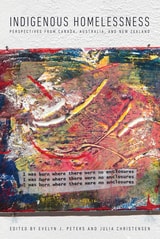
Indigenous Homelessness
Perspectives from Canada, Australia, and New ZealandEvelyn J. Peters
University of Manitoba Press, 2016
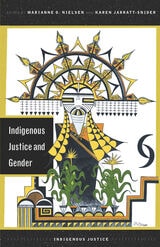
Indigenous Justice and Gender
Edited by Marianne O. Nielsen and Karen Jarratt-Snider
University of Arizona Press, 2023
This new volume offers a broad overview of topics pertaining to gender-related health, violence, and healing. Employing a strength-based approach (as opposed to a deficit model), the chapters address the resiliency of Indigenous women and two-spirit people in the face of colonial violence and structural racism.
The book centers the concept of “rematriation”—the concerted effort to place power, peace, and decision making back into the female space, land, body, and sovereignty—as a decolonial practice to combat injustice. Chapters include such topics as reproductive health, diabetes, missing and murdered Indigenous women, Indigenous women in the academy, and Indigenous women and food sovereignty.
As part of the Indigenous Justice series, this book provides an overview of the topic, geared toward undergraduate and graduate classes.
Contributors
Alisse Ali-Joseph
Michèle Companion
Mary Jo Tippeconnic Fox
Brooke de Heer
Lomayumtewa K. Ishii
Karen Jarratt-Snider
Lynn C. Jones
Anne Luna-Gordinier
Kelly McCue
Marianne O. Nielsen
Linda M. Robyn
Melinda S. Smith
Jamie Wilson
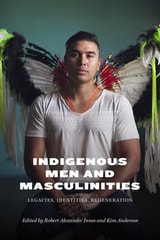
Indigenous Men and Masculinities
Legacies, Identities, RegenerationRobert Alexander Innes
University of Manitoba Press, 2015
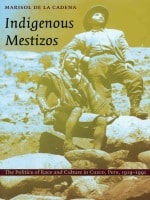
Indigenous Mestizos
The Politics of Race and Culture in Cuzco, Peru, 1919-1991Marisol de la Cadena
Duke University Press, 2000
De la Cadena’s ethnographically and historically rich study examines how indigenous citizens of the city of Cuzco have been conceived by others as well as how they have viewed themselves and places these conceptions within the struggle for political identity and representation. Demonstrating that the terms Indian and mestizo are complex, ambivalent, and influenced by social, legal, and political changes, she provides close readings of everyday concepts such as marketplace identity, religious ritual, grassroots dance, and popular culture, as well as of such common terms as respect, decency, and education. She shows how Indian has come to mean an indigenous person without economic and educational means—one who is illiterate, impoverished, and rural. Mestizo, on the other hand, has come to refer to an urban, usually literate, and economically successful person claiming indigenous heritage and participating in indigenous cultural practices. De la Cadena argues that this version of de-Indianization—which, rather than assimilation, is a complex political negotiation for a dignified identity—does not cancel the economic and political equalities of racism in Peru, although it has made room for some people to reclaim a decolonized Andean cultural heritage.
This highly original synthesis of diverse theoretical arguments brought to bear on a series of case studies will be of interest to scholars of cultural anthropology, postcolonialism, race and ethnicity, gender studies, and history, in addition to Latin Americanists.

Indigenous Migration and Social Change
The Foresteros of Cuzco, 1570-1720Ann M. Wightman
Duke University Press, 1990
Wightman shows that the dismissal of the forasteros as marginalized rural poor is superficial at best, and through laborious and painstaking archival research she presents a clear picture of the transformation of traditional society as the native populations coped with the disruptions of the conquest—and in doing so, reveals the reciprocal adaptations of the colonial power. Her choice of Cuzco is particularly appropriate, as this was a “heartland” region crucial to both the Incan and Spanish empires. The questions addressed by Wightman are of great concern to current Andean ethnohistory, one of the liveliest areas of such research, and are sure to have an important impact.
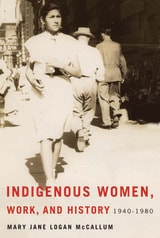
Indigenous Women, Work, and History
Mary Jane Logan McCallum
University of Manitoba Press, 2014
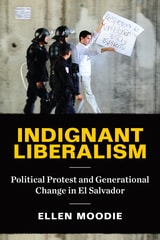
Indignant Liberalism
Political Protest and Generational Change in El SalvadorEllen Moodie
University of Texas Press, 2026
Documenting the rise and disillusionment of El Salvador’s postwar activists in the face of populist authoritarian politics.
The conclusion of El Salvador’s long civil war, in 1992, was supposed to bring about equality and political freedom. Leftist insurgents laid down arms, and the government formally embraced liberal ideals. Yet today, El Salvador is ruled by an authoritarian president who was reelected via unconstitutional means. What went wrong?
Anthropologist and journalist Ellen Moodie embedded with indignados—young middle-class protestors, demanding that the government live up to its liberal commitments—to better understand the course of political change since the civil war. Yet the “post-postwar” generation is only the latest demographic disappointed with liberalism in practice. Moodie examines a nineteenth-century “racial liberalism” that saw descendants of colonists “civilizing” Indigenous people while dispossessing them of lands and mobilizing them for labor. Today, the failure to make good on the promises of postwar liberalism has inspired robust support for strongman Nayib Bukele. Moodie argues that El Salvador’s case, though inflected by local concerns, is not unique. Rather, it is another stark demonstration of how liberalism’s imaginary social contract gives rise to populist authoritarianism.
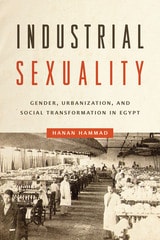
Industrial Sexuality
Gender, Urbanization, and Social Transformation in EgyptBy Hanan Hammad
University of Texas Press, 2016
Sara A. Whaley Book Prize, National Women's Studies Association, 2017
AMEWS Book Award, Journal of Middle Eastern Studies, 2017
Millions of Egyptian men, women, and children first experienced industrial work, urban life, and the transition from peasant-based and handcraft cultures to factory organization and hierarchy in the years between the two world wars. Their struggles to live in new places, inhabit new customs, and establish and abide by new urban norms and moral and gender orders underlie the story of the making of modern urban life—a story that has not been previously told from the perspective of Egypt’s working class.
Reconstructing the ordinary urban experiences of workers in al-Mahalla al-Kubra, home of the largest and most successful Egyptian textile factory, Industrial Sexuality investigates how the industrial urbanization of Egypt transformed masculine and feminine identities, sexualities, and public morality. Basing her account on archival sources that no researcher has previously used, Hanan Hammad describes how coercive industrial organization and hierarchy concentrated thousands of men, women, and children at work and at home under the authority of unfamiliar men, thus intensifying sexual harassment, child molestation, prostitution, and public exposure of private heterosexual and homosexual relationships. By juxtaposing these social experiences of daily life with national modernist discourses, Hammad demonstrates that ordinary industrial workers, handloom weavers, street vendors, lower-class landladies, and prostitutes—no less than the middle and upper classes—played a key role in shaping the Egyptian experience of modernity.

Inequality in Early America
Carla Gardina Pestana
Dartmouth College Press, 2015
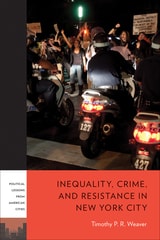
Inequality, Crime, and Resistance in New York City
Timothy P. R. Weaver
Temple University Press, 2025
Weaver brings these clashes to the fore by showing how New York City politics has been shaped by these conflicting orders. He examines the transformation of the city’s political economy in the aftermath of the 1975 fiscal crisis through neoliberal real estate development and privatization, the conservative rise of law-and-order politics in the 1970s to 1990s, and the efforts of the city’s egalitarians to respond to each of these shifts through social movements such as Occupy and Black Lives Matter.
Inequality, Crime, and Resistance in New York City belies glib assumptions about the city’s liberal character. Weaver reveals the metropolis not as a homogenous political whole, but as a site in which the victories and defeats of rival political forces change the terms of local citizenship for the millions of residents who call the city home.
In the series Political Lessons from American Cities

Inequity in the Technopolis
Race, Class, Gender, and the Digital Divide in AustinEdited by Joseph Straubhaar, Jeremiah Spence, Zeynep Tufekci, and Roberta G. Lentz
University of Texas Press, 2012
Over the past few decades, Austin, Texas, has made a concerted effort to develop into a “technopolis,” becoming home to companies such as Dell and numerous start-ups in the 1990s. It has been a model for other cities across the nation that wish to become high-tech centers while still retaining the livability to attract residents. Nevertheless, this expansion and boom left poorer residents behind, many of them African American or Latino, despite local and federal efforts to increase lower-income and minority access to technology.
This book was born of a ten-year longitudinal study of the digital divide in Austin—a study that gradually evolved into a broader inquiry into Austin’s history as a segregated city, its turn toward becoming a technopolis, what the city and various groups did to address the digital divide, and how the most disadvantaged groups and individuals were affected by those programs.
The editors examine the impact of national and statewide digital inclusion programs created in the 1990s, as well as what happened when those programs were gradually cut back by conservative administrations after 2000. They also examine how the city of Austin persisted in its own efforts for digital inclusion by working with its public libraries and a number of local nonprofits, and the positive impact those programs had.

Inglorious Artists
Art World Satire and the Emergence of a Capitalist Art Market in Paris, 1750-1850Kathryn Desplanque
University of Delaware Press, 2025
This book is also freely available online as an open access digital edition.
Inheriting the City
The Children of Immigrants Come of AgePhilip Kasinitz
Russell Sage Foundation, 2008
Innocence and Victimhood
Gender, Nation, and Women’s Activism in Postwar Bosnia-HerzegovinaElissa Helms
University of Wisconsin Press, 2013

Innocent Subjects
Feminism and WhitenessTerese Jonsson
Pluto Press, 2020
Despite a rich history of Black and postcolonial critiques of racist and imperial feminist politics, racism still exists within contemporary British feminism. To explain why, Terese Jonsson examines the history of feminism over the last forty years. She argues that Black feminism's role in shaping the movement has been marginalised through narratives which repeatedly position white women at the centre of the story, from the women's liberation movement in the 1970s to today.
Analysing the ways in which whiteness continues to pervade feminist literature, as well as feminist debates in the liberal media, Jonsson demonstrates that, despite an increased attention to race, intersectionality and difference, stories told by white feminists are shaped by their desire to maintain an 'innocent' position towards racism.
Inside Colombia
Drugs, Democracy, and WarLivingstone, Grace
Rutgers University Press, 2004
The South American nation of Colombia has seen more than forty years of unrest, conflict, and civil war. It is a country in which social violence and warfare are intricately intertwined. Colombia is also notorious for its drug trade, being one of the leading producers of cocaine in the world, and for its central role as a staging ground for the U.S. “war on drugs.” Since 9/11 the Bush administration has sought to draw political links between the Colombian drug trade, guerrilla organizations, and terrorism.
Inside Colombia offers a valuable introduction and quick reference guide to this complex nation. With chapters devoted to history, human rights issues, the economy, drugs, the controversial antidrug intervention known as Plan Colombia, and relations with the United States, the book offers an easily accessible and comprehensive overview. Readers will learn about the major players in the conflicts, significant political figures, how Colombia’s economy has fared in the twentieth century, how the country’s geography influences its politics and economy, and how U.S. intervention shapes Colombia’s political scene.
Inside Newark
Decline, Rebellion, and the Search for TransformationCurvin, Robert
Rutgers University Press, 2014
Based on historical records and revealing interviews with over one hundred residents and officials, Inside Newark traces Newark’s history from the 1950s, when the city was a thriving industrial center, to the era of Mayor Cory Booker. Along the way, Curvin covers the disturbances of July 1967, called a riot by the media and a rebellion by residents; the administration of Kenneth Gibson, the first black mayor of a large northeastern city; and the era of Sharpe James, who was found guilty of corruption. Curvin examines damaging housing and mortgage policies, the state takeover of the failing school system, the persistence of corruption and patronage, Newark’s shifting ethnic and racial composition, positive developments in housing and business complexes, and the reign of ambitious mayor Cory Booker.
Inside Newark reveals a central weakness that continues to plague Newark—that throughout this history, elected officials have not risen to the challenges they have faced. Curvin calls on those in positions of influence to work for the social and economic improvement of all groups and concludes with suggestions for change, focusing on education reform, civic participation, financial management, partnerships with agencies and business, improving Newark’s City Council, and limiting the term of the mayor. If Newark’s leadership can encompass these changes, Newark will have a chance at a true turnaround.

Inside Tenement Time
Suss, Spirit, and SurveillanceKezia Page
Rutgers University Press, 2025
Inside Tenement Time is the first comprehensive treatment of literary and cultural texts on surveillance in the Caribbean. Covering the long historical arc of the twentieth to the twenty-first centuries, Inside Tenement Time uses Jamaica as a case study to examine moments of crisis and particular spaces, especially urban yard enclaves and their environs, in the Caribbean encounter with surveillance. Making the argument that the Caribbean situation reveals flexible hegemonies rather than provinces of exclusive control, the book demonstrates the countervailing force of sussveillance and spiritveillance, Afro-Indigenous variations on surveillance. Sussveillance and spiritveillance are exemplars of vernacular arts and sciences that operate at and within the frangible borders of state power, exposing the unique dynamics of surveillance in the region and marshalling the acts of imagination with which it contends. For example, the Smile Jamaica concert of 1976, headlined by reggae Superstar Bob Marley, and the reputedly US government-backed 2010 Tivoli Gardens incursion in West Kingston, both moments that have dramatic, even mythic residue in Caribbean and global memory, are among the real-life events brought into conversation with literary representations of this history.

Inside the Celtic Tiger
Denis O'Hearn
Pluto Press, 1998

Inside the Klavern
The Secret History of a Ku Klux Klan of the 1920sEdited by David A. Horowitz
Southern Illinois University Press, 1999
Inside the Klavern is an annotated collection of the minutes of a thriving Ku Klux Klan in La Grande, Oregon, between 1922 and 1924. The most complete set of Klan minutes ever uncovered, these documents illustrate the inner workings of a Klan chapter of more than three hundred members at a time when the national membership reached into the millions and the Invisible Empire was at the peak of its power. Through an extensive introduction and conclusion as well as brief notes previewing each installment of the minutes, David A. Horowitz places these unique documents in historical perspective.
The La Grande minutes demonstrate Klan hostility to Roman Catholics, Jews, blacks, and "hyphenated" Americans. But they also explain how the chapter exercised requirements for admission, how officers were selected, and how Klansmen encountered difficulties enforcing the moral standards of their order. Because the Klan kligrapp (recording secretary) Harold R. Fosner recorded not only the official proceedings but also volunteered extemporaneous comments and gossip, readers get a genuine feeling for what it was like to attend the meetings. Through his own obvious excitement and commitment to the cause, Fosner re-creates the flavor, tone, and atmosphere of these meetings: "Tis beyond my power of expression to relate the harmony and fellowship which reigned supreme. . . . Suffice to say that these were the golden moments of our lives."
His evaluation of Klan propaganda, too, is telling: "The weekly newsletter from Atlanta, Georgia, contained a little book, the official message of our emperor, one Col. William Joseph Simmons, read before the most noble band of men ever assembled and for the noblest cause in the world. To my firm belief this book is the leading masterpiece of our day and age."
Horowitz concludes that "although it is tempting to judge Jazz Age Klansmen by the standards of later generations, the story provided by the minutes is a complex one—a chronicle of both compassion and complicity in cruelty, of positive social accomplishment and arbitrary and dysfunctional divisiveness."
Institutions and Economic Theory
The Contribution of the New Institutional EconomicsEirik Furubotn and Rudolf Richter
University of Michigan Press, 2005
This second edition assesses some of the major refinements, extensions, and useful applications that have developed in neoinstitutionalist thought in recent years. More attention is given to the overlap between the New Institutional Economics and developments in economic history and political science. In addition to updated references, new material includes analysis of parallel developments in the field of economic sociology and its attacks on representatives of the NIE as well as an explanation of the institution-as-an-equilibrium-of-game approach.
Already an international best seller, Institutions and Economic Theory is essential reading for economists and students attracted to the NIE approach. Scholars from such disciplines as political science, sociology, and law will find the work useful as the NIE continues to gain wide academic acceptance. A useful glossary for students is included.
Eirik Furubotn is Honorary Professor of Economics, Co-Director of the Center for New Institutional Economics, University of Saarland, Germany and Research Fellow, Private Enterprise Research Center, Texas A&M University.
Rudolph Richter is Professor Emeritus of Economics and Director of the Center for New Institutional Economics, University of Saarland, Germany.

Insult and the Making of the Gay Self
Didier Eribon
Duke University Press, 2004
Eribon describes the emergence of homosexual literature in Britain and France at the turn of the last century and traces this new gay discourse from Oscar Wilde and the literary circles of late-Victorian Oxford to André Gide and Marcel Proust. He asserts that Foucault should be placed in a long line of authors—including Wilde, Gide, and Proust—who from the nineteenth century onward have tried to create spaces in which to resist subjection and reformulate oneself. Drawing on his unrivaled knowledge of Foucault’s oeuvre, Eribon presents a masterful new interpretation of Foucault. He calls attention to a particular passage from Madness and Civilization that has never been translated into English. Written some fifteen years before The History of Sexuality, this passage seems to contradict Foucault’s famous idea that homosexuality was a late-nineteenth-century construction. Including an argument for the use of Hannah Arendt’s thought in gay rights advocacy, Insult and the Making of the Gay Self is an impassioned call for critical, active engagement with the question of how gay life is shaped both from without and within.

Insults in Classical Athens
Deborah Kamen
University of Wisconsin Press, 2022
While the classical city celebrated the democratic equality of "autochthonous" citizens, it counted a large population of noncitizens as inhabitants, so that ancient Athenians developed a preoccupation with negotiating, affirming, and restricting citizenship. Kamen raises key questions about what it meant to be a citizen in democratic Athens and demonstrates how insults were deployed to police the boundaries of acceptable behavior. In doing so, she illuminates surprising differences between antiquity and today and sheds light on the ways a democratic society valuing "free speech" can nonetheless curb language considered damaging to the community as a whole.

Integrating the Gridiron
Black Civil Rights and American College FootballDemas, Lane
Rutgers University Press, 2011
Integrating the Gridiron, the first book devoted to exploring the racial politics of college athletics, examines the history of African Americans on predominantly white college football teams from the nineteenth century through today. Lane Demas compares the acceptance and treatment of black student athletes by presenting compelling stories of those who integrated teams nationwide, and illuminates race relations in a number of regions, including the South, Midwest, West Coast, and Northeast. Focused case studies examine the University of California, Los Angeles in the late 1930s; integrated football in the Midwest and the 1951 Johnny Bright incident; the southern response to black players and the 1955 integration of the Sugar Bowl; and black protest in college football and the 1969 University of Wyoming "Black 14." Each of these issues drew national media attention and transcended the world of sports, revealing how fans—and non-fans—used college football to shape their understanding of the larger civil rights movement.
Interaction and Connectivity in the Greater Southwest
Karen Harry
University Press of Colorado, 2018
The book observes social interactions’ role in the diffusion of ideas and material culture; the way different social units, especially households, interacted within and between communities; and the importance of interaction and interconnectivity in understanding the archaeology of the Southwest’s northern periphery. Chapters demonstrate a movement away from strictly economic-driven models of social connectivity and interaction and illustrate that members of social groups lived in dynamic situations that did not always have clear-cut and unwavering boundaries. Social connectivity and interaction were often fluid, changing over time.
Interaction and Connectivity in the Greater Southwest is an impressive collection of established and up-and-coming Southwestern archaeologists collaborating to strengthen the theoretical underpinnings of the discipline. It will be of interest to professional and academic archaeologists, as well as researchers with interests in diffusion, identity, cultural transmission, borders, large-scale interaction, or social organization.
Contributors:
Richard V. N. Ahlstrom, James R. Allison, Jean H. Ballagh, Catherine M. Cameron, Richard Ciolek-Torello, John G. Douglass, Suzanne L. Eckert, Hayward H. Franklin, Patricia A. Gilman, Dennis A. Gilpin, William M. Graves, Kelley A. Hays-Gilpin, Lindsay D. Johansson, Eric Eugene Klucas, Phillip O. Leckman, Myles R. Miller, Barbara J. Mills, Matthew A. Peeples, David A. Phillips Jr., Katie Richards, Heidi Roberts, Thomas R. Rocek, Tammy Stone, Richard K. Talbot, Marc Thompson, David T. Unruh, John A. Ware, Kristina C. Wyckoff