1927 books match the query 'Technology & Engineering' and 74 start with i

cover of Interactions of Wind Turbines with Aviation Radio and Radar Systems

Interactions of Wind Turbines with Aviation Radio and Radar Systems

Alan Collinson

The Institution of Engineering and Technology, 2024

Wind farms and wind turbines are strong reflectors of radio waves, which can affect radar and radio systems used by civil and military aviation. The speeds of turbine blades and aircraft are comparable, and it can be difficult to discriminate between them using existing radar systems. Wind turbines may also affect communications, navigation and instrument landing systems. This situation is a brake to wind farm development slowing or stopping exploitation of many giga watts of wind capacity in many countries. Therefore, developing approaches and technologies for the mitigation of the impacts of wind farms on aviation systems is of great importance. These technologies have the potential to increase renewable energy generation and promote energy independence but, and this is critically important, they must do so without compromising safety or national defense.
[more]
cover of Internet and Wireless Security

Internet and Wireless Security

Robert Temple

The Institution of Engineering and Technology, 2002
Many organisations are transforming their businesses through the development of information and communications technologies. The security of this e-commerce is now a key enabler for businesses, and this book presents an overview of current and future infrastructures for e-business security.
[more]
cover of Introduction to Adaptive Arrays

Introduction to Adaptive Arrays

Robert A. Monzingo

The Institution of Engineering and Technology, 2011
This second edition is an extensive modernization of the bestselling introduction to the subject of adaptive array sensor systems. With the number of applications of adaptive array sensor systems growing each year, this look at the principles and fundamental techniques that are critical to these systems is more important than ever before.
[more]
cover of Introduction to Airborne Radar

Introduction to Airborne Radar

Geroge W. Stimson

The Institution of Engineering and Technology, 1998
Introduction to Airborne Radar is the revision of the classic book privately published by Hughes Aircraft Company in 1983. Lavishly produced in full color, the book was quite unlike any commercially published radar book produced by the major technical publishers. The combination of clear, understandable writing and the unparalleled illustrations established the text-reference as a 'must-have' for engineers, technicians, pilots, and even sales and marketing people within the radar and aerospace industry. The book was authored by veteran Hughes engineer and Technical Manager George W. Stimson, a publications specialist. Individual chapters were thoroughly reviewed by the appropriate experts within the Hughes Radar Systems Group. The book was initially available 1983-1987 only to those within the Hughes family: employees and customers, primarily the military. Restriction was lifted in 1987. Hughes went through three printings and 40,000 copies 1983-1993, mostly by word-of-mouth testimonials and demand. Upon retirement from Hughes, George Stimson successfully negotiated for the rights to the book and made an agreement with SciTech Publishing to do a major revision of the text to update it. The resulting Second Edition has been overwhelmingly positive and a best-seller. Second Edition The revision is extensive: thirteen entirely new chapters cover the technological advances over the fifteen years since publication, two chapters considered obsolete have been deleted entirely, three chapters are extensively rewritten and updated, two chapters have been given new sections, and fourteen chapters have been given minor tweaks, corrections, and polishing. The book has grown from 32 chapters to 44 chapters in 584 efficiently-designed pages. Efforts have been made to bring more even-handed coverage to radars developed outside of Hughes Aircraft, while older and less important Hughes radars have been deleted or abbreviated. Chapter 44 catalogs many of the cutting edge radars in functioning aircraft and near-service aircraft in early stages of production. The book's appeal is to a diverse audience: from military pilots and radar officers eager to gain a sound technical understanding of the complex systems that their lives depend upon, on up through technicians, marketing, and sales people, to the radar system design specialists, who may 'know all that stuff' but who deeply admire the expression and thus use the book to teach others who have questions. The market encompasses companies directly involved in the radar business and those on the periphery, college professors of engineering and physics themselves, along with students in aviation, aeronautics, and electromagnetics and radar courses. The cross-disciplinary and multi-level demand for the book shows that the book should not be pigeon-holed as just a radar book for electrical engineers. Virtually anybody with a knowledge of high school algebra, trigonometry, and physics will be able to read and absorb most of the material.
[more]
cover of Introduction to Biomechatronics

Introduction to Biomechatronics

Graham M. Brooker

The Institution of Engineering and Technology, 2012
This is the age of biomechatronics, a time where mechanics and electronics can interact with human muscle, skeleton, and nervous systems to assist or replace limbs, senses, and even organs damaged by trauma, birth defects, or disease. Introduction to Biomechatronics provides biomedical engineering students and professionals with the fundamental mechatronic (mechanics, electronics, robotics) engineering knowledge they need to analyze and design devices that improve lives. The first half of the book provides the engineering background to understand all the components of a biomechatronic system: the human subject, stimulus or actuation, transducers and sensors, signal conditioning elements, recording and display, and feedback elements. It also includes the major functional systems of the body to which biomechatronics can be applied including: biochemical, nervous, cardiovascular, respiratory, and musculoskeletal. The second half discusses five broadly based inventions from a historical perspective and supported by the relevant technical detail and engineering analysis. It begins with the development of hearing prostheses including middle-ear implantable hearing devices and the amazingly successful cochlear implant. This is followed by sensory substitution and visual prostheses that researchers hope will do the same for the blind as the cochlear implant has done for the deaf. The last three chapters are more mechatronic in focus, examining artificial hearts, respiratory aids from the iron lung to the latest CPAP devices, and finally artificial limbs from the first hooks and peg legs to limbs that move and have a sense of touch.
[more]
cover of Introduction to Biomechatronics: Mechatronic considerations, Volume 1

Introduction to Biomechatronics

Mechatronic considerations, Volume 1

Graham M. Brooker

The Institution of Engineering and Technology, 2025
Introduction to Biomechatronics, Second Edition, combines fundamental mechatronic (mechanics, electronics, robotics) engineering knowledge with state-of-the-art device designs that improve quality of life for patients worldwide. This new edition is comprehensively updated and includes new chapters on brain-machine interfaces and exoskeletons.
[more]
cover of Introduction to Biomechatronics: Systems and applications, Volume 2

Introduction to Biomechatronics

Systems and applications, Volume 2

Graham M. Brooker

The Institution of Engineering and Technology, 2025
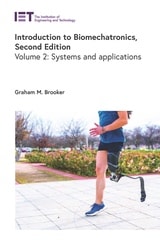
Introduction to Biomechatronics, Second Edition, combines fundamental mechatronic (mechanics, electronics, robotics) engineering knowledge with state-of-the-art device designs that improve quality of life for patients worldwide. This new edition is comprehensively updated and includes new chapters on brain-machine interfaces and exoskeletons.
[more]
cover of Introduction to Broadband Communication Systems

Introduction to Broadband Communication Systems

Cajetan M. Akujuobi

The Institution of Engineering and Technology, 2008

Broadband networks, such as asynchronous transfer mode (ATM), frame relay, and leased lines, allow us to easily access multimedia services (data, voice, and video) in one package. Exploring why broadband networks are important in modern-day telecommunications, Introduction to Broadband Communication Systems covers the concepts and components of both standard and emerging broadband communication network systems.
[more]
cover of Introduction to Digital Wireless Communications

Introduction to Digital Wireless Communications

Hong-Chuan Yang

The Institution of Engineering and Technology, 2017
This book provides an efficient introduction to fundamental and advanced digital transmission technologies in current and future wireless communication systems. The objective is to help students and engineers quickly grasp the operating principles and design trade-offs of various wireless transmission technologies, which will enable them to carry out product development or perform academic research in the field.
[more]
cover of Introduction to Electronic Warfare Modeling and Simulation

Introduction to Electronic Warfare Modeling and Simulation

David L. Adamy

The Institution of Engineering and Technology, 2006
This unique book covers the whole field of electronic warfare modeling and simulation at a systems level, including chapters that describe basic electronic warfare (EW) concepts. Written by a well-known expert in the field with more than 24 years of experience, the book explores EW applications and techniques and the radio frequency spectrum, with primary emphasis on HF (high frequency) to microwave. A detailed resource for entry-level engineering personnel in EW, military personnel with no radio or communications engineering background, technicians and software professionals, the work helps you understand the basic concepts required for modeling and simulation, as well as fidelity and other practical aspects of simulation design and application. You get clear explanations of important mathematical concepts, such as decibel notation and spherical trigonometry. This informative reference explains how to facilitate the generation of realistic computer models of EW equipment. Moreover, it describes specific types of EW equipment, how they work and how each is mathematically modeled. The book concludes with a description of the various types of models and simulations and the ways they are applied to training and equipment testing tasks.
[more]
cover of Introduction to Engineering Design: A Conceptual Overview

Introduction to Engineering Design

A Conceptual Overview

Kenneth Alfano

Michigan Publishing Services, 2025

Introduction to Engineering Design: A Conceptual Overview provides a basic overview of the process of engineering design – the "heart" of engineering – in a broadly accessible manner that assumes no specialized knowledge. The focus is on breadth over depth, for a contextual framework that can in turn facilitate more detailed or focused learning later on. Relevant for a wide range of engineering disciplines, it outlines core design process fundamentals while also introducing various related points along the way.
 
Engineering design courses are often project-oriented, and rightly so, given that the process is best understood through some amount of experience. But a conceptual foundation is likewise critical for this subject. It helps enable experiential learning to relate the broad context of design process elements to the specific context of a given project. Further, engineering students tend to start out more acquainted with thinking about math and science subjects, where there is often one way – or at least a clear best way – to a “right” answer. The design process, by marked contrast, is largely qualitative and open-ended. Relatedly, it can (perhaps ironically) aid early learners to point out how varied and inconsistent the usage can be for some terminology – so the book does so at times, to help preempt confusion down the road.
 
In addition to being a text for an introductory college course, the book can also serve as a supplemental or reference text for later courses or on the job, or simply a general overview for those curious about the subject.
[more]
cover of Introduction to RF Stealth

Introduction to RF Stealth

David L. Lynch Jr.

The Institution of Engineering and Technology, 2004

This is the only book focused on the complete aspects of RF Stealth design. It is the first book to present and explain first order methods for the design of active and passive stealth properties. Everything from Electronic Order of Battle to key component design is covered.
[more]
cover of Introduction to Radar Target Recognition

Introduction to Radar Target Recognition

P. Tait

The Institution of Engineering and Technology, 2006
This book text provides an overview of the radar target recognition process and covers the key techniques being developed for operational systems. It is based on the fundamental scientific principles of high resolution radar, and explains how the underlying techniques can be used in real systems, taking into account the characteristics of practical radar system designs and component limitations. It also addresses operational aspects, such as how high resolution modes would fit in with other functions such as detection and tracking.
[more]
cover of Introduction to Sensors for Ranging and Imaging

Introduction to Sensors for Ranging and Imaging

Graham Brooker

The Institution of Engineering and Technology, 2009
This is a comprehensive textbook and reference that provides a solid background in active sensing technology. Beginning with a historical overview and an introductory section on signal generation, filtering and modulation, it follows with a section on radiometry (infrared and microwave) as a background to the active sensing process. The core of the book is concerned with active sensing, starting with the basics of time-of-flight sensors (operational principles, components), and goes through the derivation of the radar range equation, and the detection of echo signals, both fundamental to the understanding of radar, sonar and lidar imaging. Several chapters cover signal propagation of both electromagnetic and acoustic energy, target characteristics, stealth and clutter. The remainder of the book involves the basics of the range measurement process, active imaging with an emphasis on noise and linear frequency modulation techniques, Doppler processing, and target tracking.
[more]
cover of Introduction to the Smart Grid: Concepts, technologies and evolution

Introduction to the Smart Grid

Concepts, technologies and evolution

Salman K. Salman

The Institution of Engineering and Technology, 2017
In recent years it has become increasingly apparent that conventional electrical networks cannot meet the requirements of the 21st century. These include reliability, efficiency, liberalisation of electricity markets, as well as effective and seamless integration of various types of renewable energy sources, electric vehicles, and customers as players. The emergence of new technologies such as distributed control, monitoring devices, and tremendous advances in information and communication technology have paved the way to realize the Smart Grid concept.
[more]
cover of Inventing Nadar: A History of Photographic Firsts

Inventing Nadar

A History of Photographic Firsts

Emily Doucet

Duke University Press, 2025

Félix Nadar took the first aerial photograph in 1858, so the story goes. The evidence, Emily Doucet notes, is mixed. In Inventing Nadar, Doucet analyzes the historical and material production of the nineteenth-century Parisian photographer’s famous and numerous photographic firsts. Focusing on these oft-labeled groundbreaking elements of his career, she deconstructs Nadar’s legacy as a prime protagonist in the history of photography by interrogating the media techniques used to construct his invention narratives. Doucet highlights this highly mediated process as one that canonized novel applications of photography as discrete techniques with single authors and inventors. Looking to this process of mediation through the institutions and individuals that shaped Nadar’s archives, Doucet unpacks assumptions of Nadar as a master of early photography and shows how the medium is enmeshed in larger histories of media, science, and technology. The result is both a new account of Nadar’s place in photographic history and a critical study of how stories of innovation take shape.
[more]
cover of Inventing Pollution: Coal, Smoke, and Culture in Britain since 1800

Inventing Pollution

Coal, Smoke, and Culture in Britain since 1800

Peter Thorsheim

Ohio University Press, 2017

Going as far back as the thirteenth century, Britons mined and burned coal. Britain’s supremacy in the nineteenth century depended in large part on its vast deposits of coal, which powered industry, warmed homes, and cooked food. As coal consumption skyrocketed, the air in Britain’s cities and towns filled with ever-greater and denser clouds of smoke. Yet, for much of the nineteenth century, few people in Britain even considered coal smoke to be pollution.

Inventing Pollution examines the radically new understanding of pollution that emerged in the late nineteenth century, one that centered not on organic decay but on coal combustion. This change, as Peter Thorsheim argues, gave birth to the smoke-abatement movement and to new ways of thinking about the relationships among humanity, technology, and the environment.

Even as coal production in Britain has plummeted in recent decades, it has surged in other countries. This reissue of Thorsheim’s far-reaching study includes a new preface that reveals the book’s relevance to the contentious national and international debates—which aren’t going away anytime soon—around coal, air pollution more generally, and the grave threat of human-induced climate change.
[more]
cover of Inverse Synthetic Aperture Radar Imaging: Principles, algorithms and applications

Inverse Synthetic Aperture Radar Imaging

Principles, algorithms and applications

Victor C. Chen

The Institution of Engineering and Technology, 2014

Based on the authors' 20 years' research work on Inverse Synthetic Aperture Radar (ISAR) imaging of moving targets and non-cooperative target recognition, this book provides readers with knowledge of various algorithms of ISAR imaging of targets and implementation with MATLAB. It introduces basic principles of radar backscattering, radar imaging, and signal analysis. It describes the characteristics of radar returns from targets, how to produce well-focused ISAR images of moving targets, and what features that can extracted from ISAR images. Also introduced are several important algorithms for ISAR image formation, ISAR image auto-focusing, and applications of ISAR imaging to air targets, sea vessels and ground moving targets. Examples of ISAR imaging of ground moving targets, air targets, and sea vessels are discussed in detail.
[more]
cover of IoT Technologies in Smart-Cities: From sensors to big data, security and trust

IoT Technologies in Smart-Cities

From sensors to big data, security and trust

Fadi Al-Turjman

The Institution of Engineering and Technology, 2020

Smart City and sensing platforms are considered some of the most significant topics in the Internet of Things (IoT). Sensors are at the heart of the IoT, and their development is a key issue if such concepts are to achieve their full potential.
[more]
cover of Ionospheric Radio

Ionospheric Radio

Kenneth Davies

The Institution of Engineering and Technology, 1990

Ionospheric Radio replaces an earlier publication Ionospheric Propogation and is aimed at professional scientists, engineers, and students who need an intermediate-level reference and/or text. Students of aeronomy and radio wave propogation are introduced to basic wave theory in absorbing, anisotropic and dispersive media, and to the physics of production, loss and movement of plasma in the ionosphere in the presence of the geomagnetic field. Various radio techniques are described, and applications to the interpretation of ionospheric structures and dynamics are presented. The application of ionospheric data to radio communications problems includes the use of numerical and physical models and prediction techniques, and methods for calculating signal strengths are presented. Topics include Earth-space propagation, ionospheric modification, ionospheric disturbances, propagation by scattering from plasma irregularities, topside sounding, and propagation on frequencies from the extremely low to the super high. Reference lists are extensive and a section of questions tests the reader's understanding of the material.
[more]
cover of Iowa's Minerals: Their Occurance, Origins, Industries and Lore

Iowa's Minerals

Their Occurance, Origins, Industries and Lore

Paul Garvin

University of Iowa Press, 1998
[more]
cover of Iris and Periocular Biometric Recognition

Iris and Periocular Biometric Recognition

Christian Rathgeb

The Institution of Engineering and Technology, 2017

Iris recognition technologies for identity management are already deployed globally in several large-scale nationwide biometric projects and are currently entering the mobile market. More recently, periocular recognition has been employed to augment the biometric performance of the iris in unconstrained environments where only the ocular region is present in the image.
[more]
cover of Iron Valley: The Transformation of the Iron Industry in Ohio's Mahoning Valley, 1802–1913

Iron Valley

The Transformation of the Iron Industry in Ohio's Mahoning Valley, 1802–1913

Clayton J. Ruminski

The Ohio State University Press, 2017

Youngstown, Ohio, and the surrounding Mahoning Valley supplied the iron that helped transform the United States into an industrial powerhouse in the nineteenth century. The story of the Mahoning Valley’s unorthodox rise from mid-scale iron producer to twentieth-century “Steel Valley” is a tale of innovation, stagnation, and, above all, extreme change. Located halfway between Pittsburgh and Cleveland, the Mahoning Valley became a major supplier of pig iron to America’s biggest industrial regions. For much of the nineteenth century, outside consumers relied on the Valley’s pig iron, but this reliance nurtured a reluctance on the part of Youngstown iron companies to diversify or expand their production.

In Iron Valley: The Transformation of the Iron Industry in Ohio’s Mahoning Valley, 1802–1913, Clayton J. Ruminski argues that Youngstown-area iron manufacturers were content to let others in the industry innovate, and only modernized when market conditions forced them to do so. Desperate to find new markets, some Youngstown iron manufacturers eventually looked toward steel and endured a rapid, but successful, industrial transformation that temporarily kept their old enterprises afloat in a rapidly evolving industry. Richly illustrated with rare photographs of Mahoning Valley ironmasters, mills, furnaces, and workers, Iron Valley sheds light on a previously underrepresented and vital region that built industrial America.

[more]
cover of Iron and Steel: A Driving Guide to the Birmingham Area Industrial Heritage

Iron and Steel

A Driving Guide to the Birmingham Area Industrial Heritage

James R. Bennett and Karen R. Utz

University of Alabama Press, 2010

This guidebook of historic iron-production sites is designed to give the reader a factual and illuminating look at the people and events that shaped Birmingham into one of America’s leading steel centers. Iron & Steel is heavily illustrated with both color and historical black-and-white photographs. It can be used while visiting parks or read as a coherent volume before or after a visit.

The book contains chapters devoted to the larger preserved sites open to the public, such as Sloss Furnaces National Historic Landmark and Tannehill Ironworks Historical State Park. It also highlights lesser-known, yet still accessible, sites such as Blocton Coke Ovens Park. The work provides easy-to-follow maps for every site as well as driving directions to the more remote locations, giving visitors easy access to all the notable iron and steel sites in Jefferson, Shelby, Tuscaloosa, and Bibb counties. Each chapter also includes a variety of historical information, with accompanying photographs, in order to present the reader with a detailed and comprehensive account of the Birmingham Iron and Steel District.

Featured sites include: Tannehill Ironworks Historical State Park; Shelby Ironworks Park; Billy Gould Coke Ovens Park; Brierfield Ironworks Historical State Park; Oxmoor Furnace Site; Irondale Furnace Park; Helena Rolling Mill Site; Red Mountain Park, Iron Ore Mines; Lewisburg Coke Ovens Park; Sloss Furnaces National Historic Landmark; Ruffner Mountain Nature Center; Blocton Coke Ovens Park; and Vulcan Park and Museum.

[more]