Results by title
1441 books match the query 'World' and 52 start with i
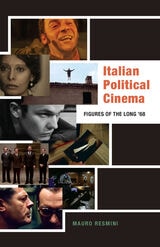
Italian Political Cinema
Figures of the Long ’68Mauro Resmini
University of Minnesota Press, 2022
An exploration of how film has made legible the Italian long ’68 as a moment of crisis and transition
Traditionally, the definition of political cinema assumes a relationship between cinema and politics. In contrast to this view, author Mauro Resmini sees this relationship as an impasse. To illustrate this theory, Resmini turns to Italian cinema to explore how films have reinvented the link between popular art and radical politics in Italy from 1968 to the early 1980s, a period of intense political and cultural struggles also known as the long ’68.
Italian Political Cinema conjures a multifaceted, complex portrayal of Italian society. Centered on emblematic figures in Italian cinema, it maps the currents of antagonism and repression that defined this period in the country’s history. Resmini explores how film imagined the possibilities, obstacles, and pitfalls that characterized the Italian long ’68 as a moment of crisis and transition. From workerism to autonomist Marxism to feminism, this book further expands the debate on political cinema with a critical interpretation of influential texts, some of which are currently only available in Italian.
A comprehensive and novel redefinition of political film, Italian Political Cinema introduces its audience to lesser-known directors alongside greats such as Pasolini, Bertolucci, Antonioni, and Bellocchio. Resmini offers access to untranslated work in Italian philosophy, political theory, and film theory, and forcefully advocates for the continued artistic and political relevance of these films in our time.
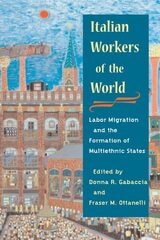
Italian Workers of the World
Labor Migration and the Formation of Multiethnic StatesEdited by Donna R. Gabaccia and Fraser M. Ottanelli
University of Illinois Press, 2001
In Italian Workers of the World, a distinguished roster of contributors examines how the reception of immigrants in their new countries shaped their sense of national identity and shaped the multiethnic states where they settled. Argentina and Brazil welcomed Italian migrants as a civilizing influence, and these immigrant workers played an instrumental part in establishing and leading movements committed to labor internationalism. In the United States, by contrast, the American Federation of Labor's hostility to socialism, internationalism, and unskilled laborers fueled distrust and xenophobia that steered Italian immigrants into ethnically mixed unions like radical Industrial Workers of the World. Essays also focus on specific topics ranging from the work of republican Garibaldians in South America to antifascist currents among Italian migrants in France and the United States, and from a 1912 textile strike in Lawrence, Massachusetts, to Mussolini's invasion of Ethiopia.
Contributors: Antonio Bechelloni, Fernando J. Devoto, Pietro Rinaldo Fanesi, Donna R. Gabaccia, Mirta Zaida Lobato, Fraser M. Ottanelli, Carina Frid de Silberstein, Michael Miller Topp, Angelo Trento, Nadia Venturini, and Elisabetta Vezzosi