Results by title
3745 books match the query 'Europe' and 130 start with i
Intimate Subjects
Touch and Tangibility in Britain's Cerebral AgeSimeon Koole
University of Chicago Press, 2024
When, where, and who gets to touch and be touched, and who decides? What do we learn through touch? How does touch bring us closer together or push us apart? These are urgent contemporary questions, but they have their origins in late nineteenth- and early twentieth-century Britain, when new urban encounters compelled intense discussion of what touch was, and why it mattered. In this vividly written book, Simeon Koole excavates the history of these concerns and reveals how they continue to shape ideas about “touch” in the present.
Intimate Subjects takes us to the bustling railway stations, shady massage parlors, all-night coffee stalls, and other shared spaces where passengers, customers, vagrants, and others came into contact, leading to new understandings of touch. We travel in crammed subway cars, where strangers negotiated the boundaries of personal space. We visit tea shops where waitresses made difficult choices about autonomy and consent. We enter classrooms in which teachers wondered whether blind children could truly grasp the world and labs in which neurologists experimented on themselves and others to unlock the secrets of touch. We tiptoe through London’s ink-black fogs, in which disoriented travelers became newly conscious of their bodies and feared being accosted by criminals. Across myriad forgotten encounters such as these, Koole shows, touch remade what it meant to be embodied—as well as the meanings of disability, personal boundaries, and scientific knowledge.
With imagination and verve, Intimate Subjects offers a new way of theorizing the body and the senses, as well as a new way of thinking about embodiment and vulnerability today.
Intimate Subjects
Touch and Tangibility in Britain's Cerebral AgeSimeon Koole
University of Chicago Press, 2024
This is an auto-narrated audiobook version of this book.
The queer recluse, the shambling farmer, the clannish hill folk—white rural populations have long disturbed the American imagination, alternately revered as moral, healthy, and hardworking, and feared as antisocial or socially uncouth. In Peculiar Places, Ryan Lee Cartwright examines the deep archive of these contrary formations, mapping racialized queer and disability histories of white social nonconformity across the rural twentieth-century United States.
Sensationalized accounts of white rural communities’ aberrant sexualities, racial intermingling, gender transgressions, and anomalous bodies and minds, which proliferated from the turn of the century, created a national view of the perversity of white rural poverty for the American public. Cartwright contends that these accounts, extracted and estranged from their own ambivalent forum of community gossip, must be read in kind: through a racialized, materialist queercrip optic of the deeply familiar and mundane. Taking in popular science, documentary photography, news media, documentaries, and horror films, Peculiar Places orients itself at the intersections of disability studies, queer studies, and gender studies to illuminate a racialized landscape both profoundly ordinary and familiar.
Intoxicated Ways of Knowing
The Untold Story of Intoxicants and the Biological Subject in Nineteenth-Century GermanyMatthew Perkins-McVey
University of Chicago Press, 2026
Intoxicating substances can be found lurking in every corner of modern life, and Matthew Perkins-McVey’s pathbreaking book offers the untold story of how they were implicated in shifting perceptions of embodiment found in the emerging sciences of the body and mind in late-nineteenth-century Germany. Their use in this experimental context gave rise to a dynamic conception of the subject within the scientific, psychological, philosophical, and sociological milieu of the era. The history of the modern biological subject, Perkins-McVey argues, turns on “intoxicated ways of knowing.”
Intoxicated Ways of Knowing identifies the state of intoxication as a tacit form of thinking and knowing with the body. Intoxicants force us to feel, intervening directly in our perceptional awareness, and, Perkins-McVey contends, they bring latent conceptual associations into the foreground of conscious thought, engendering new ways of knowing the world. The book unfurls how intoxicants affected nineteenth-century German science and how, ultimately, the connection between mental life and intoxication is taken up in the works of Friedrich Nietzsche, Max Weber, and Sigmund Freud, bringing the biological subject out of the lab and into the worlds of philosophy, psychoanalysis, sociology, and politics.
Introduction to Nordic Cultures
Edited by Annika Lindskog and Jakob Stougaard-Nielsen
University College London, 2020
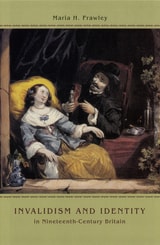
Invalidism and Identity in Nineteenth-Century Britain
Maria H. Frawley
University of Chicago Press, 2004
Using an array of primary sources, Maria Frawley here constructs a cultural history of invalidism. She describes the ways that Evangelicalism, industrialization, and changing patterns of doctor/patient relationships all converged to allow a culture of invalidism to flourish, and explores what it meant for a person to be designated—or to deem oneself—an invalid. Highlighting how different types of invalids developed distinct rhetorical strategies, her absorbing account reveals that, contrary to popular belief, many of the period's most prominent and prolific invalids were men, while many women found invalidism an unexpected opportunity for authority.
In uncovering the wide range of cultural and social responses to notions of incapacity, Frawley sheds light on our own historical moment, similarly fraught with equally complicated attitudes toward mental and physical disorder.
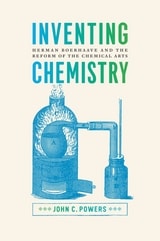
Inventing Chemistry
Herman Boerhaave and the Reform of the Chemical ArtsJohn C. Powers
University of Chicago Press, 2012
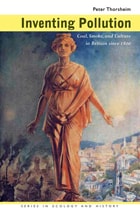
Inventing Pollution
Coal, Smoke, and Culture in Britain since 1800Peter Thorsheim
Ohio University Press, 2006
Britain's supremacy in the nineteenth century depended in large part on its vast deposits of coal. This coal not only powered steam engines in factories, ships, and railway locomotives but also warmed homes and cooked food. As coal consumption skyrocketed, the air in Britain's cities and towns became filled with ever-greater and denser clouds of smoke.
In this far-reaching study, Peter Thorsheim explains that, for much of the nineteenth century, few people in Britain even considered coal smoke to be pollution. To them, pollution meant miasma: invisible gases generated by decomposing plant and animal matter. Far from viewing coal smoke as pollution, most people considered smoke to be a valuable disinfectant, for its carbon and sulfur were thought capable of rendering miasma harmless.
Inventing Pollution examines the radically new understanding of pollution that emerged in the late nineteenth century, one that centered not on organic decay but on coal combustion. This change, as Peter Thorsheim argues, gave birth to the smoke-abatement movement and to new ways of thinking about the relationships among humanity, technology, and the environment.
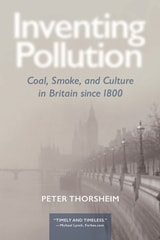
Inventing Pollution
Coal, Smoke, and Culture in Britain since 1800Peter Thorsheim
Ohio University Press, 2017
Going as far back as the thirteenth century, Britons mined and burned coal. Britain’s supremacy in the nineteenth century depended in large part on its vast deposits of coal, which powered industry, warmed homes, and cooked food. As coal consumption skyrocketed, the air in Britain’s cities and towns filled with ever-greater and denser clouds of smoke. Yet, for much of the nineteenth century, few people in Britain even considered coal smoke to be pollution.
Inventing Pollution examines the radically new understanding of pollution that emerged in the late nineteenth century, one that centered not on organic decay but on coal combustion. This change, as Peter Thorsheim argues, gave birth to the smoke-abatement movement and to new ways of thinking about the relationships among humanity, technology, and the environment.
Even as coal production in Britain has plummeted in recent decades, it has surged in other countries. This reissue of Thorsheim’s far-reaching study includes a new preface that reveals the book’s relevance to the contentious national and international debates—which aren’t going away anytime soon—around coal, air pollution more generally, and the grave threat of human-induced climate change.
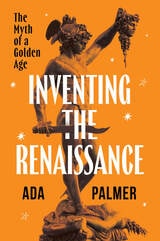
Inventing the Renaissance
The Myth of a Golden AgeAda Palmer
University of Chicago Press, 2025
WINNER OF THE HUGO AWARD
A New Yorker Best Book of 2025
An irreverent new take on the Renaissance, which reveals it as anything but Europe’s golden age.
From the darkness of a plagued and war-torn Middle Ages, the Renaissance (we’re told) heralds the dawning of a new world—a halcyon age of art, prosperity, and rebirth. Hogwash! or so says award-winning novelist and historian Ada Palmer. In Inventing the Renaissance, Palmer turns her witty and irreverent eye on the fantasies we’ve told ourselves about Europe’s not-so-golden age, myths she sets right with sharp clarity.
Palmer’s Renaissance is altogether desperate. Troubled by centuries of conflict, she argues, Europe looked to a long-lost Roman Empire (even its education practices) to save it from unending war. Later historians met their own political challenges with a similarly nostalgic vision, only now they looked to the Renaissance and told a partial story. To right this wrong, Palmer offers fifteen provocative portraits of Renaissance men and women (some famous, some obscure) whose lives reveal a far more diverse, fragile, and wild Renaissance than its glowing reputation suggests.
Inventing the Renaissance
The Myth of a Golden AgeAda Palmer
University of Chicago Press, 2025
WINNER OF THE HUGO AWARD
A New Yorker Best Book of 2025
An irreverent new take on the Renaissance, which reveals it as anything but Europe’s golden age.
From the darkness of a plagued and war-torn Middle Ages, the Renaissance (we’re told) heralds the dawning of a new world—a halcyon age of art, prosperity, and rebirth. Hogwash! or so says award-winning novelist and historian Ada Palmer. In Inventing the Renaissance, Palmer turns her witty and irreverent eye on the fantasies we’ve told ourselves about Europe’s not-so-golden age, myths she sets right with sharp clarity.
Palmer’s Renaissance is altogether desperate. Troubled by centuries of conflict, she argues, Europe looked to a long-lost Roman Empire (even its education practices) to save it from unending war. Later historians met their own political challenges with a similarly nostalgic vision, only now they looked to the Renaissance and told a partial story. To right this wrong, Palmer offers fifteen provocative portraits of Renaissance men and women (some famous, some obscure) whose lives reveal a far more diverse, fragile, and wild Renaissance than its glowing reputation suggests.
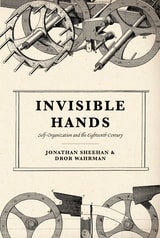
Invisible Hands
Self-Organization and the Eighteenth CenturyJonathan Sheehan and Dror Wahrman
University of Chicago Press, 2015
Why is the world orderly, and how does this order come to be? Human beings inhabit a multitude of apparently ordered systems—natural, social, political, economic, cognitive, and others—whose origins and purposes are often obscure. In the eighteenth century, older certainties about such orders, rooted in either divine providence or the mechanical operations of nature, began to fall away. In their place arose a new appreciation for the complexity of things, a new recognition of the world’s disorder and randomness, new doubts about simple relations of cause and effect—but with them also a new ability to imagine the world’s orders, whether natural or manmade, as self-organizing. If large systems are left to their own devices, eighteenth-century Europeans increasingly came to believe, order will emerge on its own without any need for external design or direction.
In Invisible Hands, Jonathan Sheehan and Dror Wahrman trace the many appearances of the language of self-organization in the eighteenth-century West. Across an array of domains, including religion, society, philosophy, science, politics, economy, and law, they show how and why this way of thinking came into the public view, then grew in prominence and arrived at the threshold of the nineteenth century in versatile, multifarious, and often surprising forms. Offering a new synthesis of intellectual and cultural developments, Invisible Hands is a landmark contribution to the history of the Enlightenment and eighteenth-century culture.
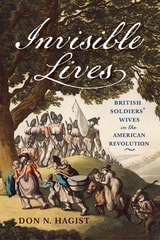
Invisible Lives
British Soldiers' Wives in the American RevolutionDon N. Hagist
Westholme Publishing, 2026
She was stabbed by her drunken husband on a storm-tossed ship in the North Atlantic. She forgave him before she died—and history never recorded her first name. Mrs. Whitlow, wife of a British soldier, is just one of the thousands of women who followed their husbands to war during the American Revolution. These women lived in the barracks and camps and endured the hardships of garrisons and campaigns in an unfamiliar and often hostile land. They faced the challenges with fortitude, proving themselves resourceful, industrious, and intrepid, but their involvement in the conflict that founded the United States has been largely lost to history. Incidents and brief mentions abound in the military writings and iconography of the era, but stories of individual lives are nearly nonexistent, which has caused this large population to be almost entirely overlooked.
Combining archival research with deeply human storytelling, Invisible Lives: British Soldiers’ Wives in the American Revolution by Don N. Hagist brings together, for the first time, the myriad glimpses of these wives to tell the larger story of how they lived, worked, suffered, and survived as women in a foreign war. Drawing on court martial proceedings, muster rolls, marriage licenses, newspaper notices, and rare surviving letters, this meticulously researched work reconstructs the lives of women who were present in every theater of the Revolutionary War. What emerges is a portrait of remarkable resilience. These women crossed oceans, survived sieges, nursed the wounded, and raised children in the chaos of an eighteenth-century war. These many moments come together to provide a more complete and invaluable picture of British soldiers’ wives and their place in the army and the surrounding society. For readers of women’s history, military history, and the American Revolution, this is an overdue and deeply moving reckoning with the lives history had left behind.
Invisible Walls and To Remember is to Heal
A German Family under the Nuremberg LawsIngeborg Hecht
Northwestern University Press, 1999
In Invisible Walls, Hecht writes of what it was like to live under these circumstances, sharing heartbreaking details of her personal life, including the loss of her daughter's father on the Russian front; the death of her own father after his deportation in 1944; and her fears of perishing coupled with the shame of faring better than most of her family and friends. This new volume adds the first translation of part of Hecht's second book, To Remember is to Heal, a collection of vignettes of encounters and experiences that resulted from the publication of the first.
Ireland's Farthest Shores
Mobility, Migration, and Settlement in the Pacific WorldMalcolm Campbell
University of Wisconsin Press, 2022
Malcolm Campbell examines the rich history of Irish experiences on land and at sea, offering new perspectives on migration and mobility in the Pacific world and of the Irish role in the establishment and maintenance of the British Empire. This volume investigates the extensive transnational connections that developed among Irish immigrants and their descendants across this vast and unique oceanic space, ties that illuminate how the Irish participated in the making of the Pacific world and how the Pacific world made them.
Ireland's Helping Hand to Europe
Combatting Hunger from Normandy to Tirana, 1945–1950Jérôme aan de Wiel
Central European University Press, 2021
Post-war Marshall Plan aid to Europe and indeed Ireland is well documented, but practically nothing is known about simultaneous Irish aid to Europe. This book provides a full record of the aid – mainly food but also clothes, blankets, medicines, etc. – that Ireland donated to continental Europe, including France, the Netherlands, Hungary, the Balkans, Italy, and zones of occupied Germany.
Starting with Ireland’s neutral wartime record, often wrongly presented as pro-German when Ireland in fact unofficially favoured the western Allies, Jerome aan de Wiel explains why Éamon de Valera’s government sent humanitarian aid to the devastated continent. His book analyses the logistics of collection and distribution of supplies sent abroad as far as the Greek islands.
Despite some alleged Cold-War hijacking of Irish relief – and this humanitarianism was not above the politics of that East-West confrontation – it became mostly a story of hope, generosity and European Christian solidarity. Rich archival records from Ireland and the European beneficiary countries, as well as contemporary local and national newspapers across Europe, allow the author to measure and describe not only the official but also the popular response to Irish relief schemes. This work is illustrated with contemporary photographs and some key graphs and tables that show the extent of the aid programme.
Ireland's New Worlds
Immigrants, Politics, and Society in the United States and Australia, 1815–1922Malcolm Campbell
University of Wisconsin Press, 2007
Ireland’s New Worlds is the first book to compare Irish immigrants in the United States and Australia. In a profound challenge to the national histories that frame most accounts of the Irish diaspora, Malcolm Campbell highlights the ways that economic, social, and cultural conditions shaped distinct experiences for Irish immigrants in each country, and sometimes in different parts of the same country. From differences in the level of hostility that Irish immigrants faced to the contrasting economies of the United States and Australia, Campbell finds that there was much more to the experiences of Irish immigrants than their essential “Irishness.” America’s Irish, for example, were primarily drawn into the population of unskilled laborers congregating in cities, while Australia’s Irish, like their fellow colonialists, were more likely to engage in farming. Campbell shows how local conditions intersected with immigrants’ Irish backgrounds and traditions to create surprisingly varied experiences in Ireland’s new worlds.
“Well conceived and thoroughly researched . . . . This clearly written, thought-provoking work fulfills the considerable ambitions of comparative migration studies.”—Choice

Irish Drama in Poland
Staging and Reception, 1900-2000Barry Keane
Intellect Books, 2016
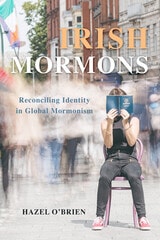
Irish Mormons
Reconciling Identity in Global MormonismHazel O'Brien
University of Illinois Press, 2023
Examining the Latter-day Saint experience against one nation’s rapid social and religious changes, Irish Mormons blends participant observation and interviews with analysis to offer a rare view of the Latter-day Saints in contemporary Ireland.
Irish Peasants
Violence and Political Unrest, 1780–1914Samuel Clark
University of Wisconsin Press, 1983
"The strength of this volume cannot be conveyed by an itemisation of its contents; for what it provides is an incisive commentary on the newly-recognised landmarks of Irish agrarian history in the modern period. . . . The importance, even indispensability, of this achievement is compounded by exemplary editing."—Roy Foster, London Times Literary Supplement
"As a whole, the volume demonstrates the wealth, complexity, and sophistication of Irish rural studies. The book is essential reading for anyone involved in modern Irish history. It will also serve as an excellent introduction to this rich field for scholars of other peasant communities and all interested in problems of economic and political developments."—American Historical Review
"A milestone in the evolution of Irish social history. There is a remarkable consistency of style and standard in the essays. . . . This is truly history from the grassroots."—Timothy P. O'Neill, Studia Hibernica
Islam and Secularity
The Future of Europe's Public SphereNilüfer Göle
Duke University Press, 2015
Islam and Travel in the Middle Ages
Houari Touati
University of Chicago Press, 2010
In the Middle Ages, Muslim travelers embarked on a rihla, or world tour, as surveyors, emissaries, and educators. On these journeys, voyagers not only interacted with foreign cultures—touring Greek civilization, exploring the Middle East and North Africa, and seeing parts of Europe—they also established both philosophical and geographic boundaries between the faithful and the heathen. These voyages thus gave the Islamic world, which at the time extended from the Maghreb to the Indus Valley, a coherent identity.
Islam and Travel in the Middle Ages assesses both the religious and philosophical aspects of travel, as well as the economic and cultural conditions that made the rihla possible. Houari Touati tracks the compilers of the hadith who culled oral traditions linked to the prophet, the linguists and lexicologists who journeyed to the desert to learn Bedouin Arabic, the geographers who mapped the Muslim world, and the students who ventured to study with holy men and scholars. Travel, with its costs, discomforts, and dangers, emerges in this study as both a means of spiritual growth and a metaphor for progress. Touati’s book will interest a broad range of scholars in history, literature, and anthropology.
Islamic Spain, 1250 to 1500
L. P. Harvey
University of Chicago Press, 1990
"Harvey not only examines the politics of the Nasrids, but also the Islamic communities in the Christian kingdoms of the peninsula. This innovative approach breaks new ground, enables the reader to appreciate the situation of all Spanish Muslims and is fully vindicated. . . . An absorbing and thoroughly informed narrative."—Richard Hitchcock, Times Higher Education Supplement
"L. P. Harvey has produced a beautifully written account of an enthralling subject."—Peter Linehan, The Observer
Island of the Doomed
Stig Dagerman
University of Minnesota Press, 2012
In the summer of 1946, while secluded in August Strindberg’s small cabin in the Stockholm archipelago, Stig Dagerman wrote Island of the Doomed. This novel was unlike any other yet seen in Sweden and would establish him as the country’s brightest literary star. To this day it is a singular work of fiction—a haunting tale that oscillates around seven castaways as they await their inevitable death on a desert island populated by blind gulls and hordes of iguanas. At the center of the island is a poisonous lagoon, where a strange fish swims in circles and devours anything in its path. As we are taken into the lives of each castaway, it becomes clear that Dagerman’s true subject is the nature of horror itself.
Island of the Doomed is a chilling profile of terror and guilt and a stunning exploration—written under the shadow of the Nuremberg Trials—of the anxieties of a generation in the postwar nuclear age.
Islanded
Britain, Sri Lanka, and the Bounds of an Indian Ocean ColonySujit Sivasundaram
University of Chicago Press, 2013
How did the modern nation of Sri Lanka come to be? In search of an answer to this question, Islanded returns us to the late eighteenth and early nineteenth centuries and to the advance of the British on the kingdom of Kandy. This advance saw the fall of the last foothold of kingly rule, centered in the highlands of the island. The British undertook a process of “islanding” and “partitioning,” which cast the island, its nature and geography, its religious and ethnic character, and its historical traditions and maritime culture as separate from British domains in mainland India and elsewhere.
Kings had seen themselves as rightful rulers of the whole territory of the island. Now, this right was violently extended by British colonists through the application of a model of crown rule and modern bureaucracy that tied ethnicity to language and religion, employing essentialized but not fully realized patterns that would continue to trouble the modern nation. Picking up a range of unusual themes, from migration, orientalism, and ethnography to botany, medicine, and education, Islanded is a groundbreaking text in Sri Lankan history writing, shaping discussions of the imperial transition in South Asia.
Isolarion
A Different Oxford JourneyJames Attlee
University of Chicago Press, 2007
Through the centuries, people from all walks of life have heard the siren call of a pilgrimage, the lure to journey away from the familiar in search of understanding. But is a pilgrimage even possible these days for city-dwellers enmeshed in the pressures of work and family life? Or is there a way to be a pilgrim without leaving one’s life behind? James Attlee answers these questions with Isolarion, a thoughtful, streetwise, and personal account of his pilgrimage to a place he thought he already knew—the Cowley Road in Oxford, right outside his door.
Isolarion takes its title from a type of fifteenth-century map that isolates an area in order to present it in detail, and that’s what Attlee, sharp-eyed and armed with tape recorder and notebook, provides for Cowley Road. The former site of a leper hospital, a workhouse, and a medieval well said to have miraculous healing powers, Cowley Road has little to do with the dreaming spires of the tourist’s or student’s Oxford. What Attlee presents instead is a thoroughly modern, impressively cosmopolitan, and utterly organic collection of shops, restaurants, pubs, and religious establishments teeming with life and reflecting the multicultural makeup of the surrounding neighborhood.
From a sojourn in a sensory-deprivation tank to a furtive visit to an unmarked pornography emporium, Attlee investigates every aspect of the Cowley Road’s appealingly eclectic culture, where halal shops jostle with craft jewelers and reggae clubs pulsate alongside quiet churchyards. But the very diversity that is, for Attlee, the essence of Cowley Road’s appeal is under attack from well-meaning city planners and predatory developers. His pilgrimage is thus invested with melancholy: will the messy glories of the Cowley Road be lost to creeping homogenization?
Drawing inspiration from sources ranging from Robert Burton’s The Anatomy of Melancholy to contemporary art, Attlee is a charming and companionable guide who revels in the extraordinary embedded in the everyday. Isolarion is at once a road movie, a quixotic stand against uniformity, and a rousing hymn in praise of the complex, invigorating nature of the twenty-first-century city.
Isolated Islands in Medieval Nature, Culture and Mind
Gerhard Jaritz
Central European University Press, 2011
The volume contains selected papers from an international workshop in 2005, at the Hungarian Academy in Rome. They aim at investigating the registers of fifteenth-century supplications to the Apostolic Penitentiary of the Holy See and to analyze the multiplicity of issues in which a context of the local needs of Western Christians and the central power of the Pope had been occurring.
The contributions make clear that local and individual factors and practice of Christian faith and religion must not be seen as separated from the global power of the Roman curia. The latter’s influence could become directly important for any individual in any local space, also … et usque ad ultimum terrae (Acts 1:8), in the utmost peripheries of the Christian world. The assistance by the Apostolic Penitentiary was indispensable in a large variety of cases. The occupation with such cases happened in the local and regional space as well as in the globalized centre of the Holy See.
It
Joseph Roach
University of Michigan Press, 2011
A consumer’s guide to iconic celebrity and ageless glamour
“Strikingly original, wickedly witty, and thoroughly learned, Roach’s anatomy of abnormally interesting people and the vicarious pleasure we take in our modern equivalents to gods and royals will captivate its readers from the first page. I dare you to read just one chapter!”
—Felicity Nussbaum, University of California, Los Angeles
“It considers the effect that arises when spectacularly compelling performers and cultural fantasy converge, as in the outpouring of public grief over the death of Princess Diana. . . . An important work of cultural history, full of metaphysical wit . . . It gives us a fresh vocabulary for interpreting how after-images endure in cultural memory.”
—Andrew Sofer, Boston College
“Joseph Roach’s enormous erudition, sharp wit, engaging style, and gift for finding the most telling historical detail or literary quote are here delightfully applied to the intriguing subject of why certain historical and theatrical figures have possessed a special power to fascinate their public.”
—Marvin Carlson, Graduate Center, City University of New York
That mysterious characteristic “It”—“the easily perceived but hard-to-define quality possessed by abnormally interesting people”—is the subject of Joseph Roach’s engrossing new book, which crisscrosses centuries and continents with a deep playfulness that entertains while it enlightens.
Roach traces the origins of “It” back to the period following the Restoration, persuasively linking the sex appeal of today’s celebrity figures with the attraction of those who lived centuries before. The book includes guest appearances by King Charles II, Samuel Pepys, Flo Ziegfeld, Johnny Depp, Elinor Glyn, Clara Bow, the Second Duke of Buckingham, John Dryden, Michael Jackson, and Lady Diana, among others.

Italian Locations
Reinhabiting the Past in Postwar CinemaNoa Steimatsky
University of Minnesota Press, 2008
Fascism and the Second World War left Italy indelibly changed, and cinema was arguably the art that most rigorously confronted the devastated nation. In this examination of four Italian filmmakers, Noa Steimatsky brilliantly maps their forceful negotiation of Italy’s identity and posits that the cinematic forms they employ constitute an imaginary reinhabiting of Italy-one that is inextricably linked with the political, physical, and symbolic predicament of reconstruction.
A dynamic intersection of pictorial and photographic, architectural and literary discourses inform Steimatsky’s revisionist interrogation of exemplary works from the 1940s to the mid–1960s. From the earliest documentary work of Michelangelo Antonioni on the River Po to Pier Paolo Pasolini’s re-siting of the Gospel in the arid, peripheral landscape of the Italian south, and from Roberto Rossellini’s tracing of a neorealist project in ruinous Berlin to Luchino Visconti’s wrought grandeur visited upon a humble Sicilian fishing village, Italian Locations probes the historical experience of displacement, anachronism, and a thoroughly contemporary anxiety in the cinematic arena.
For Steimatsky, Antonioni’s modernist achievement, informed by his native landscape, Rossellini’s neorealist image of Italy as a nation of ruins, Visconti’s reaching back to the nineteenth century and even more archaic pasts, and Pasolini’s ambivalence about modernity-all partake in a search for a politically and culturally redeemed Italy.
Noa Steimatsky is associate professor of the history of art and film studies at Yale University.
Italy and American Female Imagination
Debra Bernardi
The Ohio State University Press, 2025

Izabela Czartoryska and the Art of Persuation in Polish Visual Culture
Agnieszka Whelan
Central European University Press, 2026
As a prominent and outspoken member of the Commonwealth’s most influential political family, Czartoryska played a significant role in shaping the public image of the reformist movement through carefully orchestrated communal and cultural displays. The book examines social interactions within the public spaces of theatres and landscape gardens, highlighting the relationship between historical events and their visual and cultural responses.
By tracing the intersections of politics, sociability, and visual culture, the study demonstrates how the life of a single individual can illuminate the broader complexities of political transformation and cultural change at the end of the eighteenth century.