Results by title
5550 books match the query 'Biography & Autobiography' and 174 start with i

Is There God after Prince?
Dispatches from an Age of Last ThingsPeter Coviello
University of Chicago Press, 2023
This is a book about loving things—books, songs, people—in the shadow of a felt, looming disaster. Through lyrical, funny, heart-wrenching essays, Peter Coviello considers pieces of culture across a fantastic range, setting them inside the vivid scenes of friendship, dispute, romance, talk, and loss, where they enter our lives. Alongside him, we reencounter movies like The Shining, shows like The Sopranos; videos; poems; novels by Sam Lipsyte, Sally Rooney, and Paula Fox; as well as songs by Joni Mitchell, Gladys Knight, Steely Dan, Pavement, and the much-mourned saint of Minneapolis, Prince.
Navigating an overwhelming feeling that Coviello calls “endstrickenness,” he asks what it means to love things in calamitous times, when so much seems to be shambling toward collapse. Balancing comedy and anger, exhilaration and sorrow, Coviello illuminates the strange ways the things we cherish help us to hold on to life and to its turbulent joys. Is There God after Prince? shows us what twenty-first-century criticism can be, and how it might speak to us, in a time of ruin, in an age of “Last Things.”
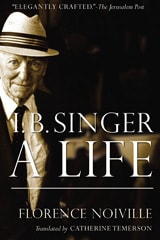
Isaac B. Singer
A LifeFlorence Noiville
Northwestern University Press, 2008
In this vivid biography, Florence Noiville offers a glimpse into the world of this much-loved but persistently elusive writer: Isaac Bashevis Singer. Singer (1904–91) is generally recognized as the most popular Yiddish writer of the twentieth century. His widely translated body of work, for which he received the Nobel Prize in Literature in 1978, is beloved around the world. But although Singer was a very public and outgoing figure, much about his personal life remains unknown.
Singer was greatly influenced by his early years in Poland, with his rabbi father and rationalist, secular mother. His interest in themes of faith and dilemma stem directly from this set of conflicts; he bounced back and forth between revering and fighting orthodoxy. This was not the only paradox in his life, however: this man, who wrote many successful children’s books, had abandoned his first wife and only son in Poland as the Nazis began to sweep across Europe. His novels and stories are recognized for their mystical, folkloric tone and his public image was that of a grandfather or uncle; but he was wracked with self-doubt, a womanizer, and, as Noiville writes, a “modern virtuoso of anguish, inhibition, and fiasco.”
Noiville speaks to these and other paradoxes surrounding her subject, drawing on letters, personal stories, Singer’s own autobiographies, and interviews with friends, family, and publishing contemporaries. She travels as he did, from Poland to New York to Florida, tracing his journey from penniless immigrant to Nobel laureate. By pursuing Singer’s public and private past, she rebuilds his story and the story of the world he wrote from: a Yiddish world, a Poland removed from history by Nazi Germany.

Isaac Bashevis Singer - American Writers 86
University of Minnesota Pamphlets on American WritersBen Siegel
University of Minnesota Press, 1969
Isaac Bashevis Singer - American Writers 86 was first published in 1969. Minnesota Archive Editions uses digital technology to make long-unavailable books once again accessible, and are published unaltered from the original University of Minnesota Press editions.

Isaac Bashevis Singer
A LifeJanet Hadda
University of Wisconsin Press, 2003
Isaac Bashevis Singer brought the vibrant milieu of pre-Holocaust Polish Jewry to the English-speaking world through his subtle psychological insight, deep sympathy for the eccentricities of Jewish folk custom, and unerring feel for the heroism of everyday life. His novels, including The Family Moskat and Enemies: A Love Story, and his short stories, such as "Yentl" and "Gimpel the Fool," prove him a consummate storyteller and probably the greatest Yiddish writer of the twentieth century.
Isaac Harby of Charleston, 1788-1828
Jewish Reformer and IntellectualGary Phillip Zola
University of Alabama Press, 1994
The visionary voice who helped shape American Judaism—and Charleston’s cultural soul.
Isaac Harby of Charleston, 1788–1828 is a richly detailed biography that brings to life one of early America’s most fascinating and underappreciated Jewish intellectuals. Gary Phillip Zola offers a compelling portrait of Harby—a playwright, newspaper editor, drama critic, educator, and religious reformer—who emerged as a central figure in Charleston’s vibrant cultural scene during the early 19th century. At a time when Charleston was experiencing both economic prosperity and cultural efflorescence, Harby stood at the crossroads of literary ambition and religious innovation.
A descendant of Sephardic Jews, Harby was deeply engaged in the intellectual and civic life of his city. He founded a literary journal at just eighteen, established a private academy, and wrote prolifically on politics, education, and religion. But his most enduring legacy lies in his role as a pioneer of Reform Judaism in America. As a founding member of the Reformed Society of Israelites in 1825, Harby advocated for a rational, modernized approach to Jewish worship—one that emphasized universal ethics and intellectual engagement over ritual formalism. His efforts, though controversial in his time, laid the groundwork for the broader Reform movement that would flourish later in the century.
Drawing on newly uncovered archival materials, including Harby’s personal library and writings, Zola’s biography not only illuminates Harby’s life and thought but also offers a window into the broader cultural, religious, and political transformations of the early American republic. This book is essential reading for anyone interested in American Jewish history, Southern intellectual life, and the roots of religious reform in the United States.
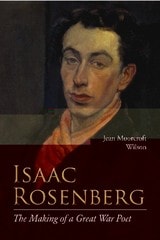
Isaac Rosenberg
The Making of a Great War Poet: A New LifeJean Moorcroft Wilson
Northwestern University Press, 2009
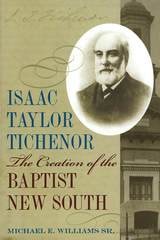
Isaac Taylor Tichenor
The Creation of the Baptist New SouthMichael E. Williams Sr.
University of Alabama Press, 2005
The influential role Tichenor played in shaping both the Baptist denomination and southern culture
Isaac Taylor Tichenor worked as a Confederate chaplain, a mining executive, and as president of the Agricultural and Mechanical College of Alabama (now Auburn University). He also served as corresponding secretary for the Home Mission Board of the Southern Baptist Convention in Atlanta from 1882 until 1899. In these capacities Tichenor developed the New South ideas that were incorporated into every aspect of his work and ultimately influenced many areas of southern life, including business, education, religion, and culture.
In Isaac Taylor Tichenor: The Creation of the Baptist New South, Michael E. Williams Sr. provides a comprehensive analysis of Tichenor’s life, examining the overall impact of his life and work. This volume also documents the methodologies Tichenor used to rally Southern Baptist support around its struggling Home Mission Board, which defined the makeup of the Southern Baptist Convention and defended the territory of the convention.
Tichenor was highly influential in forming a uniquely southern mindset prior to and at the turn of the century. Williams contends that Tichenor’s role in shaping Southern Baptists as they became the largest denomination in the South was crucial in determining their identity both the identities of the region and the SBC.
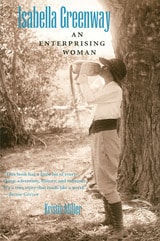
Isabella Greenway
An Enterprising WomanKristie Miller
University of Arizona Press, 2004
Isabella Greenway's life was linked with both Theodore Roosevelt and Franklin D. Roosevelt. Her infancy was spent on a snow-swept ranch in North Dakota, where young TR was a neighbor and a friend. In her teens, she captivated Edith Wharton's New York as a glamorous debutante. A bridesmaid in the wedding of Eleanor and Franklin Roosevelt, Isabella was the bride of Robert Ferguson, a Scottish nobleman and one of TR's Rough Riders. They went west when he developed tuberculosis; after his death, she married his fellow Rough Rider, Arizona copper magnate John Greenway.
In Tucson, the energetic Isabella ran an airline, worked with disabled veterans, and founded the world-famous Arizona Inn. When the Great Depression brought hard times, Eleanor Roosevelt recruited Isabella to work for the Democratic Party. Isabella played a decisive role in Franklin Roosevelt's nomination to the presidency in 1932; the New York Times called her "the most-talked-of woman at the National Democratic Convention." She was elected to Congress as Arizona's only US Representative, and again drew national media attention when she challenged FDR for not being sufficiently progressive.
Miller's meticulous biography captures a life of adventure and romance, from southern tobacco country to the ballrooms of New York, from western ranches to the dome of the US Capitol. She shows national politics played out behind the scenes, Isabella's lifelong friendship with Eleanor Roosevelt, and the drama of a loyal wife caring for a dying husband despite having fallen in love with a younger man. The book also shows Greenway's considerable influence on the development of Arizona's business and politics in the early decades of statehood. Although Isabella Greenway died in 1953, the Arizona Inn—a tribute to her enterprise—remains a premier resort hotel, celebrating its 75th anniversary in 2005. This book, too, celebrates Isabella's energy, vision, indomitable spirit, and love of life.
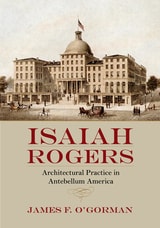
Isaiah Rogers
Architectural Practice in Antebellum AmericaJames F. O'Gorman
University of Massachusetts Press, 2015
When Isaiah Rogers died in 1869, the Cincinnati Daily Times noted that “in his profession he was, perhaps, better known than any other person in the country.” Yet until now there has been no study that fully examines his remarkable, influential, and instructive career. Based largely on Rogers's own diary, this book tells his story and adds much to our understanding of architectural practice in the United States before the Civil War.
In 1944 the distinguished historian Talbot Hamlin wrote of New York's Merchant Exchange (1836–42) that the building had “been so grandly conceived, so simply and directly planned, and so beautifully detailed . . . [that] the whole was welded inextricably into one powerful organic conception that shows Rogers as a great architect in the fullest sense of the word.” Rogers's Tremont House in Boston has been called the world's first modern hotel; it spawned many progeny, from his first Astor House in New York to his Burnet House in Cincinnati and beyond.
Rogers designed buildings from Maine to Georgia and from Boston to Chicago to New Orleans, supervising their construction while traveling widely to procure materials and workmen for the job. He finished his career as Architect of the Treasury Department during the Civil War. In this richly illustrated volume, James F. O'Gorman offers a deft portrait of an energetic practitioner at a key time in architectural history, the period before the founding of the American Institute of Architects in 1857.

Isak Dinesen
The Life And Imagination Of A SeducerOlga Anastasia Pelensky
Ohio University Press, 1991
Born into a Victorian Danish family, Karen Christentze Dinesen married her second cousin, a high-spirited and philandering baron, and moved to Kenya where she ran a coffee plantation, painted, and wrote. She later returned to Denmark, lived through the German occupation during World War II, and became a pivotal figure in Heretica, a major literary movement that flourished in Denmark after the war. By the time of her death, Dinesen was an international figure. Truman Capote would later call Out of Africa one of the most beautiful books of the century.
Despite the popularity of her writing, little is known about her life. For this provocative biography, Pelensky has uncovered hundreds of papers in libraries and private collections, and discovered new interview sources in Africa, Denmark, and England to help put the pieces of Dinesen’s life together. Her father’s outspoken sympathy for the plight of the American Indians, his suicide and the effects of his personal anguish as a failed adventurer are illuminated as major forces on Dinesen’s imagination. The Danish history of romance and masquerade and the tradition of pantomime in Denmark are also explored as themes that recur in Dinesen’s work.

Islam against the West
Shakib Arslan and the Campaign for Islamic NationalismBy William L. Cleveland
University of Texas Press, 1985
This book gives a unique perspective on the interwar history of the Middle East. By telling the life story of one man, it illuminates the political and cultural struggles of an era. Shakib Arslan (1869–1946) was a leading member of the generation of Ottoman Arabs who came to professional maturity just before the final defeat of the Ottoman Empire. Born to a powerful Lebanese Druze family, Arslan grew up perfectly suited to his time and place in history. He was one of the leading writers of his day and a dexterous, ambitious politician. But, by the end of World War I, Arslan and others of his generation found themselves adrift in a world no longer of their choosing, as the once great Ottoman state lay broken before the West.
Rather than retreating from public life in those dark days, however, Arslan emerged militant in his opposition to Western encroachment on Islamic lands and tireless in his crusade to bring the organizing principles of a universalist Islam to the age of emerging nation-states. Organizer, pamphleteer, diplomat, spokesman, and symbol, Arslan became one of the dominant, and most controversial, Muslim political figures in the two decades between the wars. His involvements were so varied and intense that to study his life is to bring into focus all the major political issues and intellectual currents of the era. By the end of his career he was both praised and vilified, but he was arguably the most widely read Arab author of his day.
Curiously, Arslan has received relatively little attention in English-language research. This may well be due less to his contemporary importance than to the perspective from which Western scholarship has viewed Middle Eastern intellectual history. Arslan was not one of the winners. For many his evocation of the old imperial ideal and his insistence on the strategic importance of Islamic ideals seemed to be simply archaic protest in a secular age. But this impeccably researched and beautifully written biography demonstrates the power and importance of Arslan’s activist heritage, reinterpreting it for its own time and showing its importance for ours.
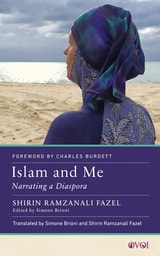
Islam and Me
Narrating a DiasporaShirin Ramzanali Fazel
Rutgers University Press, 2023
In Islam and Me, Fazel tells her story and shares the experiences of other Muslim women living in Italy, revealing the wide variety of Muslim identities and the common prejudices they encounter. Looking at Italian school textbooks, newspapers, and TV programs, she invites us to change the way Muslim immigrants, and especially women, are depicted in both news reports and scholarly research. Islam and Me is a meditation on our multireligious, multiethnic, and multilingual reality, as well as an exploration of how we might reimagine national culture and identity so that they become more diverse, inclusive, and anti-racist.
It All Began in Nuremberg
Between History and MemoryRita Thalmann
University of Michigan Press, 2015
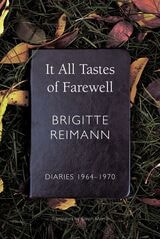
It All Tastes of Farewell
Diaries, 1964–1970Brigitte Reimann
Seagull Books, 2016
It All Tastes of Farewell is a frank account of one woman’s life and loves in 1960s East Germany. As a writer, Brigitte Reimann could not help but tell a compelling story, and that is born out here in her diaries, which are gripping as any novel. She recorded only what mattered: telling details, emotional truths, and political realities. Never written for publication and first published in full in German only after the fall of the Berlin Wall, these diaries offer a unique record of what it felt like to live in a country that no longer exists, was represented for years largely through Cold War propaganda, and is still portrayed in fairy-tale Stasi dramas. Here we get a sense of lived experience as if Doris Lessing or Edna O’Brien had been allowed in with their notebooks. This volume continues where her earlier book of diaries, I Have No Regrets, left off, in 1964. It sees Reimann grow wistful and at times bitter, as her love life, her professional life, and her health all suffer. Yet throughout she retains a lively appetite for new experiences and a dedication to writing. Finally, she finds security in a surprising new love, and although she died soon after this volume ends, the novel she was writing was to become a much-read cult hit after her death.
A remarkable document from a time and place that we still struggle to see clearly, It All Tastes of Farewell is unforgettable, a last gift from an essential writer.

It Never Goes Away
Gender Transition at a Mature AgeAnne L. Koch, D.M.D.
Rutgers University Press, 2019
Ken Koch was one of those people. Married twice, a veteran, and a world traveler, a health scare when he was sixty-three prompted him to acknowledge the feelings that had plagued him since he was a small child. By undergoing a host of procedures, he radically changed his appearance and became Anne Koch. In the process though, Anne lost everything that Ken had accomplished. She had to remake herself from the ground up. Hoping to help other people in her age bracket who may be considering transitioning, Anne describes the step by step procedures that she underwent, and shares the cost to her personal life, in order to show seniors that although it is never too late to become the person you always knew you were, it is better to go into that new life prepared for some serious challenges. Both a fascinating memoir of a well-educated man growing up trans yet repressed in the mid-twentieth century, and a guidebook to navigating the tricky waters of gender reassignment as a senior, It Never Goes Away shows how what we see in the television world of Transparent translates in real life.
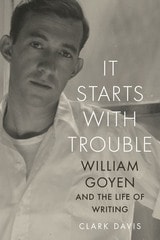
It Starts with Trouble
William Goyen and the Life of WritingBy Clark Davis
University of Texas Press, 2015
William Goyen was a writer of startling originality and deep artistic commitment whose work attracted an international audience and the praise of such luminaries as Northrop Frye, Truman Capote, Gaston Bachelard, and Joyce Carol Oates. His subject was the land and language of his native East Texas; his desire, to preserve the narrative music through which he came to know his world. Goyen sought to transform the cherished details of his lost boyhood landscape into lasting, mythic forms. Cut off from his native soil and considering himself an “orphan,” Goyen brought modernist alienation and experimentation to Texas materials. The result was a body of work both sophisticated and handmade—and a voice at once inimitable and unmistakable.
It Starts with Trouble is the first complete account of Goyen’s life and work. It uncovers the sources of his personal and artistic development, from his early years in Trinity, Texas, through his adolescence and college experience in Houston; his Navy service during World War II; and the subsequent growth of his writing career, which saw the publication of five novels, including The House of Breath, nonfiction works such as A Book of Jesus, several short story collections and plays, and a book of poetry. It explores Goyen’s relationships with such legendary figures as Frieda Lawrence, Katherine Anne Porter, Stephen Spender, Anaïs Nin, and Carson McCullers. No other twentieth-century writer attempted so intimate a connection with his readers, and no other writer of his era worked so passionately to recover the spiritual in an age of disabling irony. Goyen’s life and work are a testament to the redemptive power of storytelling and the absolute necessity of narrative art.

It Was Always About the Work
A Photojournalist's MemoirMelvin Grier
Ohio University Press, 2023
Over the last six decades, Melvin Grier’s work has vividly portrayed community, humanity, irony, fear, war, elegance, art, and, most notably, the unexpected. It Was Always About the Work includes nearly one hundred black-and-white and color photographs, including photographs from Grier’s most famous exhibitions and news stories. Whether covering local events, Cincinnati life, impoverished villages overseas, young future Marines on their way to their first post, or high fashion, Grier's photos are unmistakable and evocative.
Starting with his early years as a boy growing up in Cincinnati, this book tells the story of a young man who won his first photo contest while in the Air Force. He came home determined to make a career as a photographer, and, despite his lack of formal training and experience, he secured a job as a photographer for the Cincinnati Post. After the closure of the Cincinnati Post in 2007, Grier continued his career as an independent artist, featuring work in exhibitions such as “White People: A Retrospective” and “Clothes Encounters.” In collaboration with one of his journalist partners, reporter Molly Kavanaugh, Grier shares why it was always about the work.
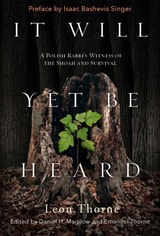
It Will Yet Be Heard
A Polish Rabbi's Witness of the Shoah and SurvivalIsaac Bashevis Singer
Rutgers University Press, 2019
Rabbi Thorne composed his memoir under extraordinary conditions, confined to a small underground bunker below a Polish peasant’s pigsty. But, It Will Yet Be Heard is remarkable not only for the story of its composition, but also for its moral clarity and complexity. A deeply religious man, Rabbi Thorne bore witness to forced labor camps, human degradation, and the murders of entire communities. And once he emerged from hiding, he grappled not only with survivor’s guilt, but also with the lingering antisemitism and anti-Jewish violence in Poland even after the war ended. Harrowing, moving, and deeply insightful, Rabbi Thorne’s firsthand account offers a rediscovered perspective on the twentieth century’s greatest tragedy.

It's About Time
The Dave Brubeck StoryFred Hall
University of Arkansas Press, 1996
A much-revered icon of jazz, Dave Brubeck is, as Doug Ramsey calls him, “one of the most celebrated and successful jazz musicians of all time.”
It’s About Time, Fred Hall’s biography, explores the many influences on Brubeck’s life and music: his youth on a cattle ranch in the foothills of the Sierras; a stint in Europe with Patton’s army during World War II; the development of the West Coast jazz scene and the rise of the Dave Brubeck Quartet; musical relationships with Paul Desmond, Eugene Wright, Joe Morello, and many more jazz greats; his phenomenal experiments with polytonality and polyrhythm; his fifty-three-year marriage to Iola, manager, collaborator, and mother of their six children; and important career breakthroughs, such as the first-ever million-selling jazz single, “Take Five.”
Including an annotated discography, It’s About Time is much more than an upbeat examination of the Brubeck phenomenon. It is also a penetrating view of the culture, the music, the musicians, the recording industry, and race relations of the country and the century that gave birth to jazz.
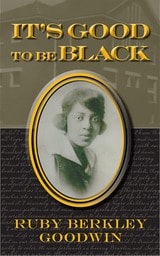
It's Good to Be Black
Ruby Berkley Goodwin
Southern Illinois University Press, 1953
From the preface by Carmen Kenya Wadley:
“Is it good to be black? To Ruby Berkley Goodwin it was....The black she writes about has nothing to do with skin color, but it does have a great deal to do with self images, values, spiritual strength, and most of all love. Unlike the contradicting definitions of blackness we see reflected in today's crime statistics, movies, television, newspapers, political speeches, advertisements, and sociological reports, Ruby Berkley Goodwin's definition of blackness is simple and to the point: black is good. It's Good to be Black is more than the story (history) of a black family living in Du Quoin, Illinois, during the early 1900s; it is a reaffirmation for all of us who know in our hearts that there is still good in the world and that some of that good is black.”
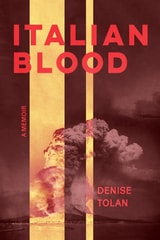
Italian Blood
A MemoirDenise Tolan
CavanKerry Press, 2023
“I’ve heard that some volcanic eruptions are soft with oozing streams of lava dancing down the side of the volcano like a Las Vegas chorus line. My father’s eruptions were quick, like bricks being thrown through a window.”
Denise Tolan’s memoir-in-essay traces the legacy of violence in an Italian American family, showing how abuse reverberates both in the body and mind of a family. The book’s first part, “Blood is Not Water,” lays out how the origins of violence can infect the roots of a family tree. The second part, “Good Blood Doesn’t Lie,” shows what grows from those roots. Italian Blood is a raw, heartbreaking series of essays where everything is connected through literal and metaphorical blood. These essays offer a connection to anyone who suffered childhood shame, violence, or fear and provide reassurance that they are not alone.

It’s All a Kind of Magic
The Young Ken KeseyRick Dodgson
University of Wisconsin Press, 2013
“Rick Dodgson has pored over Kesey’s published and unpublished writings, interviews, and historical records to write a colorful biography of this charismatic American character. The resulting portrayal challenges assumptions about Kesey’s place in the counterculture.”—Journal of American History
“Dodgson’s painstaking research unearths hidden gems of Kesey’s life that marked him as a fascinating figure.”—H-Net

Izabela Czartoryska and the Art of Persuation in Polish Visual Culture
Agnieszka Whelan
Central European University Press, 2026
As a prominent and outspoken member of the Commonwealth’s most influential political family, Czartoryska played a significant role in shaping the public image of the reformist movement through carefully orchestrated communal and cultural displays. The book examines social interactions within the public spaces of theatres and landscape gardens, highlighting the relationship between historical events and their visual and cultural responses.
By tracing the intersections of politics, sociability, and visual culture, the study demonstrates how the life of a single individual can illuminate the broader complexities of political transformation and cultural change at the end of the eighteenth century.
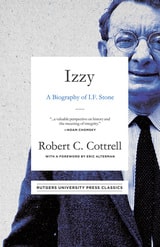
Izzy
A Biography of I. F. StoneRobert C. Cottrell
Rutgers University Press, 2020