Results by title
4917 books match the query 'Philosophy' and 177 start with i

Investigations In Philosophy Of Space
Continental Thought Series V. 11Elisabeth Ströker
Ohio University Press, 1987
The central contribution of Ströker’s investigations is a careful and strict analysis of the relationship between experienced space, Euclidean space, and non-Euclidean spaces. Her study begins with the question of experienced space, inclusive of mood space, space of action and perception, of practical activities and bodily orientations, and ends with the controversies of the proponents of geometric and mathematical understanding of space. Within the context of experienced space, Ströker includes historical discussions of place, topology, depth, perspectivity, homogeneity, orientation, and the questions of empty and full spaces. Her investigation concludes that any strict analysis of space must be founded upon an unavoidable ontology.
Philosophical Investigations of Space addresses a number of methodological controversies. It tests the limitations of a variety of scientific, phenomenological, geometric, and logical methods in order to demonstrate limitations of both methodology and underlying assumption. In addition to the richness of her historical and systematic discussion, Ströker’s work is a model of thoroughly documented philosophical scholarship and conceptual precision.
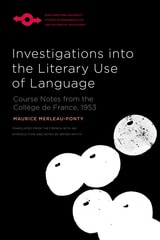
Investigations into the Literary Use of Language
Course Notes from the Collège de France, 1953Maurice Merleau-Ponty, Bryan Smyth
Northwestern University Press, 2026
A closely annotated translation of Merleau-Ponty’s lecture notes on literary language
Investigations into the Literary Use of Language presents an annotated translation of Maurice Merleau-Ponty’s lecture notes from one of the two courses that he gave during his inaugural year teaching at the Collège de France. In his notes from the concurrent course, The Sensible World and the World of Expression, Merleau-Ponty contends that our embodied perceptual engagement with the sensible world already involves the same spontaneity that underlies cultural expression. Approaching it from the other side, he revisits here the analysis of language that he had undertaken in the unfinished manuscript The Prose of the World.
Focusing on the work of Paul Valéry (1871–1945) and Stendhal (Marie-Henri Beyle, 1783–1842), Merleau-Ponty explores how the spontaneity of literary language sheds light on the relation between lived experience and language more broadly, and how cultural expression remains grounded in embodied perceptual experience in a way that is homologous yet irreducible to it. Specifically, Merleau-Ponty shows how Stendhal had already overcome Valéry’s skepticism concerning literary sincerity by effectively incorporating what the latter called the linguistic “implex”—in effect, language as institution—and thus achieving a “total style” of improvisational spontaneity in which the “conquering function” characteristic of the literary use of language gives shape to an immanent model of political engagement.
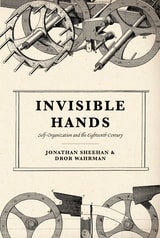
Invisible Hands
Self-Organization and the Eighteenth CenturyJonathan Sheehan and Dror Wahrman
University of Chicago Press, 2015
Why is the world orderly, and how does this order come to be? Human beings inhabit a multitude of apparently ordered systems—natural, social, political, economic, cognitive, and others—whose origins and purposes are often obscure. In the eighteenth century, older certainties about such orders, rooted in either divine providence or the mechanical operations of nature, began to fall away. In their place arose a new appreciation for the complexity of things, a new recognition of the world’s disorder and randomness, new doubts about simple relations of cause and effect—but with them also a new ability to imagine the world’s orders, whether natural or manmade, as self-organizing. If large systems are left to their own devices, eighteenth-century Europeans increasingly came to believe, order will emerge on its own without any need for external design or direction.
In Invisible Hands, Jonathan Sheehan and Dror Wahrman trace the many appearances of the language of self-organization in the eighteenth-century West. Across an array of domains, including religion, society, philosophy, science, politics, economy, and law, they show how and why this way of thinking came into the public view, then grew in prominence and arrived at the threshold of the nineteenth century in versatile, multifarious, and often surprising forms. Offering a new synthesis of intellectual and cultural developments, Invisible Hands is a landmark contribution to the history of the Enlightenment and eighteenth-century culture.
Invoking Hope
Theory and Utopia in Dark TimesPhillip E. Wegner
University of Minnesota Press, 2020
An appeal for the importance of theory, utopia, and close consideration of our contemporary dark times
What does any particular theory allow us to do? What is the value of doing so? And who benefits? In Invoking Hope, Phillip E. Wegner argues for the undiminished importance of the practices of theory, utopia, and a deep and critical reading of our current situation of what Bertolt Brecht refers to as finsteren Zeiten, or dark times.
Invoking Hope was written in response to three events that occurred in 2016: the five hundredth anniversary of the publication of Thomas More’s Utopia; the one hundredth anniversary of the founding text in theory, Ferdinand de Saussure’s Course in General Linguistics; and the rise of the right-wing populism that culminated in the election of Donald Trump. Wegner offers original readings of major interventions in theory alongside dazzling utopian imaginaries developed from classical Greece to our global present—from Theodor Adorno, Ernst Bloch, Alain Badiou, Jacques Derrida, Fredric Jameson, Sarah Ahmed, Susan Buck-Morss, and Jacques Lacan to such works as Plato’s Republic, W. E. B. Du Bois’s John Brown, Isak Dinesen’s “Babette’s Feast,” Kim Stanley Robinson’s 2312, and more. Wegner comments on an expansive array of modernist and contemporary literature, film, theory, and popular culture.
With Invoking Hope, Wegner provides an innovative lens for considering the rise of right-wing populism and the current crisis in democracy. He discusses challenges in the humanities and higher education and develops strategies of creative critical reading and hope against the grain of current trends in scholarship.
Inwardness and Existence
Subjectivity in/and Hegel, Heidegger, Marx, and FreudWalter A. Davis
University of Wisconsin Press, 1989
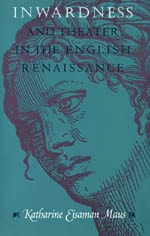
Inwardness and Theater in the English Renaissance
Katharine Eisaman Maus
University of Chicago Press, 1995
Reading works by Kyd, Marlowe, Shakespeare, Jonson, and Milton in conjuction with sectarian polemics, gynecological treatises, and accounts of criminal prosecutions, Maus delineates unexplored connections among religious, legal, sexual, and theatrical ideas of inward truth. She reveals what was at stake—ethically, politically, epistemologically, and theologically—when a writer in early modern England appealed to the difference between external show and interior authenticity. Challenging the recent tendency to see early modern selfhood as defined in wholly public terms, Maus argues that Renaissance dramatists continually payed homage to aspects of inner life they felt could never be manifested onstage.
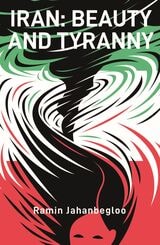
Iran
Beauty and TyrannyRamin Jahanbegloo
Gingko, 2026
Ramin Jahanbegloo turns to ancient philosophy as an antidote to contemporary authoritarianism in Iran.
From the rule of Cyrus the Great to the present day, Iran has been plagued by a recurrent syndrome of tyranny. For Ramin Jahanbegloo, the cure for this persistent cycle lies in a reengagement with the idea of a beautiful society. He presents beauty as an antidote to authoritarianism and as a methodology of freedom: one first taught by the philosophers of ancient Greece, who bound beauty and goodness together in the principle of kalokagathia, and later revived by the German Enlightenment.
A work of hope and faith in the people of Iran, this provocative and timely intervention from the author of The Idea of Persia turns to the past in order to imagine a way forward. Drawing on Hegel, Schiller, Arendt, Camus, and more, Jahanbegloo lays out a vision of how Iran and Iranians might come to live in beautiful freedom.
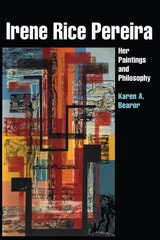
Irene Rice Pereira
Her Paintings and PhilosophyBy Karen Bearor
University of Texas Press, 1993
Artist Irene Rice Pereira was a significant figure in the New York art world of the 1930s and 1940s, who shared an interest in Jungianism with the better-known Abstract Expressionists and with various women artists and writers seeking "archetypal" imagery. Yet her artistic philosophy and innovative imagery elude easy classification with her artistic contemporaries. In consequence, her work is rarely included in studies of the period and is almost unknown to the general public. This first intellectual history of the artist and her work seeks to change that.
Karen A. Bearor thoroughly re-creates the artistic and philosophical milieu that nourished Pereira’s work. She examines the options available to Pereira as a woman artist in the first half of the twentieth century and explores how she used those options to contribute to the development of modernism in the United States. Bearor traces Pereira’s interest in the ideas of major thinkers of the period—among them, Spengler, Jung, Einstein, Cassirer, and Dewey—and shows how Pereira incorporated their ideas into her art. And she demonstrates how Pereira’s quest to understand something of the nature of ultimate reality led her from an early utopianism to a later interest in spiritualism and the occult.
This lively intellectual history amplifies our knowledge of a time of creative ferment in American art and society. It will appeal to a wide range of readers interested in the modernist period.
Iris Murdoch and the Search for Human Goodness
Edited by Maria Antonaccio and William Schweiker
University of Chicago Press, 1996
Inspired by Murdoch's tenacious wrestling with basic questions of human existence, these essays not only clarify her thoughts on human goodness, but also move beyond the academy to reflect on how we can and ought to undertake the human adventure in our daily lives.
Contributors are Charles Taylor, Martha Nussbaum, David Tracy, Cora Diamond, Maria Antonaccio, Elizabeth Dipple, Franklin I. Gamwell, Stanley Hauerwas, and William Schweiker. This volume also includes "Metaphysics and Ethics," a classic essay by Iris Murdoch.
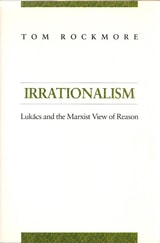
Irrationalism
Lukacs and the Marxist View of ReasonTom Rockmore
Temple University Press, 1991
This is the first detailed study, following the recent collapse of political Marxism in Eastern Europe, of twentieth-century Hungarian philosopher Georg Lukács and his position as the leading proponent of the Marxist theory of reason. Lukács's History and Class Consciousness has been called one of the three most influential philosophical works of this century, and he, the outstanding Marxist philosopher. Marxism has long suffered relative neglect in philosophical discussion as a result of its own invidious distinction between itself and the supposed irrationality of what it regards as bourgeois philosophy.
Tom Rockmore offers a uniquely detailed philosophical analysis of Lukács's entire position as a theory of reason, based on the distinction between reason and unreason, or irrationalism. The author gives special emphasis to Lukács's connection to German neo-Kantianism, particularly Lask, and on his last, unfinished work.
Rockmore begins with an account of the roots of Lukács's Marxism, followed by an in-depth analysis of his often mentioned, but still incompletely understood, seminal essay "Reification and the Class Consciousness of the Proletariat." He then traces the evolution and later demise of the distinction between reason and irrationalism in Lukács's final thought. The author thus makes available for the first time in English a strictly philosophical discussion of Georg Lukács's Marxist phase and brings consideration of his thought into the wider philosophical discussion.
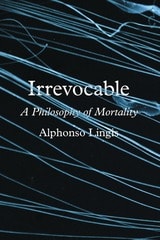
Irrevocable
A Philosophy of MortalityAlphonso Lingis
University of Chicago Press, 2018
Whether describing religious art and ritual, suffering, war and disease, the pleasures of love, the wonders of nature, archaeological findings, surfing, volcanoes, or jellyfish, Lingis writes with equal measures of rigor and abandon about the vicissitudes of our practices and beliefs. Knowing that birth, the essential encounters in our lives, crippling diseases and accidents, and even death are all determined by chance, how do we recognize and understand such chance? After facing tragedies, what makes it possible to live on while recognizing our irrevocable losses?
Lingis’s investigations are accompanied by his own vivid photographs from around the world. Balancing the local and the global, and ranging across vast expanses of culture and time, Irrevocable sounds the depths of both our passions and our impassioned bodies and minds.
Is Administrative Law Unlawful?
Philip Hamburger
University of Chicago Press, 2014
With Is Administrative Law Unlawful?, Philip Hamburger answers this question in the affirmative, offering a revisionist account of administrative law. Rather than accepting it as a novel power necessitated by modern society, he locates its origins in the medieval and early modern English tradition of royal prerogative. Then he traces resistance to administrative law from the Middle Ages to the present. Medieval parliaments periodically tried to confine the Crown to governing through regular law, but the most effective response was the seventeenth-century development of English constitutional law, which concluded that the government could rule only through the law of the land and the courts, not through administrative edicts. Although the US Constitution pursued this conclusion even more vigorously, administrative power reemerged in the Progressive and New Deal Eras. Since then, Hamburger argues, administrative law has returned American government and society to precisely the sort of consolidated or absolute power that the US Constitution—and constitutions in general—were designed to prevent.
With a clear yet many-layered argument that draws on history, law, and legal thought, Is Administrative Law Unlawful? reveals administrative law to be not a benign, natural outgrowth of contemporary government but a pernicious—and profoundly unlawful—return to dangerous pre-constitutional absolutism.
Is Feminist Philosophy Philosophy?
Emanuela Bianchi
Northwestern University Press, 1999
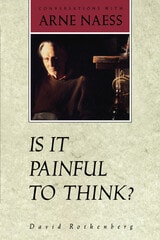
Is It Painful To Think
Conversations with Arne NaessDavid Rothenberg
University of Minnesota Press, 1992
Is St. Thomas’s Aristotelian Philosophy of Nature Obsolete?
C. Robert Koons
St. Augustine's Press, 2022
A bonus addition to this volume in the Dallas lecture series is Koon's “Aristotle, god and the Quantum.”

Is There a Measure on Earth?
Foundations for a Nonmetaphysical EthicsWerner Marx
University of Chicago Press, 1987
The poet Hölderlin posed the question, "Is there a measure on earth?" His own answer was emphatic, "There is none," for he was convinced that the measure for man was to be found only in the domain of the heavenly beings. Such metaphysical assumptions, as well as the attempt to found ethical conduct in the nature of man as a rational being, have been rejected by many contemporary thinkers, particularly Heidegger. Yet these thinkers have not been able to provide a satisfactory alternative to metaphysical foundations of the standards for responsible human conduct.
Marx, therefore, goes beyond Heidegger in demonstrating how several of his most basic notions could be relevant to a secular morality in our age. It is death, Marx claims, that unsettles man and transforms his conduct toward his fellow man. the common experience of mortality nourishes ethical life—and leads to the measures of compassion, love, and recognition of one's fellow human beings.
"It is only on the basis of these 'traditional virtues,'" Marx writes, "that we can find a motive for averting the impending dangers which have often enough been described so vividly and convincingly."
Is Ultimate Reality Unlimited Love?
Stephen G. Post
Templeton Press, 2014
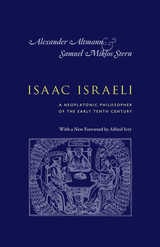
Isaac Israeli
A Neoplatonic Philosopher of the Early Tenth CenturyIsaac Israeli
University of Chicago Press, 2009
Recognized as one of the earliest Jewish neo-Platonist writers, Isaac ben Solomon Israeli (ca. 855–955) influenced Muslim, Jewish, and Christian scholars through the Middle Ages. A native of Egypt who wrote in Arabic, Israeli explored definitions of such terms as imagination, sense-perception, desire, love, creation, and “coming-to-be” in his writings.
This classic volume contains English translations of Israeli’s philosophical writings, including the Book of Definitions, the Book of Substances, and the Book on Spirit and Soul. Additionally, Isaac Israeli features a biographical sketch of the philosopher and extensive notes and comments on the texts, as well as a survey and appraisal of his philosophy. Restored to print for the first time in decades, Isaac Israeli will be essential reading for students and scholars of medieval philosophy and Jewish studies.
Isaiah Berlin
A CelebrationEdited by Edna Ullmann-Margalit and Avishai Margalit
University of Chicago Press, 1991
"Some [essays], like Joseph Brodsky's tribute, are touchingly personal. Others, like G. A. Cohen's 'Isaiah's Marx, and Mine,' mingle personal reminiscences with a more theoretical look at Berlin's ideas. . . . The volume is a fitting tribute to a thinker famed for his erudition, eclecticism, and clarity of style."—Merle Rubin, The Christian Science Monitor
"One of the many merits of this rich and rewarding collection is the sense-very imperfectly conveyed here-it transmits of the tone of Berlin's writings and conversation, of the multiplicity of his interests and the variety of his achievements. . . . The essays testify to the character of Berlin's mind as a luminous prism, in which the cultural traditions of Russia, England and Judaism are marvelously refracted."—John Gray, Times Literary Supplement
"[T]he collection testifies to the learning and profundity of Berlin's thought and, by way both of reminiscence and influence, to the charm and gaity of its expression."—Anthony Quinton, The Times of London
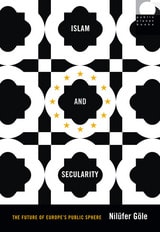
Islam and Secularity
The Future of Europe's Public SphereNilüfer Göle
Duke University Press, 2015
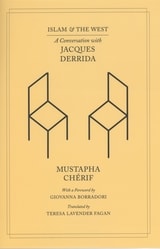
Islam and the West
A Conversation with Jacques DerridaMustapha Chérif
University of Chicago Press, 2008
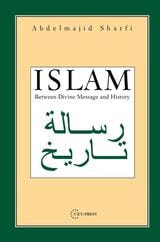
Islam
Between Divine Message and HistoryAbdelmajid Sharfi
Central European University Press, 2005
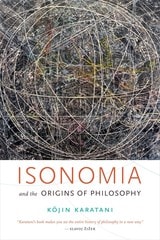
Isonomia and the Origins of Philosophy
Kojin Karatani
Duke University Press, 2017
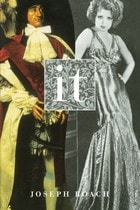
It
Joseph Roach
University of Michigan Press, 2011
A consumer’s guide to iconic celebrity and ageless glamour
“Strikingly original, wickedly witty, and thoroughly learned, Roach’s anatomy of abnormally interesting people and the vicarious pleasure we take in our modern equivalents to gods and royals will captivate its readers from the first page. I dare you to read just one chapter!”
—Felicity Nussbaum, University of California, Los Angeles
“It considers the effect that arises when spectacularly compelling performers and cultural fantasy converge, as in the outpouring of public grief over the death of Princess Diana. . . . An important work of cultural history, full of metaphysical wit . . . It gives us a fresh vocabulary for interpreting how after-images endure in cultural memory.”
—Andrew Sofer, Boston College
“Joseph Roach’s enormous erudition, sharp wit, engaging style, and gift for finding the most telling historical detail or literary quote are here delightfully applied to the intriguing subject of why certain historical and theatrical figures have possessed a special power to fascinate their public.”
—Marvin Carlson, Graduate Center, City University of New York
That mysterious characteristic “It”—“the easily perceived but hard-to-define quality possessed by abnormally interesting people”—is the subject of Joseph Roach’s engrossing new book, which crisscrosses centuries and continents with a deep playfulness that entertains while it enlightens.
Roach traces the origins of “It” back to the period following the Restoration, persuasively linking the sex appeal of today’s celebrity figures with the attraction of those who lived centuries before. The book includes guest appearances by King Charles II, Samuel Pepys, Flo Ziegfeld, Johnny Depp, Elinor Glyn, Clara Bow, the Second Duke of Buckingham, John Dryden, Michael Jackson, and Lady Diana, among others.
It's All in the Game
A Nonfoundationalist Account of Law and AdjudicationAllan C. Hutchinson
Duke University Press, 2000
Taking on leading contemporary theories to explore the claim that “law is politics,” Hutchinson delineates a route toward professional, relevant, and responsible—if radical—judicial practices. After discussing the difference between foundationalist, antifoundationalist, and nonfoundationalist legal critiques, he offers a focused, unequivocal, and positive account of the advantages of operating within a nonfoundationalist framework. Although such an approach centralizes the role of rhetoric in law, Hutchinson claims that this does not necessitate a turn away from politics or, more particularly, from a progressive politics. Driving home the political and jurisprudential impact of his critique and of his account of nonfoundationalist alternatives, he urges judges and jurists to engage in law’s language game of politics.
This engaging book will interest linguistic philosophers, legal theorists, law students, attorneys, judges, and jurists of all stripes.
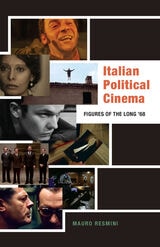
Italian Political Cinema
Figures of the Long ’68Mauro Resmini
University of Minnesota Press, 2022
An exploration of how film has made legible the Italian long ’68 as a moment of crisis and transition
Traditionally, the definition of political cinema assumes a relationship between cinema and politics. In contrast to this view, author Mauro Resmini sees this relationship as an impasse. To illustrate this theory, Resmini turns to Italian cinema to explore how films have reinvented the link between popular art and radical politics in Italy from 1968 to the early 1980s, a period of intense political and cultural struggles also known as the long ’68.
Italian Political Cinema conjures a multifaceted, complex portrayal of Italian society. Centered on emblematic figures in Italian cinema, it maps the currents of antagonism and repression that defined this period in the country’s history. Resmini explores how film imagined the possibilities, obstacles, and pitfalls that characterized the Italian long ’68 as a moment of crisis and transition. From workerism to autonomist Marxism to feminism, this book further expands the debate on political cinema with a critical interpretation of influential texts, some of which are currently only available in Italian.
A comprehensive and novel redefinition of political film, Italian Political Cinema introduces its audience to lesser-known directors alongside greats such as Pasolini, Bertolucci, Antonioni, and Bellocchio. Resmini offers access to untranslated work in Italian philosophy, political theory, and film theory, and forcefully advocates for the continued artistic and political relevance of these films in our time.
Itérations
Hans-Jörg Rheinberger
Diaphanes, 2013
Excellente introduction à cette pensée de l'épistémologie historique, Itérations est l’un des prolongements les plus féconds de la pensée de Derrida.