Results by title
8642 books match the query '20th century' and 290 start with i
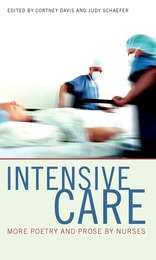
Intensive Care
More Poetry and Prose by NursesCortney & Judy Davis & Schaefer
University of Iowa Press, 2003
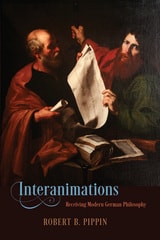
Interanimations
Receiving Modern German PhilosophyRobert B. Pippin
University of Chicago Press, 2015
After opening up his territory with an initial discussion of contemporary revisionist readings of Kant’s moral theory, Pippin sets his sights on his main objects of interest: Hegel and Nietzsche. Through them, however, he offers what few others could: an astonishing synthesis of an immense and diverse set of thinkers and traditions. Deploying an almost dialogical, conversational approach, he pursues patterns of thought that both shape and, importantly, connect the major traditions: neo-Aristotelian, analytic, continental, and postmodern, bringing the likes of Heidegger, Honneth, MacIntyre, McDowell, Brandom, Strauss, Williams, and Žižek—not to mention Hegel and Nietzsche— into the same philosophical conversation.
By means of these case studies, Pippin mounts an impressive argument about a relatively under discussed issue in professional philosophy—the bearing of work in the history of philosophy on philosophy itself—and thereby he argues for the controversial thesis that no strict separation between the domains is defensible.
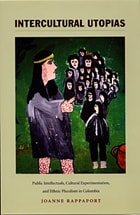
Intercultural Utopias
Public Intellectuals, Cultural Experimentation, and Ethnic Pluralism in ColombiaJoanne Rappaport
Duke University Press, 2005
Intercultural Utopias centers on southwestern Colombia’s Cauca region, a culturally and linguistically heterogeneous area well known for its history of indigenous mobilization and its pluralist approach to ethnic politics. Rappaport interweaves the stories of individuals with an analysis of the history of the Regional Indigenous Council of Cauca and other indigenous organizations. She presents insights into the movement and the intercultural relationships that characterize it from the varying perspectives of regional indigenous activists, nonindigenous urban intellectuals dedicated to the fight for indigenous rights, anthropologists, local teachers, shamans, and native politicians.
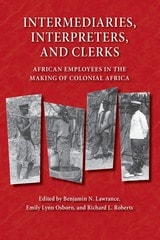
Intermediaries, Interpreters, and Clerks
African Employees in the Making of Colonial AfricaEdited by Benjamin N. Lawrance, Emily Lynn Osborn, and Richard L. Roberts
University of Wisconsin Press, 2006
By uncovering the role of such men (and a few women) in the construction, function, and legal apparatus of colonial states, the essays in this volume highlight a new perspective. They offer important insights on hegemony, collaboration, and resistance, structures and changes in colonial rule, the role of language and education, the production of knowledge and expertise in colonial settings, and the impact of colonization in dividing African societies by gender, race, status, and class.
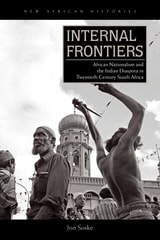
Internal Frontiers
African Nationalism and the Indian Diaspora in Twentieth-Century South AfricaJon Soske
Ohio University Press, 2017
In this ambitious new history of the antiapartheid struggle, Jon Soske places India and the Indian diaspora at the center of the African National Congress’s development of an inclusive philosophy of nationalism. In so doing, Soske combines intellectual, political, religious, urban, and gender history to tell a story that is global in reach while remaining grounded in the everyday materiality of life under apartheid.
Even as Indian independence provided black South African intellectuals with new models of conceptualizing sovereignty, debates over the place of the Indian diaspora in Africa (the “also-colonized other”) forced a reconsideration of the nation’s internal and external boundaries. In response to the traumas of Partition and the 1949 Durban Riots, a group of thinkers in the ANC, centered in the Indian Ocean city of Durban and led by ANC president and Nobel Peace Prize winner Albert Luthuli, developed a new philosophy of nationhood that affirmed South Africa’s simultaneously heterogeneous and fundamentally African character.
Internal Frontiers is a major contribution to postcolonial and Indian Ocean studies and charts new ways of writing about African nationalism.
International Political Earthquakes
Michael Brecher
University of Michigan Press, 2008
International Political Earthquakes is the masterwork of the preeminent scholar Michael Brecher. Brecher, who came of age before World War II, has witnessed more than seven decades of conflict and has spent his career studying the dynamics of relations among nations throughout the world.
When terrorism, ethnic conflict, military buildup, or other local tensions spark an international crisis, Brecher argues that the structure of global politics determines its potential to develop into open conflict. That conflict, in turn, may then generate worldwide political upheaval. Comparing international crises to earthquakes, Brecher proposes a scale analogous to the Richter scale to measure the severity and scope of the impact of a crisis on the landscape of international politics.
Brecher's conclusions about the causes of international conflict and its consequences for global stability make a convincing case for gradual, nonviolent approaches to crisis resolution.
Michael Brecher is R. B. Angus Professor of Political Science at McGill University.
Intersecting Realities and Fictions of Virginia Woolf and Colette
& COLETTEHelen Southworth
The Ohio State University Press, 2004
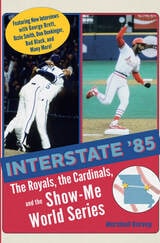
Interstate '85
The Royals, The Cardinals, and the Show-Me World SeriesMarshall Garvey
University of Missouri Press, 2025
In this blend of baseball and cultural history, Garvey defines the “I-70 Showdown Series” not only by the literal highway that links the two teams’ home cities but the individual and collective roads travelled by the players and others who took part in the event, both before the Series began and well after the last cheers faded.
In addition to gripping human stories and vivid descriptions of on-field action long overshadowed by Denkinger’s monumental blunder, Garvey’s work captures the provincial spectacle of the “Show-Me Series” throughout the state of Missouri. Featuring 27 new interviews conducted by the author, including with George Brett, Ozzie Smith, Don Denkinger, Bud Black, Andy Van Slyke, Ricky Horton, and Mark Gubicza, Interstate ’85 is baseball history writing at its deepest and most captivating.
Interventions into Modernist Cultures
Poetry from Beyond the Empty ScreenAmie Elizabeth Parry
Duke University Press, 2007
Reading various works by US expatriates Ezra Pound and Gertrude Stein, Parry compares the cultural politics of U.S. canonical modernism with alternative representations of temporality, hybridity, erasure, and sexuality in the work of the Taiwanese writers Yü Kwang-chung and Hsia Yü and the Asian American immigrant author Theresa Hak Kyung Cha. Juxtaposing poems by Pound and Yü Kwang-chung, Parry shows how Yü’s fragmented, ambivalent modernist form reveals the effects of neocolonialism while Pound denies and obscures U.S. imperialism in Asia, asserting a form of nondevelopmental universalism through both form and theme. Stein appropriates discourses of American modernity and identity to represent nonnormative desire and sexuality, and Parry contrasts this tendency with representations of sexuality in the contemporary experimental poetry of Hsia Yü. Finally, Parry highlights the different uses of modernist forms by Pound in his Cantos—which incorporate a multiplicity of decontextualized and ahistorical voices—and by Cha in her 1982 novel Dictee, a historicized, multilingual work. Parry’s sophisticated readings provide a useful critical framework for apprehending how “minor modernisms” illuminate the histories erased by certain canonical modernist texts.
Interviews with American Composers
Barney Childs in ConversationBarney Childs. Edited by Virginia Anderson
University of Illinois Press, 2022
Virginia Anderson edits the first published collection of these conversations. She pairs each interview with a contextual essay by a contemporary expert that shows how the composer's discussion with Childs fits into his life and work. Together, the interviewees cover a broad range of ideas and concerns around topics like education, notation, developments in electronic music, changing demands on performers, and tonal music.
Innovative and revealing, Interviews with American Composers is an artistic and historical snapshot of American music at an important crossroads.
Interwar Itineraries
Authenticity in Anglophone and French Travel WritingEmily O. Wittman
Amherst College Press, 2022
“This book offers a valuable account of literary activity in a genre still inadequately covered in literary-critical history. Emily Witt- man organizes her material through pairings and contextualizing that are instructive and illuminating and often exciting . . . This is comparative literature at its best.” —Vincent Sherry, Washington University

Intimate Communities
Representation and Social Transformation in Women's College Fiction, 1895–1910Sherrie A. Inness
University of Wisconsin Press, 1995
While other scholars have argued that the Progressive Era was the “golden age” for women’s single-sex education, pointing to the many positive depictions of the women’s college student, Inness suggests that these representations actually helped to perpetuate the status quo and did little to advance women’s social rights.
Intimate Radicals
East European Jewish Women and Progressive American DesiresAshley Walters
Rutgers University Press, 2027
In the early 1900s, a handful of unconventional couples emerged within the American radical Left. In Intimate Radicals, Ashley Walters tells the story of a group of young, East European Jewish women and white, Anglo-Saxon Protestant men— such as Jack London, Sinclair Lewis, and William English Walling, among other notable figures in American literature, domestic and international affairs, and early Hollywood—and how they imbued their romances with revolutionary principles. The relationships captivated the public and became a source of intrigue, largely driven by the growth of human-interest journalism. Through individual biographies, historical narrative, and literary analysis, Walters reveals the cultural and political contingencies of desire.
As Progressive Era radicals rebelled against the constraints of an earlier era, East European Jews—and Jewish women in particular— came to embody a new cosmopolitan ideal and European revolutionary spirit. Drawing on letters, newspapers, literature, and film, Walters shows how the public reception of these patrician-immigrant relationships lent credence to a new cultural mythology of Jewish womanhood. The men’s desire for East European Jewish women, she also points out, can be viewed as a form of “radical tourism,” in which men who enjoy a degree of privilege pursue an alluring Other in the hope of obtaining a more worldly identity.
This book is published with the support of the Jordan Schnitzer First Book Publication Award, administered by the Association for Jewish Studies.
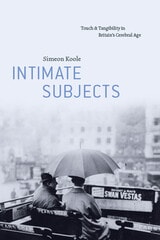
Intimate Subjects
Touch and Tangibility in Britain's Cerebral AgeSimeon Koole
University of Chicago Press, 2024
When, where, and who gets to touch and be touched, and who decides? What do we learn through touch? How does touch bring us closer together or push us apart? These are urgent contemporary questions, but they have their origins in late nineteenth- and early twentieth-century Britain, when new urban encounters compelled intense discussion of what touch was, and why it mattered. In this vividly written book, Simeon Koole excavates the history of these concerns and reveals how they continue to shape ideas about “touch” in the present.
Intimate Subjects takes us to the bustling railway stations, shady massage parlors, all-night coffee stalls, and other shared spaces where passengers, customers, vagrants, and others came into contact, leading to new understandings of touch. We travel in crammed subway cars, where strangers negotiated the boundaries of personal space. We visit tea shops where waitresses made difficult choices about autonomy and consent. We enter classrooms in which teachers wondered whether blind children could truly grasp the world and labs in which neurologists experimented on themselves and others to unlock the secrets of touch. We tiptoe through London’s ink-black fogs, in which disoriented travelers became newly conscious of their bodies and feared being accosted by criminals. Across myriad forgotten encounters such as these, Koole shows, touch remade what it meant to be embodied—as well as the meanings of disability, personal boundaries, and scientific knowledge.
With imagination and verve, Intimate Subjects offers a new way of theorizing the body and the senses, as well as a new way of thinking about embodiment and vulnerability today.
Intimate Subjects
Touch and Tangibility in Britain's Cerebral AgeSimeon Koole
University of Chicago Press, 2024
This is an auto-narrated audiobook version of this book.
The queer recluse, the shambling farmer, the clannish hill folk—white rural populations have long disturbed the American imagination, alternately revered as moral, healthy, and hardworking, and feared as antisocial or socially uncouth. In Peculiar Places, Ryan Lee Cartwright examines the deep archive of these contrary formations, mapping racialized queer and disability histories of white social nonconformity across the rural twentieth-century United States.
Sensationalized accounts of white rural communities’ aberrant sexualities, racial intermingling, gender transgressions, and anomalous bodies and minds, which proliferated from the turn of the century, created a national view of the perversity of white rural poverty for the American public. Cartwright contends that these accounts, extracted and estranged from their own ambivalent forum of community gossip, must be read in kind: through a racialized, materialist queercrip optic of the deeply familiar and mundane. Taking in popular science, documentary photography, news media, documentaries, and horror films, Peculiar Places orients itself at the intersections of disability studies, queer studies, and gender studies to illuminate a racialized landscape both profoundly ordinary and familiar.
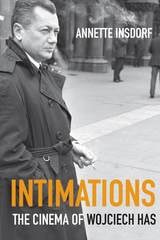
Intimations
The Cinema of Wojciech HasAnnette Insdorf
Northwestern University Press, 2017
Wojciech Has’s films are still less known outside of his native Poland than those of his countrymen Andrzej Wajda, Krzysztof Zanussi, and Krzysztof Kieslowski. Yet thanks to his singular vision, many critics rank Has among the masters of world cinema. Some of his movies have developed a cult following, notably The Saragossa Manuscript, the favorite film of the Grateful Dead’s Jerry Garcia, which has been praised by directors such as Luis Buñuel, Francis Ford Coppola, and Roman Polanski.
Has’s films reveal the inner lives of his characters, which he portrays by giving free rein to his own wildly creative imagination. In addition toThe Saragossa Manuscript, his diverse and innovative filmography includes The Hourglass Sanatorium, a vividly surreal depiction of Hassidic life in Poland between the world wars; The Noose, a stark poetic drama about a lucid alcoholic who knows he will not be able to kick the habit; and How to Be Loved, in which an actress remembers her wartime past.
Has made disparate but formally striking movies infused with European strains of existentialism and the avant-garde. With many of his films being restored and rereleased, new generations of film lovers are discovering his artistic genius. Intimations: The Cinema of Wojciech Has is the definitive guide in English to his work.
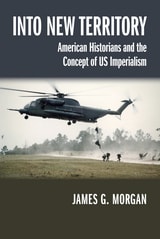
Into New Territory
American Historians and the Concept of US ImperialismJames G. Morgan
University of Wisconsin Press, 2014
Tracing the emergence of the concept of US imperialism, James G. Morgan shows how radical and revisionist scholars in the 1950s and 1960s first challenged the paradigm of denying an American empire. As the Vietnam War created a critical flashpoint, bringing the idea of American imperialism into the US mainstream, radical students of the New Left turned toward Marxist critiques, admiring revolutionaries like Che Guevara. Simultaneously, a small school of revisionist scholars, led by historian William Appleman Williams at the University of Wisconsin, put forward a progressive, nuanced critique of American empire grounded in psychology, economics, and broader historical context. It is this more sophisticated strand of thinking, Morgan argues, which demonstrated that empire can be an effective analytical framework for studying US foreign policy, thus convincing American scholars to engage with the subject seriously for the first time.
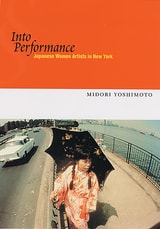
Into Performance
Japanese Women Artists in New YorkYoshimoto, Midori
Rutgers University Press, 2005
The 1960s was a time of incredible freedom and exploration in the art world, particularly in New York City, which witnessed the explosion of New Music, Happenings, Fluxus, New Dance, pop art, and minimalist art. Also notable during this period, although often overlooked, is the inordinate amount of revolutionary art that was created by women.
Into Performance fills a critical gap in both American and Japanese art history as it brings to light the historical significance of five women artists-Yoko Ono, Yayoi Kusama, Takako Saito, Mieko Shiomi, and Shigeko Kubota. Unusually courageous and self-determined, they were among the first Japanese women to leave their country-and its male-dominated, conservative art world-to explore the artistic possibilities in New York. They not only benefited from the New York art scene, however, they played a major role in the development of international performance and intermedia art by bridging avant garde movements in Tokyo and New York.
This book traces the pioneering work of these five women artists and the socio-cultural issues that shaped their careers. Into Performance also explores the transformation of these artists' lifestyle from traditionally confined Japanese women to internationally active artists. Yoshimoto demonstrates how their work paved the way for younger Japanese women artists who continue to seek opportunities in the West today.
Into the Light of Things
The Art of the Commonplace from Wordsworth to John CageGeorge J. Leonard
University of Chicago Press, 1994
In recovering the links between such seemingly disparate figures, Leonard transforms our understanding of modern culture.
Selected by the American Library Association's journal, Choice, as "one of the Outstanding Academic Books of the Year"
"Leonard's book is a fine example of interdisciplinary studies. He shifts focus persuasively from art theory to literature to religious thought and biography, making his method seem the natural mode of inquiry into culture."—Kenneth Baker, San Francisco Chronicle Book Review
"Provocative and illuminating."—Library Journal
"Highly stimulating, impassioned."—Publisher's Weekly
"A rich and rewarding study written in a clear and accessible style with excellent references and a very useful index. Highly recommended."—Choice
Intricate Thicket
Reading Late Modernist PoetriesMark Scroggins
University of Alabama Press, 2015
In these essays, Scroggins reviews the legacy of Louis Zukofsky, delineates the exceptional influence of the Black Mountain poets, and provides close readings of a wealth of examples of poetic works from poets who have carried the modernist legacy into contemporary poetry. He traces with an insider’s keen observation the careers of many of the most dynamic, innovative, and celebrated poets of the past half-century, among them Ian Hamilton Finlay, Ronald Johnson, Rae Armantrout, Harryette Mullen, and Anne Carson.
In a concluding pair of essays, Scroggins situates his own practice within the broad currents he has described. He reflects on his own aesthetics as a contemporary poet and, drawing on his extensive study and writing about Louis Zukofsky, examines the practical and theoretical challenges of literary biography.
While the core of these essays is the interpretation of poetry, Scroggins also offers clear aesthetic evaluations of the successes and failures of the poetries he examines. Scroggins engages with complex and challenging works, and yet his highly accessible descriptions and criticisms avoid theoretical entanglements and specialized jargon. Intricate Thicket yields subtle and multifaceted insights to experts and newcomers alike.
Invasion of the Mind Snatchers
Television's Conquest of America in the FiftiesEric Burns
Temple University Press, 2010
When the first television was demonstrated in 1927, a headline in The New York Times read, “Like a Photo Come to Life.” It was a momentous occasion. But the power of television wasn’t fully harnessed until the 1950s, when the medium was, as Eric Burns says, “At its most preoccupying, its most life-altering.” And Burns, a former NBC News correspondent who is an Emmy-winner for his broadcast writing, knows about the impact of television.
Invasion of the Mind Snatchers chronicles the influence of television that was watched daily by the baby boomer generation. As kids became spellbound by Howdy Doody and The Ed Sullivan Show, Burns reveals, they often acted out their favorite programs. Likewise, they purchased the merchandise being promoted by performers, and became fascinated by the personalities they saw on screen, often emulating their behavior. It was the first generation raised by TV and Burns looks at both the promise of broadcasting as espoused by the inventors, and how that promise was both redefined and lost by the corporations who helped to spread the technology.
Yet Burns also contextualizes the social, cultural, and political events that helped shape the Fifties—from Sputnik and the Rosenberg trial to Senator Joseph McCarthy’s Red Scare. In doing so, he charts the effect of television on politics, religion, race, and sex, and how the medium provided a persuasive message to the young, impressionable viewers.
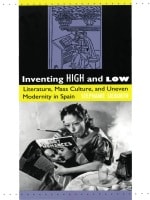
Inventing High and Low
Literature, Mass Culture, and Uneven Modernity in SpainStephanie Sieburth
Duke University Press, 1994
Choosing two historical moments of sweeping material and cultural change in Spanish history, Sieburth reads two novels from the 1880s (by Benito Pérez Galdós) and two from the 1970s (by Juan Goytisolo and Carmen Martín Gaite) as fictional theories about the impact of modernity on culture and politics. Her analysis reveals that the high/low division in the cultural sphere reinforces other kinds of separations—between social classes or between men and women—dear to the elite but endangered by progress. This tension, she shows, is particularly evident in Spain, where modernization has been a contradictory and uneven process, rarely accompanied by political freedom, and where consumerism and mass culture coexist uneasily with older ways of life.
Weaving together a wide spectrum of diverse material, her work will be of interest to readers concerned with Spanish history and literature, literary theory, popular culture, and the relations between politics, economics, gender, and the novel.
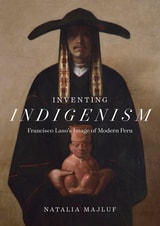
Inventing Indigenism
Francisco Laso's Image of Modern PeruNatalia Majluf
University of Texas Press, 2021
2023 ALAA Book Award, Association for Latin American Art/Arvey Foundation
A fascinating account of the modern reinvention of the image of the Indian in nineteenth-century literature and visual culture, seen through the work of Peruvian painter Francisco Laso.
One of the outstanding painters of the nineteenth century, Francisco Laso (1823–1869) set out to give visual form to modern Peru. His solemn and still paintings of indigenous subjects were part of a larger project, spurred by writers and intellectuals actively crafting a nation in the aftermath of independence from Spain. In this book, at once an innovative account of modern indigenism and the first major monograph on Laso, Natalia Majluf explores the rise of the image of the Indian in literature and visual culture. Reading Laso’s works through a broad range of sources, Majluf traces a decisive break in a long history of representations of indigenous peoples that began with the Spanish conquest. She ties this transformation to the modern concept of culture, which redefined both the artistic field and the notion of indigeneity. As an abstraction produced through indigenist discourse, an icon of authenticity, and a densely racialized cultural construct, the Indian would emerge as a central symbol of modern Andean nationalisms.
Inventing Indigenism brings the work and influence of this extraordinary painter to the forefront as it offers a broad perspective on the dynamics of art and visual culture in nineteenth-century Latin America.
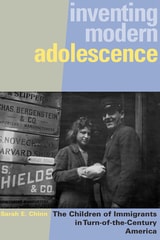
Inventing Modern Adolescence
The Children of Immigrants in Turn-of-the-Century AmericaSarah E. Chinn
Rutgers University Press, 2008
Inventing Paradise
The Greek Journey, 1937-47Edmund Keeley
Northwestern University Press, 2002
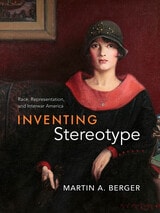
Inventing Stereotype
Race, Representation, and Interwar AmericaMartin A. Berger
University of Chicago Press, 2025
Upending a century of scholarly and popular thinking about stereotype, Martin A. Berger traces our current understanding of it to the 1920s, when American journalist and public intellectual Walter Lippmann borrowed the term from printmaking techniques and defined it as a shared mental picture that simplified a person, event, group, or thing so it could be easily grasped. Berger uncovers stereotype’s intellectual debts to philosophy, psychology, political science, and, in particular, art history and interwar racial theories.
Inventing Stereotype analyzes a series of plays, novels, and paintings from the 1920s and 1930s that sparked fierce debate about whether they employed racial stereotypes in the depiction of Black, Jewish, and other characters. Through careful attention to audience responses—parsed by race, political leanings, religion, and class—the book illustrates how artistic depictions are categorized as either stereotyped or not, relative to current representational norms, rather than to their success in conveying the authentic identities of individuals or racial groups.
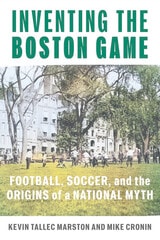
Inventing the Boston Game
Football, Soccer, and the Origins of a National MythKevin Tallec Marston and Mike Cronin
University of Massachusetts Press, 2024
Honorable Mention, 2025 North American Society for Sport History Book Award
On Boston Common stands a monument dedicated to the Oneida Football Club. It honors the site where, in the 1860s, sixteen boys played what was then called the “Boston game”—an early version of football in the United States. The boys were largely the sons of upper-class Boston Brahmins, and they lived through the transformative periods of the Civil War, Reconstruction, and the Gilded Age. Later as they grew old, in the 1920s, a handful of them orchestrated a series of commemorative events about their boyhood game. Benefitting from elite networks developed through the city’s social and educational institutions, including Harvard University, they donated artifacts (such as an oddly shaped, battered black ball) to museums, deposited self-penned histories into libraries and archives, and erected bronze and stone memorials, all to elevate themselves as the inventors of American football (and later, by extension, soccer). But was this origin story of what, by then, had become one of America’s favorite games as straightforward as they made it seem or a myth-making hoax?
In Inventing the Boston Game, Kevin Tallec Marston and Mike Cronin investigate the history of the Oneida Football Club and reveal what really happened. In a compelling, well told narrative that is informed by sports history, Boston history, and the study of memory, they posit that these men engaged in self-memorialization to reinforce their elite cultural status during a period of tremendous social and economic change, and particularly increased immigration. This exploration of the Club’s history provides fascinating insight into how and why origin stories are created in the first place.
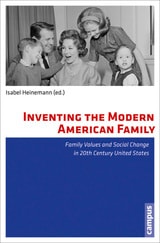
Inventing the Modern American Family
Family Values and Social Change in 20th Century United StatesEditedy by Isabel Heinemann
Campus Verlag, 2012
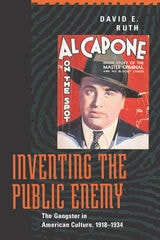
Inventing the Public Enemy
The Gangster in American Culture, 1918-1934David E. Ruth
University of Chicago Press, 1996
We see efficient criminal executives demonstrating the multifarious uses of organization; dapper, big-spending gangsters highlighting the promises and perils of the emerging consumer society; and gunmen and molls guiding an uncertain public through the shifting terrain of modern gender roles. In this fascinating study, Ruth reveals how the public enemy provides a far-ranging critique of modern culture.

Invisible Country
Four Polish PlaysEdited and Translated by Teresa Murjas
Intellect Books, 2012
The late nineteenth and early twentieth century marked a tumultuous period in Poland’s history, with artists and writers working under difficult sociopolitical conditions. This book contains the first English- language translations of four plays by Polish writers in the modernist tradition: Snow by Stanislaw Przybyszewski, In a Small House by Tadeusz Rittner, Ashanti by Wlodzimierz Perzynski, and All the Same by Leopold Staff. Well-chosen and carefully annotated, these translations provide important insight into this underexplored area of Polish dramatic history and practice and facilitate greater understanding of its role in the development of European theater. Also included is a broad discussion of the characteristics of translation for the theater.
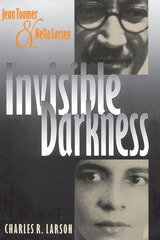
Invisible Darkness
Jean Toomer and Nella LarsenCharles R. Larson
University of Iowa Press, 1993
Invisible Darkness offers a striking interpretation of the tortured lives of the two major novelists of the Harlem Renaissance: Jean Toomer, author of Cane (1923), and Nella Larsen, author of Quicksand (1928) and Passing (1929). Charles R. Larson examines the common belief that both writers "disappeared" after the Harlem Renaissance and died in obscurity; he dispels the misconception that they vanished into the white world and lived unproductive and unrewarding lives.
In clear, jargon-free language, Larson demonstrates the opposing views that both writers had about their work vis-à-vis the incipient black arts movement; he traces each writer's troubled childhood and describes the unresolved questions of race that haunted Toomer and Larsen all of their lives. Larson follows Toomer through the wreckage of his personal life as well as the troubled years of his increasingly quirky spiritual quest until his death in a nursing home in 1967. Using previously unpublished letters and documents, Larson establishes for the first time the details of Larsen's life, illustrating that virtually every published fact about her life is incorrect.
With an innovative chronology that breaks the conventions of the traditional biographical form, Larson narrates what happened to both of these writers during their supposed years of withdrawal. He demonstrates that Nella Larsen never really gave up her fight for creative and personal fulfillment and that Jean Toomer's connection to the Harlem Renaissance—and the black world—is at best a dubious one. This strong revisionist interpretation of two major writers will have a major i mpact on African American literary studies.
Invisible Enemies
The American War on Vietnam, 1975-2000Edwin A. Martini
University of Massachusetts Press, 2007
Beginning where most histories of the Vietnam War end, Invisible Enemies examines the relationship between the United States and Vietnam following the American pullout in 1975. Drawing on a broad range of sources, from White House documents and congressional hearings to comic books and feature films, Edwin Martini shows how the United States continued to wage war on Vietnam “by other means” for another twenty-five years. In addition to imposing an extensive program of economic sanctions, the United States opposed Vietnam's membership in the United Nations, supported the Cambodians, including the Khmer Rouge, in their decade-long war with the Vietnamese, and insisted that Vietnam provide a “full accounting” of American MIAs before diplomatic relations could be established. According to Martini, such policies not only worked against some of the stated goals of U.S. foreign policy, they were also in opposition to the corporate economic interests that ultimately played a key role in normalizing relations between the two nations in the late 1990s.
Martini reinforces his assessment of American diplomacy with an analysis of the “cultural front”—the movies, myths, memorials, and other phenomena that supported continuing hostility toward Vietnam while silencing opposing views of the war and its legacies. He thus demonstrates that the “American War on Vietnam” was as much a battle for the cultural memory of the war within the United States as it was a lengthy economic, political, and diplomatic campaign to punish a former adversary.
Invisible Hawkeyes
African Americans at the University of Iowa during the Long Civil Rights EraLena M. Hill and Michael D. Hill
University of Iowa Press, 2016
By examining the quieter collisions between Iowa’s polite midwestern progressivism and African American students’ determined ambition, Invisible Hawkeyes focuses attention on both local stories and their national implications. By looking at the University of Iowa and a smaller midwestern college town like Iowa City, this collection reveals how fraught moments of interracial collaboration, meritocratic advancement, and institutional insensitivity deepen our understanding of America’s painful conversion into a diverse republic committed to racial equality.
SUBJECTS COVERED
Edison Holmes Anderson, George Overall Caldwell, Elizabeth Catlett, Fanny Ellison, Oscar Anderson Fuller, Michael Harper, James Alan McPherson, Herbert Franklin Mells, Herbert Nipson, Thomas Pawley, William Oscar Smith, Mitchell Southall, Margaret Walker
CONTRIBUTORS
Dora Martin Berry, Richard M. Breaux, Kathleen A. Edwards, Lois Eichaker, Brian Hallstoos, Lena M. Hill, Michael D. Hill, Dianna Penny, Donald W. Tucker, Ted Wheeler
Invisible Immigrants
The English in Canada since 1945Marilyn Barber
University of Manitoba Press, 2015
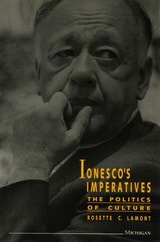
Ionesco's Imperatives
The Politics of CultureRosette C. Lamont
University of Michigan Press, 1993
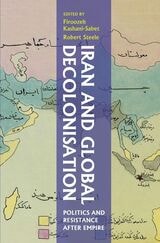
Iran and Global Decolonisation
Politics and Resistance After EmpireEdited by Robert Steele and Firoozeh Kashani-Sabet
Gingko, 2023
How did Iran’s unique position in the world affect and define its treatment of decolonization? During the final decades of Pahlavi rule in the late 1970s, the country sought to establish close relationships with newly independent counterparts in the Global South. Most scholarly work focused on this period is centered around the Cold War and Iran's relations with the United States, Russia, and Europe. Little attention has been paid to how the country interacted with other regions, such as Africa, Asia, and the Americas. Adding to an important and growing body of literature that discusses the profound and lasting impact of decolonization, Iran and Global Decolonisation contributes to the theoretical debates around the re-shaping of the world brought about by the end of an empire. It considers not only the impact of global decolonization on movements and ideas within Iran but also how Iran’s own experiences of imperialism shaped how these ideas were received and developed.
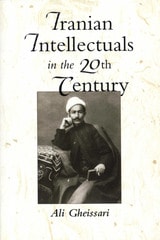
Iranian Intellectuals in the Twentieth Century
By Ali Gheissari
University of Texas Press, 1997
Since the middle of the nineteenth century, Iranian intellectuals have been preoccupied by issues of political and social reform, Iran's relation with the modern West, and autocracy, or arbitrary rule. Drawing from a close reading of a broad array of primary sources, this book offers a thematic account of the Iranian intelligentsia from the Constitutional movement of 1905 to the post-1979 revolution.
Ali Gheissari shows how in Iran, as in many other countries, intellectuals have been the prime mediators between the forces of tradition and modernity and have contributed significantly to the formation of the modern Iranian self image. His analysis of intellectuals' response to a number of fundamental questions, such as nationalism, identity, and the relation between Islam and modern politics, sheds new light on the factors that led to the Iranian Revolution—the twentieth century's first major departure from Western political ideals—and helps explain the complexities surrounding the reception of Western ideologies in the Middle East.
Iranians in Texas
Migration, Politics, and Ethnic IdentityBy Mohsen M. Mobasher
University of Texas Press, 2012
Thousands of Iranians fled their homeland when the 1978–1979 revolution ended the fifty-year reign of the Pahlavi Dynasty. Some fled to Europe and Canada, while others settled in the United States, where anti-Iranian sentiment flared as the hostage crisis unfolded. For those who chose America, Texas became the fourth-largest settlement area, ultimately proving to be a place of paradox for any Middle Easterner in exile. Iranians in Texas culls data, interviews, and participant observations in Iranian communities in Houston, Dallas, and Austin to reveal the difficult, private world of cultural pride, religious experience, marginality, culture clashes, and other aspects of the lives of these immigrants.
Examining the political nature of immigration and how the originating and receiving countries shape the prospects of integration, Mohsen Mobasher incorporates his own experience as a Texas scholar born in Iran. Tracing current anti-Muslim sentiment to the Iranian hostage crisis, two decades before 9/11, he observes a radically negative shift in American public opinion that forced thousands of Iranians in the United States to suddenly be subjected to stigmatization and viewed as enemies. The book also sheds light on the transformation of the Iranian family in exile and some of the major challenges that second-generation Iranians face in their interactions with their parents.
Bringing to life a unique population in the context of global politics, Iranians in Texas overturns stereotypes while echoing diverse voices.
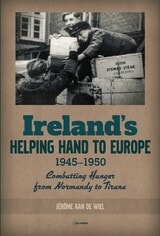
Ireland's Helping Hand to Europe
Combatting Hunger from Normandy to Tirana, 1945–1950Jérôme aan de Wiel
Central European University Press, 2021
Post-war Marshall Plan aid to Europe and indeed Ireland is well documented, but practically nothing is known about simultaneous Irish aid to Europe. This book provides a full record of the aid – mainly food but also clothes, blankets, medicines, etc. – that Ireland donated to continental Europe, including France, the Netherlands, Hungary, the Balkans, Italy, and zones of occupied Germany.
Starting with Ireland’s neutral wartime record, often wrongly presented as pro-German when Ireland in fact unofficially favoured the western Allies, Jerome aan de Wiel explains why Éamon de Valera’s government sent humanitarian aid to the devastated continent. His book analyses the logistics of collection and distribution of supplies sent abroad as far as the Greek islands.
Despite some alleged Cold-War hijacking of Irish relief – and this humanitarianism was not above the politics of that East-West confrontation – it became mostly a story of hope, generosity and European Christian solidarity. Rich archival records from Ireland and the European beneficiary countries, as well as contemporary local and national newspapers across Europe, allow the author to measure and describe not only the official but also the popular response to Irish relief schemes. This work is illustrated with contemporary photographs and some key graphs and tables that show the extent of the aid programme.
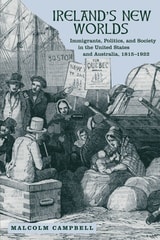
Ireland's New Worlds
Immigrants, Politics, and Society in the United States and Australia, 1815–1922Malcolm Campbell
University of Wisconsin Press, 2007
Ireland’s New Worlds is the first book to compare Irish immigrants in the United States and Australia. In a profound challenge to the national histories that frame most accounts of the Irish diaspora, Malcolm Campbell highlights the ways that economic, social, and cultural conditions shaped distinct experiences for Irish immigrants in each country, and sometimes in different parts of the same country. From differences in the level of hostility that Irish immigrants faced to the contrasting economies of the United States and Australia, Campbell finds that there was much more to the experiences of Irish immigrants than their essential “Irishness.” America’s Irish, for example, were primarily drawn into the population of unskilled laborers congregating in cities, while Australia’s Irish, like their fellow colonialists, were more likely to engage in farming. Campbell shows how local conditions intersected with immigrants’ Irish backgrounds and traditions to create surprisingly varied experiences in Ireland’s new worlds.
“Well conceived and thoroughly researched . . . . This clearly written, thought-provoking work fulfills the considerable ambitions of comparative migration studies.”—Choice
Irish Drama in Poland
Staging and Reception, 1900-2000Barry Keane
Intellect Books, 2016
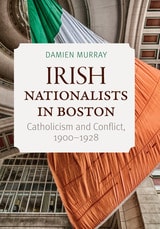
Irish Nationalists in Boston
Catholicism and Conflict, 1900-1928Damien Murray
Catholic University of America Press, 2018
For a brief period after World War I, Irish-American nationalism in Boston became a vehicle for the promotion of wider democratic reform. Though the movement was unable to survive the disagreements surrounding the Anglo-Irish Treaty of 1921, it had been a source of ethnic unity that enabled Boston’s Irish community to negotiate the challenges of the postwar years including the anti-socialist Red Scare and the divisions caused by the Boston Police Strike in the fall of 1919. Furthermore, Boston’s Irish nationalists drew heavily on Catholic Church teachings such that Irish ethnicity came to be more clearly identified with the advocacy of both cultural pluralism and the rights of immigrant and working families in Boston and America.
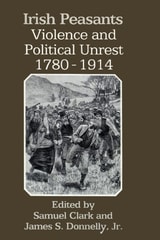
Irish Peasants
Violence and Political Unrest, 1780–1914Samuel Clark
University of Wisconsin Press, 1983
"The strength of this volume cannot be conveyed by an itemisation of its contents; for what it provides is an incisive commentary on the newly-recognised landmarks of Irish agrarian history in the modern period. . . . The importance, even indispensability, of this achievement is compounded by exemplary editing."—Roy Foster, London Times Literary Supplement
"As a whole, the volume demonstrates the wealth, complexity, and sophistication of Irish rural studies. The book is essential reading for anyone involved in modern Irish history. It will also serve as an excellent introduction to this rich field for scholars of other peasant communities and all interested in problems of economic and political developments."—American Historical Review
"A milestone in the evolution of Irish social history. There is a remarkable consistency of style and standard in the essays. . . . This is truly history from the grassroots."—Timothy P. O'Neill, Studia Hibernica
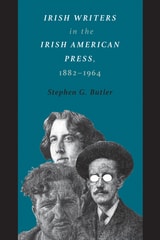
Irish Writers in the Irish American Press, 1882-1964
Stephen G. Butler
University of Massachusetts Press, 2018
Irish Writers in the Irish American Press spans the period from Oscar Wilde's 1882 American lecture tour to the months following JFK's assassination and covers the century in which Irish American identity was shaped by immigration, religion, politics, and economic advancement. Through a close engagement with Irish American periodicals, Butler offers a more nuanced understanding of the connections between Irish literary studies and Irish American culture during this period.
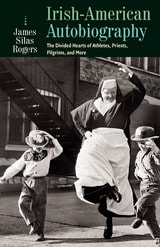
Irish-American Autobiography
James Silas Rogers
Catholic University of America Press, 2016
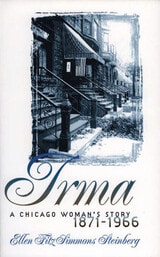
Irma
A Chicago Woman's Story, 1871-1966Ellen Fitzsimmons Steinberg
University of Iowa Press, 2004
Irma’s journals and diaries were private accounts in which she chronicled the rhythm of her days and the shape of her life. She recorded her thoughts and short quotations from her reading, jotted down her own poems and short stories, constructed dinner-party menus, and wrote biographical sketches of her family. Interspersed among the records of what she did when and with whom are a number of lengthy reflections on Chicago history, her early life, religious beliefs, education, her aspirations, disappointments, sorrows, and successes. She documented her family’s activities during the Chicago Fire, the city’s rebuilding, early educational curricula in the city’s schools, what it was like to participate in the suffrage movement and vote for the first time, the effect of the Great Depression on the middle class, and World War II as seen from her perspective.
In each chapter, Ellen Steinberg has set Irma’s contemporary entries and later memoirs against the context of the Chicago history that Irma knew so well. Irma’s story will fascinate those interested in diaries and autobiography, women’s history, and Chicago history. From a plethora of rich source materials—including over half a million words of Irma’s writings alone—Steinberg has created a seamless, fascinating narrative about a Chicago woman who, although “nobody famous” (in her words), lived a vital life in a vibrant city.
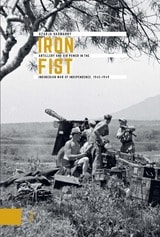
Iron Fist
Artillery and Air Power in the Indonesian War of Independence, 1945-1949Azarja Harmanny
Amsterdam University Press, 2026
Iron Valley
The Transformation of the Iron Industry in Ohio's Mahoning Valley, 1802–1913Clayton J. Ruminski
The Ohio State University Press, 2017
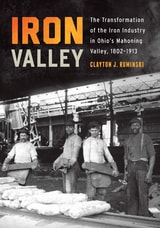
Youngstown, Ohio, and the surrounding Mahoning Valley supplied the iron that helped transform the United States into an industrial powerhouse in the nineteenth century. The story of the Mahoning Valley’s unorthodox rise from mid-scale iron producer to twentieth-century “Steel Valley” is a tale of innovation, stagnation, and, above all, extreme change. Located halfway between Pittsburgh and Cleveland, the Mahoning Valley became a major supplier of pig iron to America’s biggest industrial regions. For much of the nineteenth century, outside consumers relied on the Valley’s pig iron, but this reliance nurtured a reluctance on the part of Youngstown iron companies to diversify or expand their production.
In Iron Valley: The Transformation of the Iron Industry in Ohio’s Mahoning Valley, 1802–1913, Clayton J. Ruminski argues that Youngstown-area iron manufacturers were content to let others in the industry innovate, and only modernized when market conditions forced them to do so. Desperate to find new markets, some Youngstown iron manufacturers eventually looked toward steel and endured a rapid, but successful, industrial transformation that temporarily kept their old enterprises afloat in a rapidly evolving industry. Richly illustrated with rare photographs of Mahoning Valley ironmasters, mills, furnaces, and workers, Iron Valley sheds light on a previously underrepresented and vital region that built industrial America.
Irony's Antics
Walser, Kafka, Roth, and the German Comic TraditionErica Weitzman
Northwestern University Press, 2014
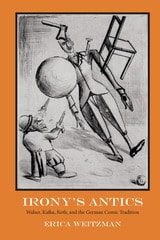
Combining theoretical breadth with close textual analysis, Erica Weitzman shows how irony, a key term for the German romantics, reemerged in the early twentieth century from a postromantic relegation to the nonsensical and the nihilistic in a way that both rethought romantic irony and dramatically extended its reach.
Through readings of works by Robert Walser, Franz Kafka, and Joseph Roth against the rich history of comic theory (particularly Hegel and Freud), Weitzman traces the development of a specifically comic irony in modern German-language literature and philosophy, a play with the irony that is itself the condition for all play. She thus provides a crucial reevaluation of German literary history and offers new insights into the significance of irony and the comic from the Enlightenment to the present day.
Irrationalism
Lukacs and the Marxist View of ReasonTom Rockmore
Temple University Press, 1991
This is the first detailed study, following the recent collapse of political Marxism in Eastern Europe, of twentieth-century Hungarian philosopher Georg Lukács and his position as the leading proponent of the Marxist theory of reason. Lukács's History and Class Consciousness has been called one of the three most influential philosophical works of this century, and he, the outstanding Marxist philosopher. Marxism has long suffered relative neglect in philosophical discussion as a result of its own invidious distinction between itself and the supposed irrationality of what it regards as bourgeois philosophy.
Tom Rockmore offers a uniquely detailed philosophical analysis of Lukács's entire position as a theory of reason, based on the distinction between reason and unreason, or irrationalism. The author gives special emphasis to Lukács's connection to German neo-Kantianism, particularly Lask, and on his last, unfinished work.
Rockmore begins with an account of the roots of Lukács's Marxism, followed by an in-depth analysis of his often mentioned, but still incompletely understood, seminal essay "Reification and the Class Consciousness of the Proletariat." He then traces the evolution and later demise of the distinction between reason and irrationalism in Lukács's final thought. The author thus makes available for the first time in English a strictly philosophical discussion of Georg Lukács's Marxist phase and brings consideration of his thought into the wider philosophical discussion.