Results by title
18284 books match the query 'United States' and 636 start with i
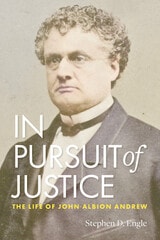
In Pursuit of Justice
The Life of John Albion AndrewStephen D. Engle
University of Massachusetts Press, 2023
Widely known as the “poor man’s lawyer” in antebellum Boston, John Albion Andrew (1818–1867) was involved in nearly every cause and case that advanced social and racial justice in Boston in the years preceding the Civil War. Inspired by the legacies of John Quincy Adams and Ralph Waldo Emerson, and mentored by Charles Sumner, Andrew devoted himself to the battle for equality. By day, he fought to protect those condemned to the death penalty, women seeking divorce, and fugitives ensnared by the Fugitive Slave Law. By night, he coordinated logistics and funding for the Underground Railroad as it ferried enslaved African Americans northward.
In this revealing and accessible biography, Stephen D. Engle traces Andrew’s life and legacy, giving this important, but largely forgotten, figure his due. Rising to national prominence during the Civil War years as the governor of Massachusetts, Andrew raised the African American regiment known as the Glorious 54th and rallied thousands of soldiers to the Union cause. Upon his sudden death in 1867, a correspondent for Harper’s Weekly wrote, “Not since the news came of Abraham Lincoln’s death were so many hearts truly smitten.”
In Pursuit of Leviathan
Technology, Institutions, Productivity, and Profits in American Whaling, 1816-1906Lance E. Davis, Robert E. Gallman, and Karin Gleiter
University of Chicago Press, 1997
Providing a wealth of historical information, In Pursuit of Leviathan is a classic industry study that will provide intriguing reading for anyone interested in the history of whaling.
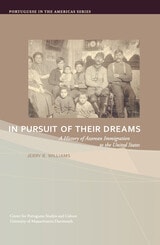
In Pursuit of Their Dreams
A History of Azorean Immigration to the United StatesJerry R. Williams
Tagus Press, 2007
Jerry Williams' history of Azorean immigration to the United States offers us valuable insight into the experience and culture of Portuguese immigrants and their descendants. This account fills a major gap in American immigration history and gives us a comprehensive overview of how Portuguese-Americans—now numbering close to a million people—have come to constitute a vibrant and highly visible presence within southeastern New England, the areas around San Francisco and San Diego, Hawaii, and the New Jersey/New York metropolitan area. Even though Azorean immigrants all came from similar cultural and social backgrounds, Williams shows how regionally specific opportunity structures and social hierarchies have contributed to significant differences within the Portuguese-American experience.
Starting with the whaling routes that first connected the mid-Atlantic archipelago with the ports of call in New England and California in the early 1800s, Williams lays out the complex relationship between the Azores and the US that has continued into the present. We learn how particular patterns of poverty, overpopulation and social inequality in the Azores pushed large numbers of the islands' inhabitants to leave their homes in search of better opportunities for themselves and their children. He tells the story of how the early whalers who jumped ship in New Bedford, San Francisco, or Hawaii were followed by kin and fellow villagers who had heard of plentiful jobs in New England's textile mills, gold and land in California, or agricultural work on Hawaiian plantations. Williams' account allows us to understand the importance of family and community connections throughout the immigrants' arduous transition from peasant life to industrial society.
In Pursuit
The Hunt for the Beltway SnipersDavid Reichenbaugh
University Press of New England, 2018

In Rare Form
A Pictorial History of Baseball Evangelist Billy SundayW. A. Firstenberger
University of Iowa Press, 2005
Through an organizational scheme that incorporates memorabilia from childhood (samplers, Civil War badges), baseball (Billy’s 1891 Philadelphia contract, scorecards), evangelism (cartoons, books such as Monkeys and Missing Links), social issues (KKK ads endorsing Sunday, his Women's Christian Temperance life membership certificate), life style (Arts and Crafts decorative pieces, extensive photos of the family's Mount Hood bungalow), and family relations (his personal possessions and those of his wife, Nell, and their children), In Rare Form brings together the inconsistencies between Sunday’s material world and his spiritual world.
Since Sunday might have objected to a materialistic analysis of his life, Firstenberger has allowed him a say: each section of the book begins with an apt quote from Sunday’s sermons and writings. Firstenberger also includes appendixes providing detailed information on Sunday’s revivals and speaking appearances, his 870,075 documented converts, the members of his evangelistic team, the overall structure of his family, and an extensive bibliography. Acknowledging Sunday’s faults and contradictions alongside his heroic accomplishments, the author presents a wryly insightful and innovative perspective on this larger-than-life figure.
In Reunion
Transnational Korean Adoptees and the Communication of FamilyDocan-Morgan, Sara
Temple University Press, 2024
The paradoxes of adoption and reunion—shared history without blood relations, and blood relations without shared history—generate questions: What does it mean to be “family”? How do people use communication to constitute family relationships? How are family relationships created, maintained, and negotiated over time? In Reunion details adoptive and cultural identities, highlighting how adoptees often end up shouldering communicative responsibility in their family relationships. Interviews reveal how adoptees navigate birth family relationships across language and culture while also attempting to maintain relationships with their adoptive family members.
Docan-Morgan details the challenges, rewards, and contradictions of reunion. She also offers practical recommendations for transnational adoptees in reunion, adoptees considering reunion, adoptive families, and adoption practitioners.
In tracing the stories of the intercultural dynamics inherent in adoptees’ reunions, Docan-Morgan demonstrates the effort, flexibility, empathy, self-reflection, and time required to navigate long-term relationships with birth families.
In Sacred Loneliness
The DocumentsTodd Compton
Signature Books, 2022
This volume includes many autobiographical writings, diaries, and letters, with Compton providing annotations and introductory material that illuminates these crucial primary sources. This allows readers to take their understanding of this unique group of women to a new level and to drive home that fact that their lives go far beyond the Nauvoo experiment that forever links them to Mormonism’s founding prophet.
In Sacred Loneliness
The Plural Wives of Joseph SmithTodd Compton
Signature Books, 1997
The majority of Smith’s wives were younger than he, and one-third were between fourteen and twenty years of age. Another third were already married, and some of the husbands served as witnesses at their own wife’s polyandrous wedding. In addition, some of the wives hinted that they bore Smith children—most notably Sylvia Sessions’s daughter Josephine—although the children carried their stepfather’s surname.
For all of Smith’s wives, the experience of being secretly married was socially isolating, emotionally draining, and sexually frustrating. Despite the spiritual and temporal benefits, which they acknowledged, they found their faith tested to the limit of its endurance. After Smith’s death in 1844, their lives became even more “lonely and desolate.” One even joined a convent. The majority were appropriated by Smith’s successors, based on the Old Testament law of the Levirate, and had children by them, though they considered these guardianships unsatisfying. Others stayed in the Midwest and remarried, while one moved to California. But all considered their lives unhappy, except for the joy they found in their children and grandchildren.

In Search of Admiration and Respect
Chinese Cultural Diplomacy in the United States, 1875–1974Yanqui Zheng
University of Michigan Press, 2024
In Search of Admiration and Respect uses the Chinese case to underscore what Zheng calls “infrastructure of persuasion,” in which American philanthropy, museums, exhibitions, and show business had disproportionate power in setting the agenda of unequal intercultural encounters. This volume also provides historical insights into China’s ongoing quest for international recognition. Drawing upon diverse archival sources, Zheng expands the contours of cultural diplomacy beyond established powers and sheds light on the limited agency of peripheral nations in their self-representation.
In Search of American Jewish Culture
Stephen J. Whitfield
Brandeis University Press, 2001
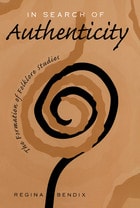
In Search of Authenticity
The Formation of Folklore StudiesRegina Bendix
University of Wisconsin Press, 1997
Searches for authenticity, Bendix contends, have been a constant companion to the feelings of loss inherent in modernization, forever upholding a belief in a pristine yet endangered cultural essence and fueling cultural nationalism worldwide. Beginning with precursors of Herder and Emerson and the “discovery” of the authentic in expressive culture and literature, she traces the different, albeit intertwined, histories of German Volkskunde and American folklore studies. A Swiss native educated in American folklore programs, Bendix moves effortlessly between the two traditions, demonstrating how the notion of authenticity was used not only to foster national causes, but also to lay the foundations for categories of documentation and analysis within the nascent field of folklore studies.
Bendix shows that, in an increasingly transcultural world, where Zulu singers back up Paul Simon and where indigenous artists seek copyright for their traditional crafts, the politics of authenticity mingles with the forces of the market. Arguing against the dichotomies implied in the very idea of authenticity, she underscores the emptiness of efforts to distinguish between folklore and fakelore, between echt and ersatz.

In Search of First Contact
The Vikings of Vinland, the Peoples of the Dawnland, and the Anglo-American Anxiety of DiscoveryAnnette Kolodny
Duke University Press, 2012
Kolodny considers what the sagas reveal about the Native peoples encountered by the Norse in Vinland around the year A.D. 1000, and she recovers Native American stories of first contacts with Europeans, including one that has never before been shared outside of Native communities. These stories contradict the dominant narrative of "first contact" between Europeans and the New World. Kolodny rethinks the lingering power of a mythic American Viking heritage and the long-standing debate over whether Leif Eiriksson or Christopher Columbus should be credited as the first discoverer. With this paradigm-shattering work, Kolodny shows what literary criticism can bring to historical and social scientific endeavors.
In Search of New England's Native Past
Selected Essays by Gordon M. DayGordon M. Day
University of Massachusetts Press, 1998
This volume highlights the work of the late Gordon M. Day, renowned for his groundbreaking research on the history and culture of the Western Abenakis and their Indian neighbors. Where previous historians had tended to portray northern New England as an area largely devoid of aboriginal peoples, Day established beyond all doubt the presence of Abenaki settlements along the eastern shore of Lake Champlain as well as the upper reaches of the Connecticut and Merrimack rivers.
For nearly three decades, Day focused his work on the community of Saint Francis, or Odanak, in Quebec, to which Abenaki refugees from interior New England had fled, beginning in the mid-seventeenth century and continuing into the nineteenth. Drawing on the methods of several disciplines, including ethnology, linguistics, and ethnohistory, he synthesized data from fragmentary historical records, oral traditions, and place names to reconstruct a world assumed to be lost.
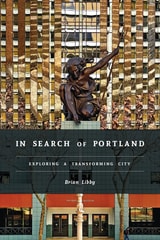
In Search of Portland
Exploring a Transforming CityBrian Libby
Oregon State University Press, 2026
“A good walking tour is not just about individual stops but the total experience of moving along a city’s streets, taking in a variety of neighborhoods, buildings, shops, parks, public art, and bridges: a chance to be the grand marshal in your own parade,” writes Brian Libby in the introduction of In Search of Portland. Starting from his 1997 home, the Empire Apartments at Southwest Eleventh Avenue and Jefferson Street, Libby shares one hundred fascinating points of interest through personal reflection, interviews, and anecdotal history.
The six excursions exploring Portland’s downtown, Old Town, and Pearl District not only focus on the city’s important landmarks and hidden gems but showcase an evolving city’s resilience and heart. Alongside his own experiences, Libby reveals how luminaries like Humphrey Bogart, Mark Rothko, Gus Van Sant, Vera Katz, and Bill Walton appreciated the City of Roses. From Pioneer Courthouse Square to the Crystal Ballroom, each location in the book celebrates the spirit of place in addition to its architecture.
More than a book about buildings, In Search of Portland reveals the stories behind the built landscape, the people, and the history that have created modern Portland.

In Search of Susanna
Suzanne L. Bunkers
University of Iowa Press, 1996
On a summer day in 1980 in Niederfeulen, Luxembourg, Suzanne Bunkers pored over parish records of her maternal ancestors, immigrants to the rural American Midwest in the mid 1800s. Suddenly, chance led her to the name Simmerl and to the missing piece in the genealogical puzzle that had brought her so far: Susanna Simmerl, Bunkers' paternal great-great-grandmother, who had given birth to an illegitimate daughter in 1856 before coming to America. Finding Susanna was the catalyst for Bunkers' intensely personal book, which blends history, memory, and imagination into a drama of two women's lives within their multigenerational family.
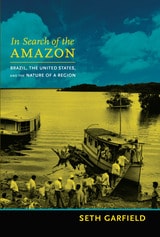
In Search of the Amazon
Brazil, the United States, and the Nature of a RegionSeth Garfield
Duke University Press, 2013
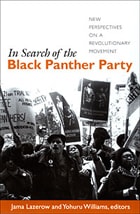
In Search of the Black Panther Party
New Perspectives on a Revolutionary MovementJama Lazerow and Yohuru Williams, eds.
Duke University Press, 2006
One contributor evaluates the legal basis of the Panthers’ revolutionary struggle, explaining how they utilized and critiqued the language of the Constitution. Others explore the roles of individuals, looking at a one-time Panther imprisoned for a murder he did not commit and an FBI agent who monitored the activities of the Panthers’ Oakland branch. Contributors assess the Panthers’ relations with Students for a Democratic Society, the Young Lords, the Brown Berets, and the Peace and Freedom Party. They discuss the Party’s use of revolutionary aesthetics, and they show how the Panthers manipulated and were manipulated by the media. Illuminating some of the complexities involved in placing the Panthers in historical context, this collection demonstrates that the scholarly search for the Black Panthers has only just begun.
Contributors. Bridgette Baldwin, Davarian L. Baldwin, David Barber, Rod Bush, James T. Campbell, Tim Lake, Jama Lazerow, Edward P. Morgan, Jeffrey O. G. Ogbar, Roz Payne, Robert O. Self, Yohuru Williams, Joel Wilson
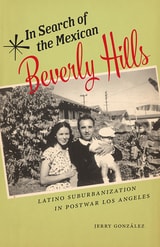
In Search of the Mexican Beverly Hills
Latino Suburbanization in Postwar Los AngelesGonzález, Jerry
Rutgers University Press, 2018
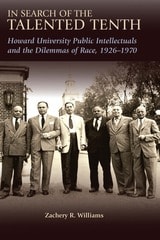
In Search of the Talented Tenth
Howard University Public Intellectuals and the Dilemmas of Race, 1926-1970Zachery R. Williams
University of Missouri Press, 2009
In Search of the Talented Tenth tells how individuals like Rayford Logan, E. Franklin Frazier, John Hope Franklin, Merze Tate, Charles Wesley, and Dorothy Porter left an indelible imprint on academia and black communities alike through their impact on civil rights, anticolonialism, and women’s rights. Zachery Williams explores W. E. B. Du Bois’s Talented Tenth by describing the role of public intellectuals from the Harlem Renaissance to the Black Power movement, in times as trying as the Jim Crow and Cold War eras.
Williams first describes how the years 1890 to 1926 laid the foundation for Howard’s emergence as the “capstone of Negro education” during the administration of university president Mordecai Johnson. He offers a wide-ranging discussion of how the African American community of Washington, D.C., contributed to the dynamism and intellectual life of the university, and he delineates the ties that linked many faculty members to one another in ways that energized their intellectual growth and productivity as scholars. He also discusses the interaction of Howard’s intellectual community with those of the West Indies, Africa, and other places, showing the international impact of Howard’s intellectuals and the ways in which black and brown elites outside the United States stimulated the thought and scholarship of the Howard intellectuals.
In Search of the Talented Tenth marks the first in-depth study of the intellectual activity of this community of scholars and further attests to the historic role of women faculty in shaping the university. It testifies to the impact of this group as a model against which the twenty-first century’s black public intellectuals can be measured.

In Service to America
A History of VISTA in Arkansas, 1965-1985Marvin Schwartz
University of Arkansas Press, 1988

In Service to American Pharmacy
The Professional Life of William Procter Jr.Gregory J. Higby
University of Alabama Press, 1992
The story of the visionary pharmacist who helped build modern American pharmacy.
In Service to American Pharmacy: The Professional Life of William Procter Jr. by Gregory J. Higby is the definitive biography of William Procter Jr., widely recognized as the "Father of American Pharmacy." Through meticulous historical research, Higby chronicles Procter's extraordinary career and demonstrates how one individual's dedication helped transform pharmacy in the United States from a commercial trade into a respected healthcare profession during the nineteenth century.
The book follows Procter's contributions as a practicing pharmacist, pharmaceutical scientist, educator, editor, and organizational leader. It places his accomplishments within the broader evolution of American healthcare, tracing developments from the founding of the Philadelphia College of Pharmacy in 1821 through the emergence of professional standards, drug quality controls, pharmaceutical education, and meaningful pharmacy legislation. Higby shows how Procter's commitment to scientific rigor and public service helped establish many of the principles that continue to guide pharmacy practice today.
This book offers a valuable history of nineteenth-century medicine, science, and professionalization in America. Rich in historical context and scholarly insight, it illustrates the challenges and achievements involved in creating a modern profession dedicated to public health and pharmaceutical excellence. Essential for historians of medicine, pharmacy practitioners, and scholars of American science, this work highlights the enduring legacy of one of the most influential figures in healthcare history.
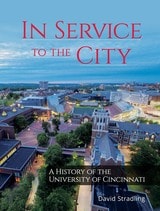
In Service to the City
A History of the University of CincinnatiDavid Stradling
University of Minnesota Press, 2018
In Service to the City: A History of the University of Cincinnati, the first history of the university written in over fifty years, explores the evolving, complex relationship between UC and the city of Cincinnati. In Service to the City casts an unvarnished lens on the details of student demographics, faculty research, curricular changes, and athletic controversy to challenges associated with campus architecture and planning, neighborhood relations, regional and national consequences of urban decline, and the roles of municipal, state, and federal governments within American higher education.
Urban, environmental historian David Stradling traces UC’s story through starts and stops, growth and contraction. In the 1870s the institution began its transformation into a comprehensive, municipal university located in America’s thriving heartland. Expansion continued through mergers with Cincinnati College-Conservatory of Music and Cincinnati Medical College, among others. In 1977, University President Warren Bennis and Governor Jim Rhodes signed papers ending UC’s municipal status while securing its future as part of the state university system of Ohio.
UC maintains its strong relationship with Cincinnati, pioneering countless community and regionally oriented programs, from its expanding co-op education system, the first in the nation, to the Niehoff Urban Studio. Stradling describes the social and political activism of UC students and faculty—front and center in the civil rights and women’s rights movements, as well as the public health and environmental movements. Often they struggled to change the culture within their own institution, which at times appeared conservative or reactionary.
Drawing on archival research, Stradling recounts in lively prose and through dozens of illustrations, two-hundred years of UC history, setting the story in the context of changes within higher education in the United States.
With the cost of higher education on the minds of legislators and the public, questions first posed by Daniel Drake in 1819 upon the founding of Cincinnati College remain relevant. Who should the college serve? What and how should students learn? How can we pay for it? In Service to the City encourages readers to consider how the University of Cincinnati—with a history so entwined with its city—can balance its urban-serving tradition with its aspiration to be a leader global research university.

In Sputnik's Shadow
The President's Science Advisory Committee and Cold War AmericaWang, Zuoyue
Rutgers University Press, 2009
In today’s world of rapid advancements in science and technology, we need to scrutinize more than ever the historical forces that shape our perceptions of what these new possibilities can and cannot do for social progress. In Sputnik’s Shadow provides a lens to do just that, by tracing the rise and fall of the President’s Science Advisory Committee from its ascendance under Eisenhower in the wake of the Soviet launching of Sputnik to its demise during the Nixon years. Members of this committee shared a strong sense of technological skepticism; they were just as inclined to advise the president about what technology couldn’t do—for national security, space exploration, arms control, and environmental protection—as about what it could do.
Zuoyue Wang examines key turning points during the twentieth century, including the beginning of the Cold War, the debates over nuclear weapons, the Sputnik crisis in 1957, the struggle over the Vietnam War, and the eventual end of the Cold War, showing how the involvement of scientists in executive policymaking evolved over time. Bringing new insights to the intellectual, social, and cultural histories of the era, this book not only depicts the drama of Cold War American science, it gives perspective to how we think about technological advancements today.
In Sullivan's Shadow
The Use and Abuse of Libel Law during the Long Civil Rights StruggleAimee Edmondson
University of Massachusetts Press, 2019
Drawing on archival research and scholarship in journalism, legal history, and African American studies, Edmondson offers a new narrative of brave activists, bold journalists and publishers, and hardheaded southern officials. These little-known courtroom dramas at the intersection of race, libel, and journalism go beyond the activism of the 1960s and span much of the country's history, beginning with lawsuits filed against abolitionist William Lloyd Garrison and concluding with a suit spawned by the 1988 film Mississippi Burning.
In Tender Consideration
Women, Families, and the Law in Abraham Lincoln's IllinoisEdited by Daniel W. Stowell
University of Illinois Press, 2002
Drawing on the rich resources of The Law Practice of Abraham Lincoln: Complete Documentary Edition, a DVD version of Lincoln's complete legal papers, In Tender Consideration scans the full range of family woes that antebellum Americans took to the law. Deserted wives, destitute widows, jilted brides with illegitimate children, and slandered women brought their cases before the courts, often receiving a surprising degree of sympathy and support.
Through the stories of dozens of individuals who took legal action to obtain a divorce, contest a will, prosecute a rapist, or assert rights to family property, this volume illuminates the legal status of women and children in Illinois and their experiences with the law in action. Contributors document how the courts viewed children and how they responded to inheritance, custody, and other types of cases involving children or their interests. These cases also highlight Lincoln's life in law, placing him more clearly within the context of the legal culture in which he lived and raising intriguing questions about the influence of his legal life on his subsequent political one.

In The Box Called Pleasure
Kim Addonizio
University of Alabama Press, 1999
These gutsy and post feminist stories will elicit the shock of recognition from women and may reveal to men something about the further regions of the female psyche. By turns graphic and funny, these urban tales present characters who are teetering on the edge. Indifferent or absent lovers, too much alcohol, too many cigarettes, obsession, paranoia, a desire that is always fresh in spite of the facts—this is the macabre landscape of these very unusual and unrestrained works.
In "Reading Sontag," Addonizio invades and recasts Susan Sontag's essay "The Pornographic Imagination" while describing a monumentally failed relationship. In "The Gift," a woman finds a dildo on the street and is magically transformed into a man.These are fictions to prepare us for the real millennium.
In The Break
The Aesthetics Of The Black Radical TraditionFred Moten
University of Minnesota Press, 2003
Investigates the connections between jazz, sexual identity, and radical black politics
In his controversial essay on white jazz musician Burton Greene, Amiri Baraka asserted that jazz was exclusively an African American art form and explicitly fused the idea of a black aesthetic with radical political traditions of the African diaspora. In the Break is an extended riff on “The Burton Greene Affair,” exploring the tangled relationship between black avant-garde in music and literature in the 1950s and 1960s, the emergence of a distinct form of black cultural nationalism, and the complex engagement with and disavowal of homoeroticism that bridges the two. Fred Moten focuses in particular on the brilliant improvisatory jazz of John Coltrane, Ornette Coleman, Albert Ayler, Eric Dolphy, Charles Mingus, and others, arguing that all black performance—culture, politics, sexuality, identity, and blackness itself—is improvisation.
For Moten, improvisation provides a unique epistemological standpoint from which to investigate the provocative connections between black aesthetics and Western philosophy. He engages in a strenuous critical analysis of Western philosophy (Heidegger, Kant, Husserl, Wittgenstein, and Derrida) through the prism of radical black thought and culture. As the critical, lyrical, and disruptive performance of the human, Moten’s concept of blackness also brings such figures as Frederick Douglass and Karl Marx, Cecil Taylor and Samuel R. Delany, Billie Holiday and William Shakespeare into conversation with each other.
Stylistically brilliant and challenging, much like the music he writes about, Moten’s wide-ranging discussion embraces a variety of disciplines—semiotics, deconstruction, genre theory, social history, and psychoanalysis—to understand the politicized sexuality, particularly homoeroticism, underpinning black radicalism. In the Break is the inaugural volume in Moten’s ambitious intellectual project-to establish an aesthetic genealogy of the black radical tradition
In Their Letters, in Their Words
Illinois Civil War Soldiers Write HomeEdited by Mark Flotow
Southern Illinois University Press, 2019
A vital lifeline to home during the Civil War, the letters of soldiers to their families and friends remain a treasure for those seeking to connect with and understand the most turbulent period of American history. Rather than focus on the experiences of a few witnesses, this impressively researched book documents 165 Illinois Civil War soldiers’ and sailors’ lives through the lens of their personal letters. Editor Mark Flotow chose a variety of letter writers who hailed from counties throughout the state, served in different branches of the military at different ranks, and represented the gamut of social experiences and war outcomes.
Flotow provides extensive quotations from the letters. By allowing the soldiers to speak for themselves, he captures what mattered most to them. Illinois soldiers wrote about their reasons for enlisting; the nature of training and duties; necessities like eating, sleeping, marching, and making the best of often harsh and chaotic circumstances; Southern culture; slavery; their opinions of commanding officers and the president; disease, medicine, and hospitals; their prisoner-of-war experiences; and the ways they left the army. Through letters from afar, many soldiers sought to manage their homes and farms, while some single men attempted to woo their sweethearts.
Flotow includes brief biographies for each soldier quoted in the book, weaves historical context and analysis with the letters, and organizes them by topic. Thus, intimate details cited in individual letters reveal their significance for those who lived and shaped this tumultuous era. The result is not only insightful history but also compelling reading.
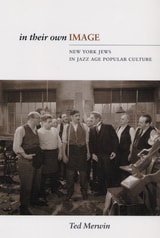
In Their Own Image
New York Jews in Jazz Age Popular CultureMerwin, Ted
Rutgers University Press, 2006
The Jazz Age of the 1920s is an era remembered for illegal liquor, innovative music and dance styles, and burgeoning ideas of social equality. It was also the period during which second-generation Jews began to emerge as a significant demographic in New York City. In TheirOwn Image examines thegrowing cultural visibility of Jewish life amid this vibrant scene.
From the vaudeville routines of Fanny Brice, Eddie Cantor, George Jessel, and Sophie Tucker, to the slew of Broadway comedies about Jewish life and the silent films that showed immigrant families struggling to leave the ghetto, images and representations of Jews became staples of interwar popular culture. Through the performing arts, Jews expressed highly ambivalent feelings about their identification with Jewish and American cultures. Ted Merwin shows how they became American by producing and consuming not images of another group, but images of themselves. As a result, they humanized Jewish stereotypes, softened anti-Semitic attitudes, and laid the groundwork for today’s Jewish comedians.
An entertaining look at the role popular culture plays in promoting the acculturation of an ethnic group, In Their Own Image enhances our understanding of American Jewish history and provides a model for the study of other groups and their integration into mainstream society.
In Time of War
Understanding American Public Opinion from World War II to IraqAdam J. Berinsky
University of Chicago Press, 2009
From World War II to the war in Iraq, periods of international conflict seem like unique moments in U.S. political history—but when it comes to public opinion, they are not. To make this groundbreaking revelation, In Time of War explodes conventional wisdom about American reactions to World War II, as well as the more recent conflicts in Korea, Vietnam, the Gulf, Afghanistan, and Iraq. Adam Berinsky argues that public response to these crises has been shaped less by their defining characteristics—such as what they cost in lives and resources—than by the same political interests and group affiliations that influence our ideas about domestic issues.
With the help of World War II–era survey data that had gone virtually untouched for the past sixty years, Berinsky begins by disproving the myth of “the good war” that Americans all fell in line to support after the Japanese bombed Pearl Harbor. The attack, he reveals, did not significantly alter public opinion but merely punctuated interventionist sentiment that had already risen in response to the ways that political leaders at home had framed the fighting abroad. Weaving his findings into the first general theory of the factors that shape American wartime opinion, Berinsky also sheds new light on our reactions to other crises. He shows, for example, that our attitudes toward restricted civil liberties during Vietnam and after 9/11 stemmed from the same kinds of judgments we make during times of peace.
With Iraq and Afghanistan now competing for attention with urgent issues within the United States, In Time of War offers a timely reminder of the full extent to which foreign and domestic politics profoundly influence—and ultimately illuminate—each other.
In Visible Archives
Queer and Feminist Visual Culture in the 1980sMargaret Galvan
University of Minnesota Press, 2023
Analyzing how 1980s visual culture provided a vital space for women artists to theorize and visualize their own bodies and sexualities
In 1982, the protests of antiporn feminists sparked the censorship of the Diary of a Conference on Sexuality, a radical and sexually evocative image-text volume whose silencing became a symbol for the irresolvable feminist sex wars. In Visible Archives documents the community networks that produced this resonant artifact and others, analyzing how visual culture provided a vital space for women artists to theorize and visualize their own bodies and sexualities.
Margaret Galvan explores a number of feminist and cultural touchstones—the feminist sex wars, the HIV/AIDS crisis, the women in print movement, and countercultural grassroots periodical networks—and examines how visual culture interacts with these pivotal moments. She goes deep into the records to bring together a decade’s worth of research in grassroots and university archives that include comics, collages, photographs, drawings, and other image-text media produced by women, including Hannah Alderfer, Beth Jaker, Marybeth Nelson, Roberta Gregory, Lee Marrs, Alison Bechdel, Gloria Anzaldúa, and Nan Goldin.
The art highlighted in In Visible Archives demonstrates how women represented their bodies and sexualities on their own terms and created visibility for new, diverse identities, thus serving as blueprints for future activism and advocacy—work that is urgent now more than ever as LGBTQ+ and women’s rights face challenges and restrictions across the nation.

In Washington but Not of It
The Prophetic Politics of Religious LobbyistsDaniel Hofrenning
Temple University Press, 1995
In a Classroom of Their Own
The Intersection of Race and Feminist Politics in All-Black Male SchoolsKeisha Lindsay
University of Illinois Press, 2018
Keisha Lindsay explains the complex politics of ABMSs by situating these schools within broader efforts at neoliberal education reform and within specific conversations about both "endangered” black males and a “boy crisis” in education. Lindsay also demonstrates that intersectionality, long considered feminist, is in fact a politically fluid framework. As such, it represents a potent tool for advancing many political agendas, including those of ABMSs supporters who champion antiracist education for black boys while obscuring black girls’ own race and gender-based oppression in school. Finally, Lindsay theorizes a particular means by which black men and other groups can form antiracist and feminist coalitions even when they make claims about their experiences that threaten bridge building. The way forward, Lindsay shows, allows disadvantaged groups to navigate the racial and gendered politics that divide them in pursuit of productive—and progressive—solutions.
Far-thinking and boldly argued, In a Classroom of Their Own explores the dilemmas faced by professionals and parents in search of equitable schooling for all students—black boys and otherwise.

In a Closet Hidden
The Life and Work of Mary E. Wilkins FreemanLeah Blatt Glasser
University of Massachusetts Press, 1996
The first literary biography of a much-neglected American writer, this book explores the multiple tensions at the core of Mary E. Wilkins Freeman's life and work. A prolific short story writer and novelist, Freeman (1852–1930) developed a reputation as a local colorist who depicted the peculiarities of her native New England. Yet as Leah Blatt Glasser shows, Freeman was one of the first American authors to write extensively about the relationships women form outside of marriage and motherhood, the role of work in women's lives, the complexity of women's sexuality, and the interior lives of women who rebel rather than conform to patriarchal strictures.
In a Closet Hidden traces Freeman's evolution as a writer, showing how her own inner conflicts repeatedly found expression in her art. As Glasser demonstrates, Freeman's work examined the competing claims of creativity and convention, self-fulfillment and self-sacrifice, spinsterhood and marriage, lesbianism and heterosexuality.

In a New Century
Essays on Queer History, Politics, and Community LifeJohn D’Emilio
University of Wisconsin Press, 2014
A pioneering scholar of gay history, John D’Emilio reflects in this wide-ranging collection of essays upon the social, cultural, and political changes provoked by LGBT activism. He offers provocative questions and historical analyses: What can we learn from a life-long activist like Bayard Rustin, who questioned the wisdom of “identity politics”? Was Richard Nixon a “gay liberationist”? How can knowing local stories—like those of Chicago in the 1950s, 1960s, and 1970s—help build stronger communities and enrich traditions of activism? Might the focus on achieving actually be evidence of growing conservatism in LGBT communities?
In a New Century provides a dynamic, thoughtful, and important resource for identifying changes that have occurred in the United States since 1960, taking stock of the work that still needs to be done, and issuing an urgent call to action for getting there.
Best Books for General Audiences, selected by the American Association of School Librarians
Best Special Interest Books, selected by the Public Library Reviewers

In a Pickle
A Family Farm StoryJerry Apps
University of Wisconsin Press, 2008
In and Out of This World
Material and Extraterrestrial Bodies in the Nation of IslamStephen C. Finley
Duke University Press, 2022

In the Arms of Saguaros
Iconography of the Giant CactusWilliam L. Bird Jr.
University of Arizona Press, 2023
In the Arms of the Saguaros shows how, from the botanical explorers of the nineteenth century to the tourism boosters in our own time, saguaros and their images have fulfilled attention-getting needs and expectations. Through text and lavish images, this work explores the saguaro’s growth into a western icon from the early days of the American railroad to the years bracketing World War II, when Sun Belt boosterism hit its zenith and proponents of tourism succeed in moving the saguaro to the center of the promotional frame.
This book explores how the growth of tourism brought the saguaro to ever-larger audiences through the proliferation of western-themed imagery on the American roadside. The history of the saguaro’s popular and highly imaginative range points to the current moment in which the saguaro touches us as a global icon in art, fashion, and entertainment.

In the Balance of Power
Independent Black Politics and Third-Party Movements in the United StatesOmar H. Ali
Ohio University Press, 2008
Historically, most black voters in the United States have aligned themselves with one of the two major parties: the Republican Party from the time of the Civil War to the New Deal and, since the New Deal—and especially since the height of the modern civil rights movement—the Democratic Party. However, as In the Balance of Power convincingly demonstrates, African Americans have long been part of independent political movements and have used third parties to advance some of the most important changes in the United States, notably the abolition of slavery, the extension of voting rights, and the enforcement of civil rights.
Since the early nineteenth century, there has been an undercurrent of political independence among African Americans. They helped develop the Liberty Party in the 1840s and have continued to work with third parties to challenge the policies of the two major parties. But despite the legal gains of the modern civil rights movement, elements of Jim Crow remain deeply embedded in our electoral process.
In the Balance of Power presents a history and analysis of African American third-party movements that can help us better understand the growing diversity among black voters today.
In the Balance of Power
Independent Black Politics and Third-Party Movements in the United StatesOmar H. Ali
Ohio University Press, 2020
REVISED AND EXPANDED EDITION
Reveals the multiple independent political tactics and strategies that African Americans have used to expand democracy and uphold civil and political rights since the founding of the nation.
This new edition of Ali’s groundbreaking narrative includes an epilogue by independent political analyst and leader Jacqueline Salit. New material addresses the historic presidencies of both Barack Obama and Donald Trump, as well as the rising tide of independent and anti-party sentiments.

In the Barrios
Latinos and the Underclass DebateJoan Moore
Russell Sage Foundation, 1993
In the Company of Books
Literature and Its "Classes" in Nineteenth-Century AmericaSarah Wadsworth
University of Massachusetts Press, 2006
With sections focusing on segmentation by age, gender, and cultural status, In the Company of Books analyzes the ways authors and publishers carved up the field of literary production into a multitude of distinct submarkets, differentiated their products, and targeted specific groups of readers in order to guide their book-buying decisions. Combining innovative approaches to canonical authors such as Nathaniel Hawthorne, Louisa May Alcott, Mark Twain, and Henry James with engaging investigations into the careers of many lesser-known literary figures, Sarah Wadsworth reveals how American writers responded to—and contributed to—this diverse, and diversified, market.
In the Company of Books contends that specialized editorial and marketing tactics, in concert with the narrative strategies of authors and the reading practices of the book-buying public, transformed the literary landscape, leading to new roles for the book in American culture, the innovation of literary genres, and new relationships between books and readers. Both an exploration of a fragmented print culture through the lens of nineteenth-century American literature and an analysis of nineteenth-century American literature from the perspective of this subdivided marketplace, this wide-ranging study offers fresh insight into the impact of market forces on the development of American literature.
In the Company of Generals
The World War I Diary of Pierpont L. StackpoleEdited & Intro by Robert H. Ferrell
University of Missouri Press, 2009
Pierpont Stackpole was a Boston lawyer who in January 1918 became aide to Lieutenant General Hunter Liggett, soon to be commander of the first American corps in France. Stackpole’s diary, published here for the first time, is a major eyewitness account of the American Expeditionary Forces’ experience on the Western Front, offering an insider’s view into the workings of Liggett’s commands, his day-to-day business, and how he orchestrated his commands in trying and confusing situations.
Hunter Liggett did not fit John J. Pershing’s concept of the trim and energetic officer, but Pershing entrusted to him a corps and then an army command. Liggett assumed leadership of the U.S. First Army in mid-October of 1918, and after reorganizing, reinforcing, and resting, the battle-weary troops broke through the German lines in a fourth attack at the Meuse-Argonne—accomplishing what Pershing had failed to do in three previous attempts. The victory paved the way to armistice on November 11.
Liggett has long been a shadowy figure in the development of the American high command. He was “Old Army,” a veteran of Indian wars who nevertheless kept abreast of changes in warfare and more than other American officers was ready for the novelties of 1914–1918. Because few of his papers have survived, the diary of his aide—who rode in the general’s staff car as Liggett unburdened himself about fellow generals and their sometimes abysmal tactical notions—provides especially valuable insights into command within the AEF.
Stackpole’s diary also sheds light on other figures of the war, presenting a different view of the controversial Major General Clarence Edwards than has recently been recorded and relating the general staff’s attitudes about the flamboyant aviation figure Billy Mitchell. General Liggett built the American army in France, and the best measure of his achievement is this diary of his aide. That record stands here as a fascinating and authentic look at the Great War.

In the Company of Grace
A Veterinarian's Memoir of Trauma and HealingJody Lulich
University of Minnesota Press, 2023
The son of a Black mother and white father overcomes family trauma to find the courage of compassion in veterinary practice
Rising to accept a prestigious award, Jody Lulich wondered what to say. Explain how he’d been attracted to veterinary medicine? Describe how caring for helpless, voiceless animals in his own shame and pain provided a lifeline, a chance to heal himself as well? Lulich tells his story in In the Company of Grace, a memoir about finding courage in compassion and strength in healing—and power in finally confronting the darkness of his youth.
Lulich’s white father and Black mother met at a civil rights rally, but love was no defense against their personal demons. His mother’s suicide, in his presence when he was nine years old, and his sometimes brutal father’s subsequent withdrawal set Lulich on a course from the South Side of Chicago to the Tuskegee School of Veterinary Medicine in Alabama to an endowed chair at the University of Minnesota, forever searching for the approval and affection that success could not deliver. Though shadowed by troubling secrets, his memoir also features scenes of surprising light and promise—of the neighbors who take him in, a brother’s unlikely effort to save Christmas, his mother’s memories of the family’s charmed early days, bright moments (and many curious details) of veterinary practice. Most consequentially, at Tuskegee Lulich rents a room in the home of a seventy-five-year-old Black woman named Grace, whose wholehearted adoption of him—and her own stories of the Jim Crow era—finally gives him a sense of belonging and possibility.
Completing his book amid the furor over George Floyd’s murder, Lulich reflects on all the ways that race has shaped his life. In the Company of Grace is a moving testament to the power of compassion in the face of seemingly overwhelming circumstances.

In the Company of Radical Women Writers
Rosemary Hennessy
University of Minnesota Press, 2023
Recovering the bold voices and audacious lives of women who confronted capitalist society’s failures and injustices in the 1930s—a decade unnervingly similar to our own
In the Company of Radical Women Writers rediscovers the political commitments and passionate advocacy of seven writers—Black, Jewish, and white—who as young women turned to communism around the Great Depression and, over decades of national crisis, spoke to issues of labor, land, and love in ways that provide urgent, thought-provoking guidance for today. Rosemary Hennessy spotlights the courageous lives of women who confronted similar challenges to those we still face: exhausting and unfair labor practices, unrelenting racial injustice, and environmental devastation.
As Hennessy brilliantly shows, the documentary journalism and creative and biographical writings of Marvel Cooke, Louise Thompson Patterson, Claudia Jones, Alice Childress, Josephine Herbst, Meridel Le Sueur, and Muriel Rukeyser recognized that life is sustained across a web of dependencies that we each have a duty to maintain. Their work brought into sharp focus the value and dignity of Black women’s domestic work, confronted the destructive myths of land exploitation and white supremacy, and explored ways of knowing attuned to a life-giving erotic energy that spans bodies and relations. In doing so, they also expanded the scope of American communism.
By tracing the attention these seven women pay to “life-making” as the relations supporting survival and wellbeing—from Harlem to the American South and Midwest—In the Company of Radical Women Writers reveals their groundbreaking reconceptions of the political and provides bracing inspiration in the ongoing fight for justice.
In the Company of Scholars
The Struggle for the Soul of Higher EducationBy Julius G. Getman
University of Texas Press, 1992
"I began this book to articulate my sense of disappointment and alienation from the status I had fought so hard to achieve." A remarkable admission from an alumnus of Harvard Law School who has held tenured professorships in the law schools of Yale and Stanford and has taught in the law schools of Harvard and Chicago.
In this personal reflection on the status of higher education, Julius Getman probes the tensions between status and meaning, elitism and egalitarianism, that challenge the academy and academics today. He shows how higher education creates a shared intellectual community among people of varied races and classes—while simultaneously dividing people on the basis of education and status.
In the course of his explorations, Getman touches on many of the most current issues in higher education today, including the conflict between teaching and research, challenges to academic freedom, the struggle over multiculturalism, and the impact of minority and feminist activism. Getman presents these issues through relevant, often humorous anecdotes, using his own and others' experiences in coping with the constantly changing academic landscape.
Written from a liberal perspective, the book offers another side of the story told in such works as Allan Bloom's The Closing of the American Mind and Roger Kimball's Tenured Radicals.

In the Days of Victorio
Recollections of a Warm Springs ApacheEve Ball; Narrated by James Kaywaykla
University of Arizona Press, 1970
"This volume contains a great deal of interesting information."—Journal of the West
"The Apache point of view [is] presented with great clarity."—Books of the Southwest
"A valuable addition to the southwestern frontier shelf and long will be drawn upon and used."—Journal of Arizona History
"A genuine contribution to the story of the Apache wars, and a very readable book as well."—Westerners Brand Book
"Shining through every page is the unquenchable spirit that was the Apache. Inured, indeed trained, to suffering, Apaches stood strong beside Victorio, Nana, and finally Geronimo in a vain attempt to maintain those things they held more dear than life itself—freedom, homeland, dignity as human beings. A warm and vital people, the Apaches had, and have, a great deal to offer."—Arizona and the West

In the Desert of Desire
Las Vegas and the Culture of SpectacleWilliam L. Fox
University of Nevada Press, 2007
Las Vegas, says William Fox, is a pay-as-you-play paradise that succeeds in satisfying our fantasies of wealth and the excesses of pleasure and consumption that go with it. In this context, Fox examines how Las Vegas’s culture of spectacle has obscured the boundaries between high art and entertainment extravaganza, nature and fantasy, for-profit and nonprofit enterprises. His purview ranges from casino art galleries—including Steve Wynn’s private collection and a branch of the famed Guggenheim Museum—to the underfunded Las Vegas Art Museum; from spectacular casino animal collections like those of magicians Siegfried and Roy and Mandalay Bay’s Shark Reef exhibit to the city’s lack of support for a viable public zoo; from the environmental and psychological impact of lavish water displays in the arid desert to the artistic ambiguities intrinsic to Las Vegas’s floating world of showgirls, lapdancers, and ballet divas. That Las Vegas represents one of the world’s most opulent displays of private material wealth in all its forms, while providing miserly funding for local public amenities like museums and zoos, is no accident, Fox maintains. Nor is it unintentional that the city’s most important collections of art and exotic fauna are presented in the context of casino entertainment, part of the feast of sensation and excitement that seduces millions of visitors each year. Instead, this phenomenon shows how our insatiable modern appetite for extravagance and spectacle has diminished the power of unembellished nature and the arts to teach and inspire us, and demonstrates the way our society privileges private benefit over public good. Given that Las Vegas has been a harbinger of national cultural trends, Fox’s commentary offers prescient insight into the increasing commercialization of nature and culture across America.

In the Evil Day
Violence Comes to One Small TownRichard Adams Carey
University Press of New England, 2015
In the Footsteps of Lewis and Clark
Early Commemorations and the Origins of the National Historic TrailWallace G. Lewis
University Press of Colorado, 2024
The first significant stirrings of national public interest in Lewis and Clark coincided with the beginning of a nationwide fascination with transcontinental automobile touring. Americans began to reconnect with the past and interact with the history of Western expansion by becoming a new breed of "frontier explorer" via their cars. As a result, early emphasis on local plaques and monuments yielded to pageants, reenactments, and, ultimately, attempts to retrace the route, promoting conservation and recreation along its length.
Wallace G. Lewis details the ingenuity that inspired the establishment of the Lewis and Clark National Historic Trail, opening a window to how America reimagines, recreates, and remembers its own past. In the Footsteps of Lewis and Clark will appeal to both scholarly and armchair historians interested in the Western frontier as experienced by both Lewis and Clark and those retracing their steps today.